
Impact Assessment of US/Israel-Iran Conflict
Impact Assessment of US/Israel-Iran Conflict
- US President Donald Trump stated that Washington was engaged in productive discussions with Tehran and would not launch an attack on Iran before the 3rd Nov’26 midterm elections, easing immediate concerns over further military escalation.
- Oil movements through the Strait of Hormuz declined by approximately 27% from their wartime weekly peak to 10.1 MBpd, equivalent to around 74% of pre-war levels, with only seven commodity vessels crossing on 06th Oct’26 , the lowest number since 23rd Jul’26. Meanwhile, exports through alternative routes via the Gulf of Oman and the Red Sea increased to approximately 6.7 MBpd, partially offsetting the decline in Hormuz shipments.
- On 8th Oct’26, the chemical tanker Acers was struck by multiple projectiles approximately 51 nautical miles north of Madinat ash Shamal, Qatar, injuring crew members and raising concerns over maritime security and the safety of oil and energy shipments across the Persian Gulf.
- Iran threatened to block unauthorised oil shipping routes through the Strait of Hormuz amid intensifying tanker attacks, with vessel traffic falling to its lowest level in more than two months. The escalating maritime security risks are disrupting crude transportation and increasing uncertainty over the reliability of Middle Eastern oil exports.
- The US imposed new sanctions targeting 17 vessels, along with individuals and networks involved in transporting Iranian crude oil, petroleum products and petrochemicals, aiming to restrict Iran’s oil revenues and further constrain its crude-export channels.
- US President Donald Trump stated that Washington was engaged in productive discussions with Tehran and would not launch an attack on Iran before the 3rd Nov’26 midterm elections, easing immediate concerns over further military escalation.
- Hurricane related disruptions forced the shutdown of approximately 1.3 MBpd of US Gulf of Mexico crude production, equivalent to 62.9% of regional output, as Shell, Chevron and BP suspended operations at offshore facilities. The production losses could persist until weather conditions improve and safety inspections are completed, potentially tightening US crude supply in the near term.
- Chinese refiners are set to resume gasoline, diesel and jet fuel exports following a temporary suspension during the Golden Week holiday, with authorities approving approximately 3.7 mln tons of combined exports for Oct’26. The resumption is expected to improve regional fuel availability and ease supply tightness across Asian markets.
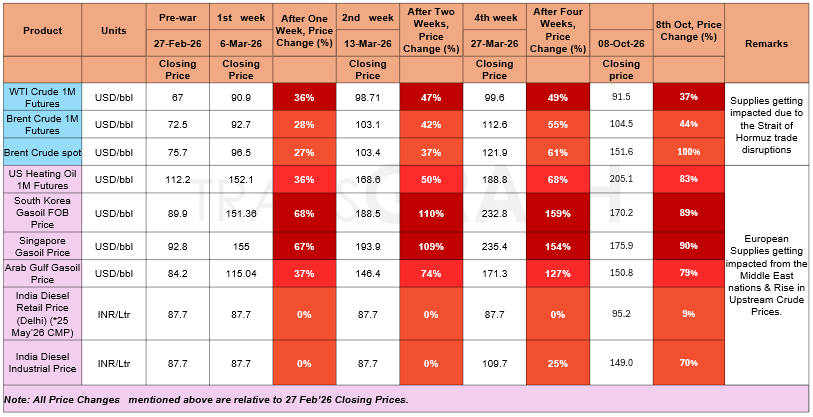
War Impact on Crude Oil & Gasoil/Diesel Prices
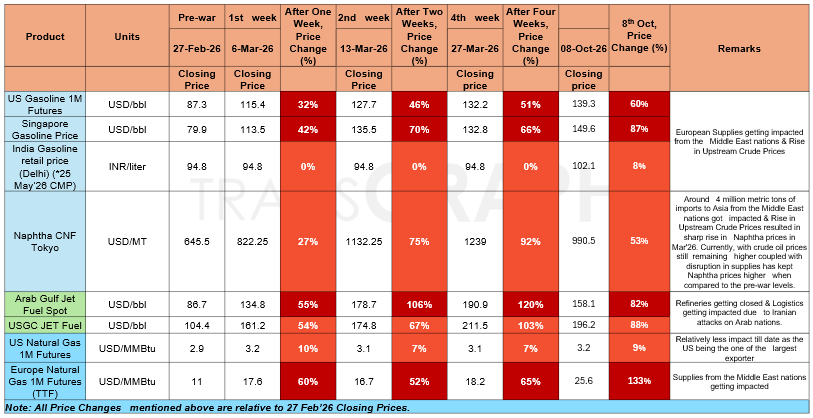
War Impact on Gasoline, ATF & Natural Gas Prices
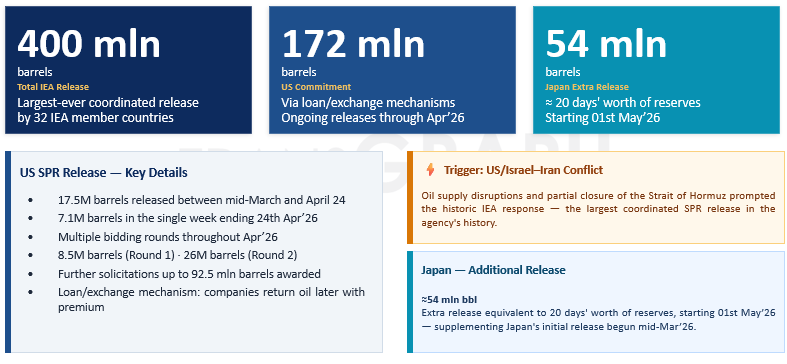
GCC Bypass Pipelines Running Near Capacity — But Shah Gas Field Ablaze and Fujairah Zone Struck
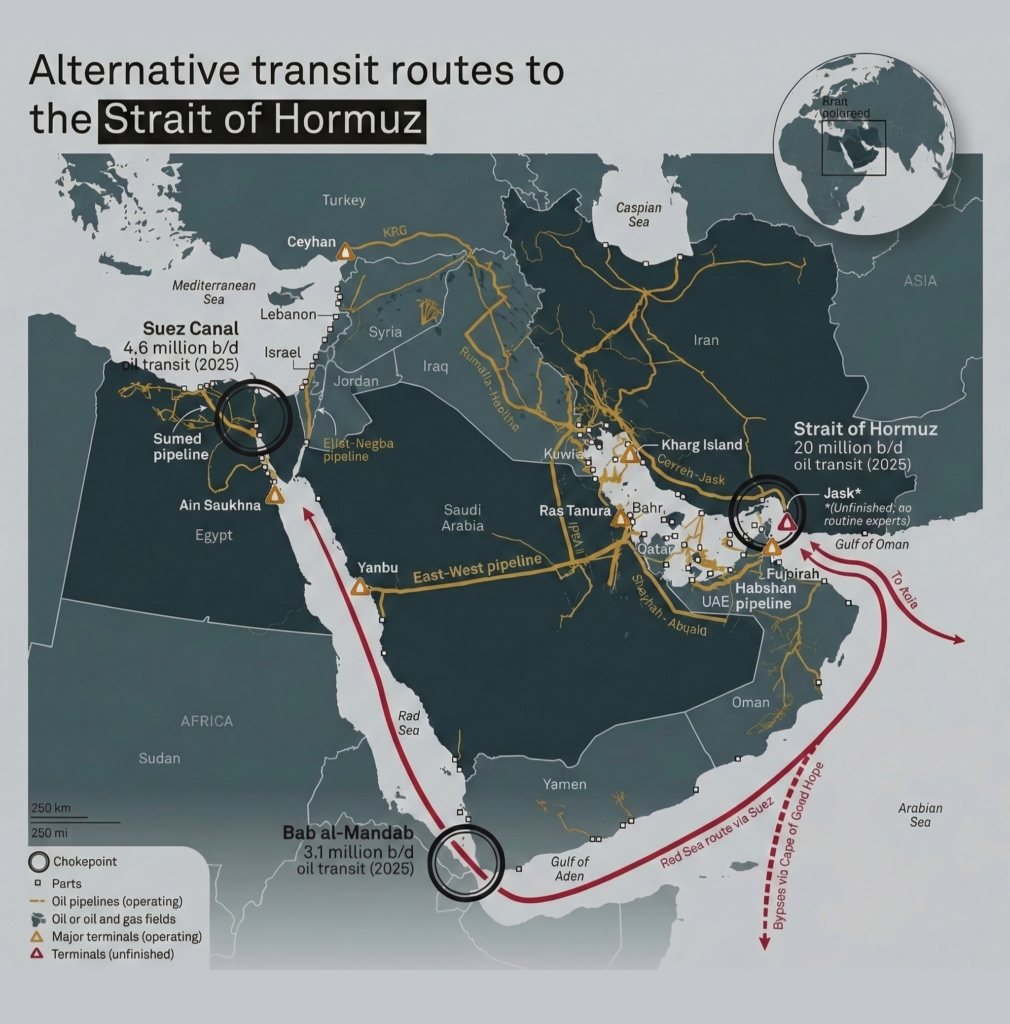
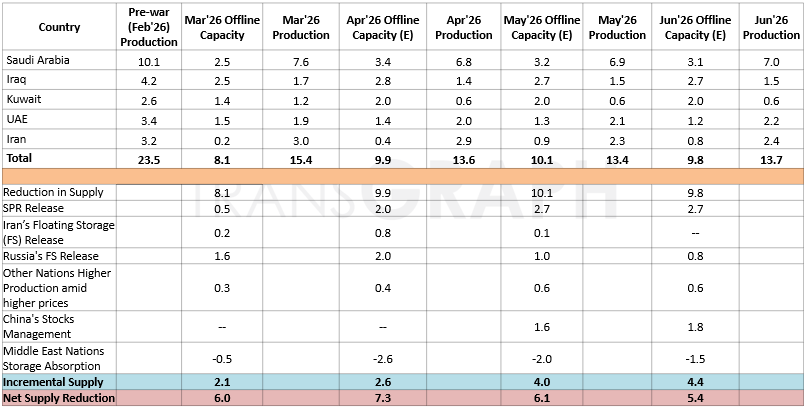
- Saudi Arabia's East-West pipeline is pumping oil at its full capacity of 7 MBpd, bypassing the Strait of Hormuz. Crude oil exports from Yanbu port have reached 5 MBpd, and the country is also exporting 0.70 to 0.90 MBpd of oil products.
- Of approximately 15 MBpd of crude transiting the Strait of Hormuz in OND'25, combined SPR releases and bypass pipeline capacity can offset roughly two-thirds — or slightly more — for the next 20 to 30 days, providing the Trump administration a window to assess strategic direction.
- New strikes directly threaten this buffer — Iranian drones struck the UAE's Shah gas field (currently ablaze) and the Fujairah Oil Industry Zone on Mar 17. A tanker was also hit near the Strait of Hormuz. Saudi Arabia intercepted over a dozen drones; Kuwait and Bahrain sustained additional attacks. These represent the first direct strikes on GCC energy export infrastructure since the conflict began.
War Scenarios Point to Global Supply Deficit of 0.92–1.07 MBpd in 2026 and AMJ Quarter Most Severe with a deficit of 4.10 MBpd.
Pre-war, global supply and demand were near-balanced with a modest surplus of +0.55 MBpd projected for 2026. Both conflict scenarios introduce significant supply deficits driven by Strait of Hormuz disruptions and impacts on Iraq and Kuwait crude production.
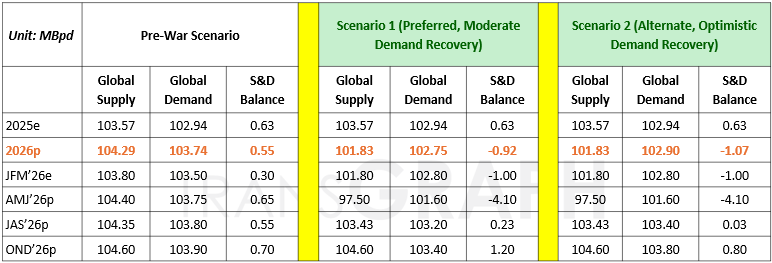
- Scenario 1 (Preferred): Ceasefire talks continue to progress positively, with tanker flows through the Strait of Hormuz gradually normalizing over the next 4–5 weeks. Supply recovers steadily, while demand improves at a slower pace and remains below pre-war expectations, resulting in a moderate market surplus.
- Scenario 2 (Alternate): The Strait of Hormuz normalizes over the next 4–5 weeks, supporting a gradual recovery in oil exports and supply. Demand rebounds more strongly than in Scenario 1, reducing the market surplus, although overall consumption remains below pre-war levels.
Geopolitical backdrop:

War Front: Yemen Escalation Raises Red Sea and Gulf Shipping Risks - Yemen fighting has intensified as Saudi-backed forces advance near the Bab el-Mandeb Strait, while Houthi attacks on Saudi infrastructure and continued tanker incidents around the Strait of Hormuz keep Gulf shipping risks elevated. At the same time, the U.S. is expanding its military presence in the Gulf, including an additional carrier and around 10,000 sailors and Marines, while diplomacy with Iran remains stalled.
US central bank viewed inflation as the biggest risk to their outlook, with most participants assessed that another increase in the fed funds target range would likely be appropriate by year end. This led to a higher Treasury yields ,strengthening the dollar’s interest rate differentials. However, September nonfarm payrolls increased by only 29K, well below expectations, adding to expectations that the Fed may have less scope for October Fed rate hike, along with dovish comments from New York Fed President John Williams, further limited the dollar’s upside.
Steel:
- Steel supply chains remain largely insulated from the Middle East conflict.
- Moreover, HRC prices are up by 2.1% on a monthly basis due to raw material price surge and stronger demand from auto sector.
Base metals:
- LME 3M copper are up by just 0.2% on a weekly basis as support from weaker job data, reduced rate hike expectations, several supply disruptions in Chile (Escondida, Radomiro Tomic, and Centinela), backwardation structure, and drawdown in SHFE inventory was capped by progress in Grasberg repairs and geopolitical tensions.
- Aluminum prices are down 3.2% due to gradual recovery from GCC and stronger dollar despite tensions in the middle east.
Precious metals:
- Stronger U.S. yields and weak industrial offtake are suppressing any upside momentum.
- Stronger US Dollar and geopolitical tensions are weighing on precious metal prices.
LPG Market Update
- For October, Saudi Aramco CP was set at USD 680/ton for propane and USD 730/ton for butane, representing increases of USD 55/ton and USD 70/ton, respectively, from September levels. The propane-butane spread widened further to USD 50/ton, compared with USD 35/ton in September and USD 20/ton in August, indicating continued relative strength in butane pricing and tighter butane availability compared with propane. The larger month-on-month increase in butane also points to a stronger rise in butane market tightness entering October.
- Sonatrach increased its October propane OSP by USD 110/ton, from USD 560/ton in September to USD 670/ton. Meanwhile, the butane OSP increased by USD 140/ton, from USD 610/ton to USD 750/ton.
- US LPG prices strengthened across the board between 1 October and 8 October 2026, with propane rising by 8.6% to USD 466/ton from USD 429/ton. Butane increased by 7.6% to USD 738/ton from USD 686/ton, while the 50:50 LPG blend climbed by 8.0% to USD 601.77/ton from USD 557.28/ton. Notably, the Mont Belvieu 50:50 LPG blend crossed the USD 600/ton threshold for the first time since 2022, underscoring the strength of the current price rally. The simultaneous increase in propane and butane indicates broad-based upward pressure across the US LPG market rather than a rally driven by a single component.
Impact Assessment of US/Israel-Iran Conflict
- Saudi Arabia’s East-West Pipeline continued to restore crude export capacity, with the Energy Minister stating on 6th Oct’26 that cumulative crude volumes pumped through the pipeline to Yanbu had reached 5.8 mln bbl. The pipeline, which can transport around 4 MBpd, is being used as an alternative export route to the Strait of Hormuz amid ongoing regional disruptions.
- Saudi crude exports drove the recovery in Gulf flows in Sep’26, with Saudi shipments rising by 4.2 MBpd MoM to 6.6 MBpd, while overall Gulf flows excluding Iran recovered to more than 81% of pre-war levels.
- Iranian crude exports fell to zero in Sep’26 as the US blockade severely restricted outbound shipments, while floating Iranian crude inventories outside the blockade zone declined to around 45 mln bbl from approximately 100 mln bbl in late Jul’26, further tightening Iran’s export availability.
- Iraq’s 2027 draft budget assumes crude exports of around 4 MBpd, including Kurdistan volumes, while Baghdad is exploring alternative transportation routes because of disruption to Gulf shipments.
- According to the market grapevine ,US crude production is expected to reach a record high of 14.3 MBpd in 2027 amid rapidly declining global inventories and tight diesel markets linked to the Iran conflict.
- A developing storm was forecasted to become the first Atlantic hurricane of 2026, with offshore areas in its projected path accounting for around 15% of US crude production. The storm could also disrupt Gulf Coast refineries, which represent roughly 50% of US refining capacity, posing risks to both crude production and refining operations.
- Chinese independent refiners increased purchases of Iraqi Basrah Medium/Heavy crude and Qatar Al-Shaheen crude, securing at least 12 mln bbl for Oct’26–Nov’26 delivery, with total purchases estimated at 15–20 mln bbl, as Iranian crude imports fell to 0.59 MBpd in Sep’26, the lowest level since January 2023 which is prompting refiners to seek alternative supplies.
- Petrobras announced a new oil discovery off Brazil’s Amapá state on 2nd Oct’26 in ultra deep waters in the Equatorial Margin, an area considered one of the country’s most promising new oil frontiers.
- Venezuela’s 0.31 MBpd Cardón refinery was shut after a fire, highlighting the country’s paradox of rising crude exports but severely constrained domestic refining capacity and increasing reliance on imported fuel.
War Impact on Crude Oil & Gasoil/Diesel Prices
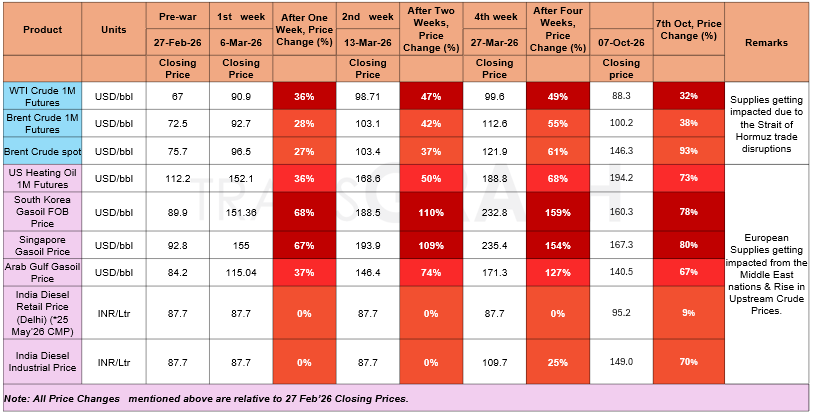
War Impact on Gasoline, ATF & Natural Gas Prices
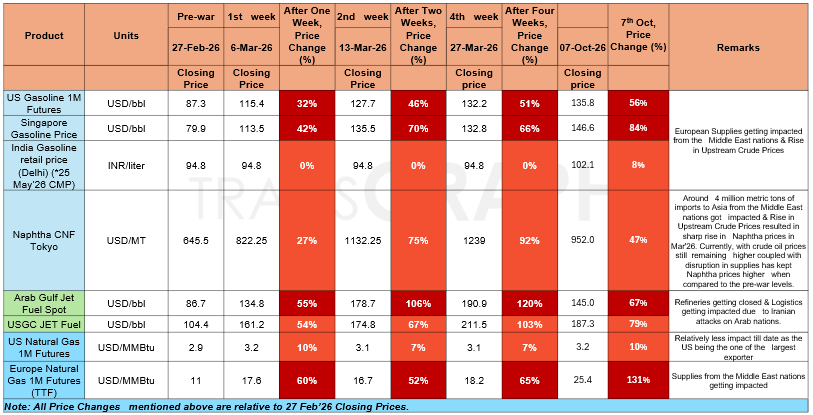
GCC Bypass Pipelines Running Near Capacity — But Shah Gas Field Ablaze and Fujairah Zone Struck
- Saudi Arabia's East-West pipeline is pumping oil at its full capacity of 7 MBpd, bypassing the Strait of Hormuz. Crude oil exports from Yanbu port have reached 5 MBpd, and the country is also exporting 0.70 to 0.90 MBpd of oil products.
- Of approximately 15 MBpd of crude transiting the Strait of Hormuz in OND'25, combined SPR releases and bypass pipeline capacity can offset roughly two-thirds — or slightly more — for the next 20 to 30 days, providing the Trump administration a window to assess strategic direction.
- New strikes directly threaten this buffer — Iranian drones struck the UAE's Shah gas field (currently ablaze) and the Fujairah Oil Industry Zone on Mar 17. A tanker was also hit near the Strait of Hormuz. Saudi Arabia intercepted over a dozen drones; Kuwait and Bahrain sustained additional attacks. These represent the first direct strikes on GCC energy export infrastructure since the conflict began.
War Scenarios Point to Global Supply Deficit of 0.92–1.07 MBpd in 2026 and AMJ Quarter Most Severe with a deficit of 4.10 MBpd.
Pre-war, global supply and demand were near-balanced with a modest surplus of +0.55 MBpd projected for 2026. Both conflict scenarios introduce significant supply deficits driven by Strait of Hormuz disruptions and impacts on Iraq and Kuwait crude production.
- Scenario 1 (Preferred): Ceasefire talks continue to progress positively, with tanker flows through the Strait of Hormuz gradually normalizing over the next 4–5 weeks. Supply recovers steadily, while demand improves at a slower pace and remains below pre-war expectations, resulting in a moderate market surplus.
- Scenario 2 (Alternate): The Strait of Hormuz normalizes over the next 4–5 weeks, supporting a gradual recovery in oil exports and supply. Demand rebounds more strongly than in Scenario 1, reducing the market surplus, although overall consumption remains below pre-war levels.
Geopolitical backdrop:
War Front: Yemen Escalation Raises Red Sea and Gulf Shipping Risks - Yemen fighting has intensified as Saudi-backed forces advance near the Bab el-Mandeb Strait, while Houthi attacks on Saudi infrastructure and continued tanker incidents around the Strait of Hormuz keep Gulf shipping risks elevated. At the same time, the U.S. is expanding its military presence in the Gulf, including an additional carrier and around 10,000 sailors and Marines, while diplomacy with Iran remains stalled.
US central bank viewed inflation as the biggest risk to their outlook, with most participants assessed that another increase in the fed funds target range would likely be appropriate by year end. This led to a higher Treasury yields ,strengthening the dollar’s interest rate differentials. However, September nonfarm payrolls increased by only 29K, well below expectations, adding to expectations that the Fed may have less scope for October Fed rate hike, along with dovish comments from New York Fed President John Williams, further limited the dollar’s upside.
Steel:
- Steel supply chains remain largely insulated from the Middle East conflict.
- Moreover, HRC prices are up by 2.1% on a monthly basis due to raw material price surge and stronger demand from auto sector.
Base metals:
- LME 3M copper are up by just 0.2% on a weekly basis as support from weaker job data, reduced rate hike expectations, several supply disruptions in Chile (Escondida, Radomiro Tomic, and Centinela), backwardation structure, and drawdown in SHFE inventory was capped by progress in Grasberg repairs and geopolitical tensions.
- Aluminum prices are down 3.2% due to gradual recovery from GCC and stronger dollar despite tensions in the middle east.
Precious metals:
- Stronger U.S. yields and weak industrial offtake are suppressing any upside momentum.
- Stronger US Dollar and geopolitical tensions are weighing on precious metal prices.
LPG Market Update
- For August 2026, Saudi Aramco Contract Prices (CPs) rebounded to USD 620/ton for propane and USD 640/ton for butane, compared with USD 580/ton and USD 600/ton, respectively, in July. This represents a 6.9% month-on-month increase in propane CPs and a 6.7% month-on-month increase in butane CPs.
- Sonatrach raised its August propane OSP by 4.2% m-o-m, from $518/ton to $540/ton, while the butane OSP was cut by 5.0%, from $600/ton to $570/ton.
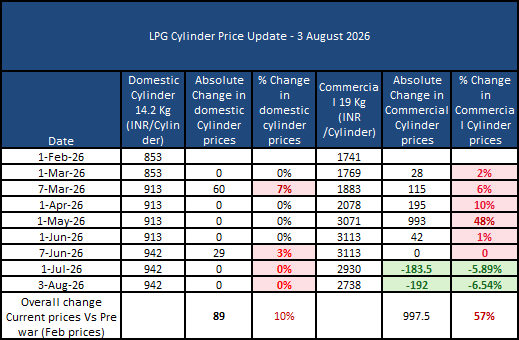
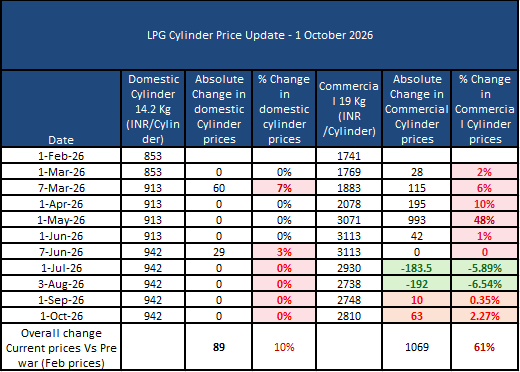
- India’s commercial LPG prices eased further in August, with the 19 kg cylinder price in New Delhi declining by ₹192, from ₹2,930 in July to ₹2,738 as of 3 August 2026. Despite the recent correction, commercial LPG remains substantially above its pre-war level of ₹1,741/cylinder. In contrast, the 14.2 kg domestic LPG cylinder remained unchanged at ₹942, reflecting continued price stability for household consumers.
Impact Assessment of US/Israel-Iran Conflict
- Saudi Arabia’s East-West Pipeline continued to restore crude export capacity, with the Energy Minister stating on 6th Oct’26 that cumulative crude volumes pumped through the pipeline to Yanbu had reached 5.8 mln bbl. The pipeline, which can transport around 4 MBpd, is being used as an alternative export route to the Strait of Hormuz amid ongoing regional disruptions.
- Saudi crude exports drove the recovery in Gulf flows in Sep’26, with Saudi shipments rising by 4.2 MBpd MoM to 6.6 MBpd, while overall Gulf flows excluding Iran recovered to more than 81% of pre-war levels.
- Iranian crude exports fell to zero in Sep’26 as the US blockade severely restricted outbound shipments, while floating Iranian crude inventories outside the blockade zone declined to around 45 mln bbl from approximately 100 mln bbl in late Jul’26, further tightening Iran’s export availability.
- Iraq’s 2027 draft budget assumes crude exports of around 4 MBpd, including Kurdistan volumes, while Baghdad is exploring alternative transportation routes because of disruption to Gulf shipments.
- According to the market grapevine ,US crude production is expected to reach a record high of 14.3 MBpd in 2027 amid rapidly declining global inventories and tight diesel markets linked to the Iran conflict.
- A developing storm was forecasted to become the first Atlantic hurricane of 2026, with offshore areas in its projected path accounting for around 15% of US crude production. The storm could also disrupt Gulf Coast refineries, which represent roughly 50% of US refining capacity, posing risks to both crude production and refining operations.
- Chinese independent refiners increased purchases of Iraqi Basrah Medium/Heavy crude and Qatar Al-Shaheen crude, securing at least 12 mln bbl for Oct’26–Nov’26 delivery, with total purchases estimated at 15–20 mln bbl, as Iranian crude imports fell to 0.59 MBpd in Sep’26, the lowest level since January 2023 which is prompting refiners to seek alternative supplies.
- Petrobras announced a new oil discovery off Brazil’s Amapá state on 2nd Oct’26 in ultra deep waters in the Equatorial Margin, an area considered one of the country’s most promising new oil frontiers.
- Venezuela’s 0.31 MBpd Cardón refinery was shut after a fire, highlighting the country’s paradox of rising crude exports but severely constrained domestic refining capacity and increasing reliance on imported fuel.
War Impact on Crude Oil & Gasoil/Diesel Prices
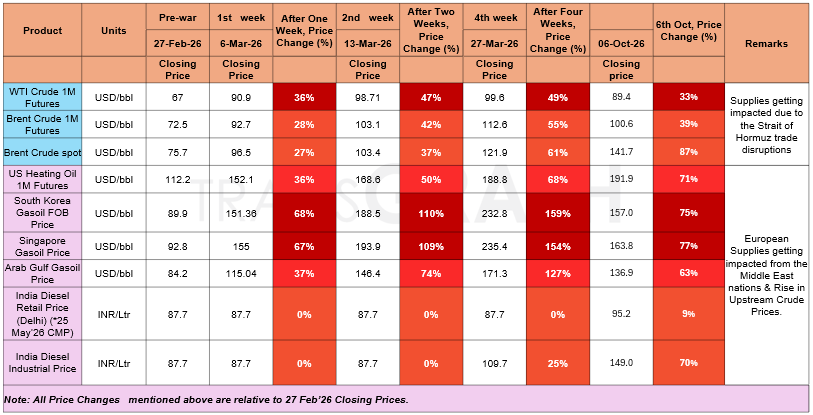
War Impact on Gasoline, ATF & Natural Gas Prices
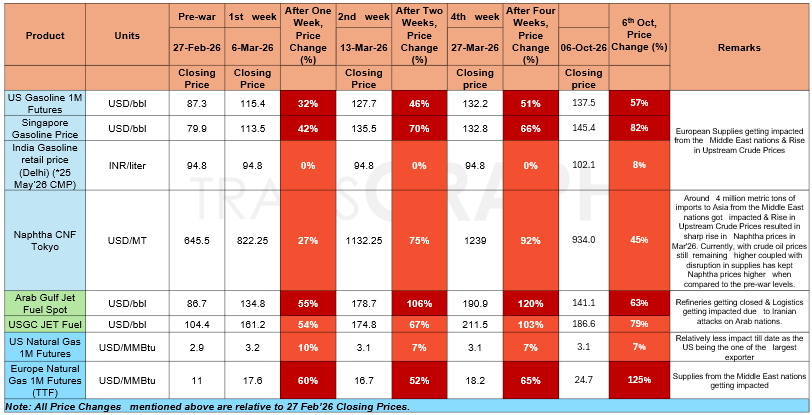
GCC Bypass Pipelines Running Near Capacity — But Shah Gas Field Ablaze and Fujairah Zone Struck
- Saudi Arabia's East-West pipeline is pumping oil at its full capacity of 7 MBpd, bypassing the Strait of Hormuz. Crude oil exports from Yanbu port have reached 5 MBpd, and the country is also exporting 0.70 to 0.90 MBpd of oil products.
- Of approximately 15 MBpd of crude transiting the Strait of Hormuz in OND'25, combined SPR releases and bypass pipeline capacity can offset roughly two-thirds — or slightly more — for the next 20 to 30 days, providing the Trump administration a window to assess strategic direction.
- New strikes directly threaten this buffer — Iranian drones struck the UAE's Shah gas field (currently ablaze) and the Fujairah Oil Industry Zone on Mar 17. A tanker was also hit near the Strait of Hormuz. Saudi Arabia intercepted over a dozen drones; Kuwait and Bahrain sustained additional attacks. These represent the first direct strikes on GCC energy export infrastructure since the conflict began.
War Scenarios Point to Global Supply Deficit of 0.92–1.07 MBpd in 2026 and AMJ Quarter Most Severe with a deficit of 4.10 MBpd.
Pre-war, global supply and demand were near-balanced with a modest surplus of +0.55 MBpd projected for 2026. Both conflict scenarios introduce significant supply deficits driven by Strait of Hormuz disruptions and impacts on Iraq and Kuwait crude production.
- Scenario 1 (Preferred): Ceasefire talks continue to progress positively, with tanker flows through the Strait of Hormuz gradually normalizing over the next 4–5 weeks. Supply recovers steadily, while demand improves at a slower pace and remains below pre-war expectations, resulting in a moderate market surplus.
- Scenario 2 (Alternate): The Strait of Hormuz normalizes over the next 4–5 weeks, supporting a gradual recovery in oil exports and supply. Demand rebounds more strongly than in Scenario 1, reducing the market surplus, although overall consumption remains below pre-war levels.
Geopolitical backdrop:

War Front: President Trump has indicated that US has rejected the latest peace deal. Fears of fresh attacks have risen amid breakdown in negotiations weighing on base metals. US President Donald Trump has rejected a news report claiming his administration offered Iran sanctions relief and access to frozen funds, calling the story a hoax on social media. Iranian Foreign Minister Abbas Araghchi says Tehran has held further indirect talks with the United States through Qatari mediators in New York, with Washington’s formal response expected by Tuesday.
The United States and China have agreed to reduce tariffs on $30 billion of goods and launch a dialogue on AI, both countries said following President Xi Jinping's visit to Washington. The tariff reductions would apply to US exports such as agricultural goods, wood and cosmetics, as well as US imports including small appliances, toys, decorations, a White House statement said on Friday.
Recently New York Fed President John Williams said there was “no urgency” to raise rates again. This reduced expectations of an immediate/October Fed hike: Saudi Arabia restarted flows through its East-West pipeline after repairs following drone attacks. September crude exports from Middle Eastern producers reached about 16.3 million barrels/day. The US offered to loan up to 40 million barrels from its Strategic Petroleum Reserve. This adds another potential source of crude supply and therefore put downward pressure on prices. These factors eased near-term supply concerns, reducing inflation pressure.
Steel:
- Steel supply chains remain largely insulated from the Middle East conflict.
- Moreover, HRC prices are up by 3.2% on a monthly basis due to raw material price surge and stronger demand from auto sector.
Base metals:
- LME 3M copper are down 2.6% on a weekly basis as mid autumn festival slowed China consumption. Further, rejection of peace deal by US and stronger dollar is weighing on metals. However, backwardation structure, reduced rate hike expectations, and supply disruptions will provide some support.
- Aluminum prices are down 4.4% due to gradual recovery from GCC and stronger dollar despite tensions in the middle east.
Precious metals:
- Stronger U.S. yields and weak industrial offtake are suppressing any upside momentum.
- Stronger US Dollar and geopolitical tensions are weighing on precious metal prices.
LPG Market Update
- For August 2026, Saudi Aramco Contract Prices (CPs) rebounded to USD 620/ton for propane and USD 640/ton for butane, compared with USD 580/ton and USD 600/ton, respectively, in July. This represents a 6.9% month-on-month increase in propane CPs and a 6.7% month-on-month increase in butane CPs.
- Sonatrach raised its August propane OSP by 4.2% m-o-m, from $518/ton to $540/ton, while the butane OSP was cut by 5.0%, from $600/ton to $570/ton.
- India’s commercial LPG prices eased further in August, with the 19 kg cylinder price in New Delhi declining by ₹192, from ₹2,930 in July to ₹2,738 as of 3 August 2026. Despite the recent correction, commercial LPG remains substantially above its pre-war level of ₹1,741/cylinder. In contrast, the 14.2 kg domestic LPG cylinder remained unchanged at ₹942, reflecting continued price stability for household consumers.
Impact Assessment of US/Israel-Iran Conflict
- Gulf oil flows excluding Iran recovered to 19.2 MBpd in Sep’26, or 81% of the pre-war level of 23.6 MBpd, driven mainly by Saudi Arabia, whose crude and condensate exports surged 4.2 MBpd MoM to 6.6 MBpd.
- Crude and condensate exports recovered to 91% of pre-war levels, while refined fuel and LPG exports remained at just 60%, with Iranian exports falling to zero and combined Gulf crude and condensate exports rising to 14.7 MBpd from 10.8 MBpd in Aug’26.
- Saudi Arabia faced renewed attacks on its energy infrastructure, with Yemen’s Iran backed Houthis claiming missile and drone strikes on Saudi Aramco facilities in Riyadh and the Khurais area on 5th Oct’26.
- From 28th Sep’26 onward,at least seven tanker incidents were reported around the Strait of Hormuz , including the 1st Oct’26 projectile strike on the 2 mln bbl Kuwaiti crude carrier Kazimah III, keeping regional crude flows and shipping exposed to elevated security risks.
- Iraq transported around 2 mln bbl of crude through the Strait of Hormuz on 3rd Oct’26, marking the first such operation by the country’s state owned Oil Tanker Company in decades. The shipment provides Iraq’s state oil marketer SOMO with greater flexibility in crude sales and demonstrates that Iraqi barrels can still transit the Strait despite ongoing shipping disruptions.
- OPEC+ agreed to keep its Nov’26 oil production targets unchanged at its 4th Oct’26 meeting, with output from the seven core members rising by 0.63 MBpd MoM to around 25 MBpd in Aug’26 but remaining roughly 5 MBpd below the Feb’26 pre war level. Meanwhile, around 2 MBpd of production cuts remain in place, while Gulf producers continue to operate below their quotas due to export disruptions.
- G7 countries agreed to release 100 mln bbl of crude and diesel from emergency reserves over four months, with a substantial portion of the diesel volumes expected to be released within the first 20 days, while G7 members also committed to avoiding energy export restrictions.
- Vietnam’s Nghi Son refinery has secured sufficient crude supplies to operate at around 125% of its 0.2 MBpd design capacity through Nov’26, with about 75% of its new crude cargoes sourced from Kuwait. The refinery has diversified its feedstock to 10 crude types following earlier supply disruptions and has been operating above nameplate capacity since Jul’26 to meet strong domestic and regional fuel demand.
- Chinese refiners have suspended oil product exports beyond Hong Kong and Macau until further notice, while PetroChina cancelled several Oct’26 gasoline and jet fuel cargoes to prioritize domestic fuel availability, this move could reduce refinery runs and crude demand if restrictions persist, while tightening refined product supplies across Asian markets.
- India’s Middle Eastern crude imports rose to 11.3 mln tons in Sep’26, the highest since Feb’26, improving crude availability for its 5.6 MBpd refining system and enabling Indian refiners to potentially increase refined product exports to fill part of the supply gap created by restricted Chinese fuel exports.
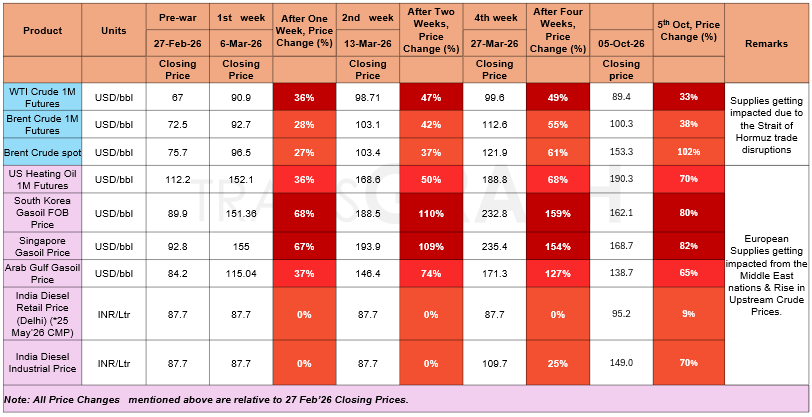
War Impact on Crude Oil & Gasoil/Diesel Prices
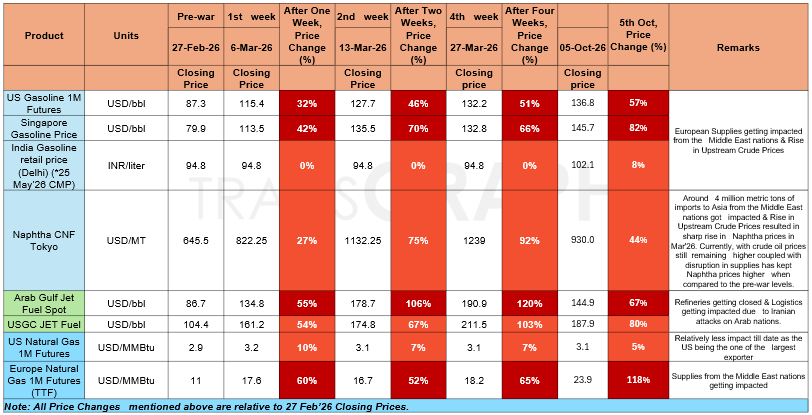
War Impact on Gasoline, ATF & Natural Gas Prices
GCC Bypass Pipelines Running Near Capacity — But Shah Gas Field Ablaze and Fujairah Zone Struck
- Saudi Arabia's East-West pipeline is pumping oil at its full capacity of 7 MBpd, bypassing the Strait of Hormuz. Crude oil exports from Yanbu port have reached 5 MBpd, and the country is also exporting 0.70 to 0.90 MBpd of oil products.
- Of approximately 15 MBpd of crude transiting the Strait of Hormuz in OND'25, combined SPR releases and bypass pipeline capacity can offset roughly two-thirds — or slightly more — for the next 20 to 30 days, providing the Trump administration a window to assess strategic direction.
- New strikes directly threaten this buffer — Iranian drones struck the UAE's Shah gas field (currently ablaze) and the Fujairah Oil Industry Zone on Mar 17. A tanker was also hit near the Strait of Hormuz. Saudi Arabia intercepted over a dozen drones; Kuwait and Bahrain sustained additional attacks. These represent the first direct strikes on GCC energy export infrastructure since the conflict began.
War Scenarios Point to Global Supply Deficit of 0.92–1.07 MBpd in 2026 and AMJ Quarter Most Severe with a deficit of 4.10 MBpd.
Pre-war, global supply and demand were near-balanced with a modest surplus of +0.55 MBpd projected for 2026. Both conflict scenarios introduce significant supply deficits driven by Strait of Hormuz disruptions and impacts on Iraq and Kuwait crude production.
- Scenario 1 (Preferred): Ceasefire talks continue to progress positively, with tanker flows through the Strait of Hormuz gradually normalizing over the next 4–5 weeks. Supply recovers steadily, while demand improves at a slower pace and remains below pre-war expectations, resulting in a moderate market surplus.
- Scenario 2 (Alternate): The Strait of Hormuz normalizes over the next 4–5 weeks, supporting a gradual recovery in oil exports and supply. Demand rebounds more strongly than in Scenario 1, reducing the market surplus, although overall consumption remains below pre-war levels.
Geopolitical backdrop:
War Front: President Trump has indicated that US has rejected the latest peace deal. Fears of fresh attacks have risen amid breakdown in negotiations weighing on base metals. US President Donald Trump has rejected a news report claiming his administration offered Iran sanctions relief and access to frozen funds, calling the story a hoax on social media. Iranian Foreign Minister Abbas Araghchi says Tehran has held further indirect talks with the United States through Qatari mediators in New York, with Washington’s formal response expected by Tuesday.
The United States and China have agreed to reduce tariffs on $30 billion of goods and launch a dialogue on AI, both countries said following President Xi Jinping's visit to Washington. The tariff reductions would apply to US exports such as agricultural goods, wood and cosmetics, as well as US imports including small appliances, toys, decorations, a White House statement said on Friday.
Recently New York Fed President John Williams said there was “no urgency” to raise rates again. This reduced expectations of an immediate/October Fed hike: Saudi Arabia restarted flows through its East-West pipeline after repairs following drone attacks. September crude exports from Middle Eastern producers reached about 16.3 million barrels/day. The US offered to loan up to 40 million barrels from its Strategic Petroleum Reserve. This adds another potential source of crude supply and therefore put downward pressure on prices. These factors eased near-term supply concerns, reducing inflation pressure.
Steel:
- Steel supply chains remain largely insulated from the Middle East conflict.
- Moreover, HRC prices are up by 3.2% on a monthly basis due to raw material price surge and stronger demand from auto sector.
Base metals:
- LME 3M copper are down 2.6% on a weekly basis as mid autumn festival slowed China consumption. Further, rejection of peace deal by US and stronger dollar is weighing on metals. However, backwardation structure, reduced rate hike expectations, and supply disruptions will provide some support.
- Aluminum prices are down 4.4% due to gradual recovery from GCC and stronger dollar despite tensions in the middle east.
Precious metals:
- Stronger U.S. yields and weak industrial offtake are suppressing any upside momentum.
- Stronger US Dollar and geopolitical tensions are weighing on precious metal prices.
LPG Market Update
- For August 2026, Saudi Aramco Contract Prices (CPs) rebounded to USD 620/ton for propane and USD 640/ton for butane, compared with USD 580/ton and USD 600/ton, respectively, in July. This represents a 6.9% month-on-month increase in propane CPs and a 6.7% month-on-month increase in butane CPs.
- Sonatrach raised its August propane OSP by 4.2% m-o-m, from $518/ton to $540/ton, while the butane OSP was cut by 5.0%, from $600/ton to $570/ton.
- India’s commercial LPG prices eased further in August, with the 19 kg cylinder price in New Delhi declining by ₹192, from ₹2,930 in July to ₹2,738 as of 3 August 2026. Despite the recent correction, commercial LPG remains substantially above its pre-war level of ₹1,741/cylinder. In contrast, the 14.2 kg domestic LPG cylinder remained unchanged at ₹942, reflecting continued price stability for household consumers.
Impact Assessment of US/Israel-Iran Conflict
- Crude flows through the Strait of Hormuz reached a seven day average of 14.2 MBpd on 26 Sep’26, nearly 80% of pre-war levels, as Gulf producers resumed transit. Despite the recovery, record tanker rates, higher insurance costs and vessel shortages continue to constrain effective crude availability and logistics.
- Middle East crude exports recovered to above pre-war levels, reaching 19.5–22.5 MBpd on several days in the final week of Sep’26, with the seven day average rising to 18.5 MBpd on 1st Oct’26 versus 18 MBpd pre-war.
- Saudi Arabia faced renewed attacks on its energy infrastructure, with Yemen’s Iran backed Houthis claiming missile and drone strikes on Saudi Aramco facilities in Riyadh and the Khurais area on 5th Oct’26.
- From 28th Sep’26 onward,at least seven tanker incidents were reported around the Strait of Hormuz , including the 1st Oct’26 projectile strike on the 2 mln bbl Kuwaiti crude carrier Kazimah III, keeping regional crude flows and shipping exposed to elevated security risks.
- Iraq transported around 2 mln bbl of crude through the Strait of Hormuz on 3rd Oct’26, marking the first such operation by the country’s state owned Oil Tanker Company in decades. The shipment provides Iraq’s state oil marketer SOMO with greater flexibility in crude sales and demonstrates that Iraqi barrels can still transit the Strait despite ongoing shipping disruptions.
- OPEC+ agreed to keep its Nov’26 oil production targets unchanged at its 4th Oct’26 meeting, with output from the seven core members rising by 0.63 MBpd MoM to around 25 MBpd in Aug’26 but remaining roughly 5 MBpd below the Feb’26 pre war level. Meanwhile, around 2 MBpd of production cuts remain in place, while Gulf producers continue to operate below their quotas due to export disruptions.
- G7 countries agreed to release 100 mln bbl of crude and diesel from emergency reserves over four months, with a substantial portion of the diesel volumes expected to be released within the first 20 days, while G7 members also committed to avoiding energy export restrictions.
- Vietnam’s Nghi Son refinery has secured sufficient crude supplies to operate at around 125% of its 0.2 MBpd design capacity through Nov’26, with about 75% of its new crude cargoes sourced from Kuwait. The refinery has diversified its feedstock to 10 crude types following earlier supply disruptions and has been operating above nameplate capacity since Jul’26 to meet strong domestic and regional fuel demand.
- Chinese refiners have suspended oil product exports beyond Hong Kong and Macau until further notice, while PetroChina cancelled several Oct’26 gasoline and jet fuel cargoes to prioritize domestic fuel availability, this move could reduce refinery runs and crude demand if restrictions persist, while tightening refined product supplies across Asian markets.
- India’s Middle Eastern crude imports rose to 11.3 mln tons in Sep’26, the highest since Feb’26, improving crude availability for its 5.6 MBpd refining system and enabling Indian refiners to potentially increase refined product exports to fill part of the supply gap created by restricted Chinese fuel exports.
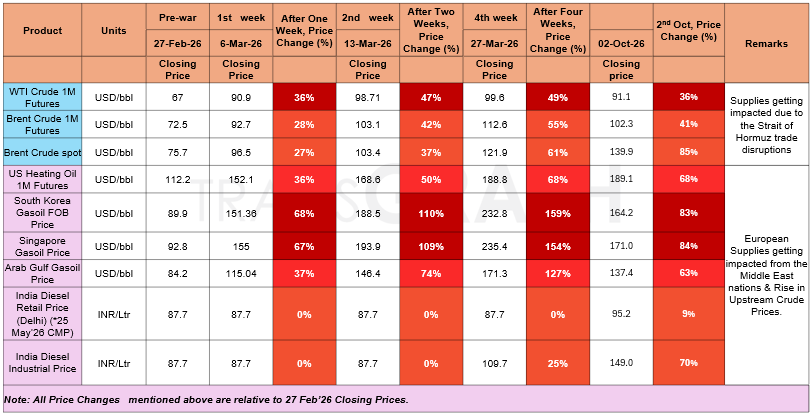
War Impact on Crude Oil & Gasoil/Diesel Prices
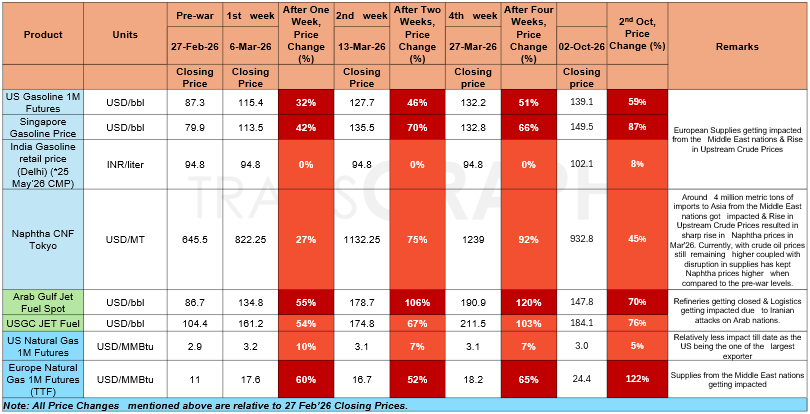
War Impact on Gasoline, ATF & Natural Gas Prices
GCC Bypass Pipelines Running Near Capacity — But Shah Gas Field Ablaze and Fujairah Zone Struck
- Saudi Arabia's East-West pipeline is pumping oil at its full capacity of 7 MBpd, bypassing the Strait of Hormuz. Crude oil exports from Yanbu port have reached 5 MBpd, and the country is also exporting 0.70 to 0.90 MBpd of oil products.
- Of approximately 15 MBpd of crude transiting the Strait of Hormuz in OND'25, combined SPR releases and bypass pipeline capacity can offset roughly two-thirds — or slightly more — for the next 20 to 30 days, providing the Trump administration a window to assess strategic direction.
- New strikes directly threaten this buffer — Iranian drones struck the UAE's Shah gas field (currently ablaze) and the Fujairah Oil Industry Zone on Mar 17. A tanker was also hit near the Strait of Hormuz. Saudi Arabia intercepted over a dozen drones; Kuwait and Bahrain sustained additional attacks. These represent the first direct strikes on GCC energy export infrastructure since the conflict began.
War Scenarios Point to Global Supply Deficit of 0.92–1.07 MBpd in 2026 and AMJ Quarter Most Severe with a deficit of 4.10 MBpd.
Pre-war, global supply and demand were near-balanced with a modest surplus of +0.55 MBpd projected for 2026. Both conflict scenarios introduce significant supply deficits driven by Strait of Hormuz disruptions and impacts on Iraq and Kuwait crude production.
- Scenario 1 (Preferred): Ceasefire talks continue to progress positively, with tanker flows through the Strait of Hormuz gradually normalizing over the next 4–5 weeks. Supply recovers steadily, while demand improves at a slower pace and remains below pre-war expectations, resulting in a moderate market surplus.
- Scenario 2 (Alternate): The Strait of Hormuz normalizes over the next 4–5 weeks, supporting a gradual recovery in oil exports and supply. Demand rebounds more strongly than in Scenario 1, reducing the market surplus, although overall consumption remains below pre-war levels.
Geopolitical backdrop:
War Front: President Trump has indicated that US has rejected the latest peace deal. Fears of fresh attacks have risen amid breakdown in negotiations weighing on base metals. US President Donald Trump has rejected a news report claiming his administration offered Iran sanctions relief and access to frozen funds, calling the story a hoax on social media. Iranian Foreign Minister Abbas Araghchi says Tehran has held further indirect talks with the United States through Qatari mediators in New York, with Washington’s formal response expected by Tuesday.
The United States and China have agreed to reduce tariffs on $30 billion of goods and launch a dialogue on AI, both countries said following President Xi Jinping's visit to Washington. The tariff reductions would apply to US exports such as agricultural goods, wood and cosmetics, as well as US imports including small appliances, toys, decorations, a White House statement said on Friday.
Recently New York Fed President John Williams said there was “no urgency” to raise rates again. This reduced expectations of an immediate/October Fed hike: Saudi Arabia restarted flows through its East-West pipeline after repairs following drone attacks. September crude exports from Middle Eastern producers reached about 16.3 million barrels/day. The US offered to loan up to 40 million barrels from its Strategic Petroleum Reserve. This adds another potential source of crude supply and therefore put downward pressure on prices. These factors eased near-term supply concerns, reducing inflation pressure.
Steel:
- Steel supply chains remain largely insulated from the Middle East conflict.
- Moreover, HRC prices are up by 3.2% on a monthly basis due to raw material price surge and stronger demand from auto sector.
Base metals:
- LME 3M copper are down 2.6% on a weekly basis as mid autumn festival slowed China consumption. Further, rejection of peace deal by US and stronger dollar is weighing on metals. However, backwardation structure, reduced rate hike expectations, and supply disruptions will provide some support.
- Aluminum prices are down 4.4% due to gradual recovery from GCC and stronger dollar despite tensions in the middle east.
Precious metals:
- Stronger U.S. yields and weak industrial offtake are suppressing any upside momentum.
- Stronger US Dollar and geopolitical tensions are weighing on precious metal prices.
LPG Market Update
- For August 2026, Saudi Aramco Contract Prices (CPs) rebounded to USD 620/ton for propane and USD 640/ton for butane, compared with USD 580/ton and USD 600/ton, respectively, in July. This represents a 6.9% month-on-month increase in propane CPs and a 6.7% month-on-month increase in butane CPs.
- Sonatrach raised its August propane OSP by 4.2% m-o-m, from $518/ton to $540/ton, while the butane OSP was cut by 5.0%, from $600/ton to $570/ton.
- India’s commercial LPG prices eased further in August, with the 19 kg cylinder price in New Delhi declining by ₹192, from ₹2,930 in July to ₹2,738 as of 3 August 2026. Despite the recent correction, commercial LPG remains substantially above its pre-war level of ₹1,741/cylinder. In contrast, the 14.2 kg domestic LPG cylinder remained unchanged at ₹942, reflecting continued price stability for household consumers.
Impact Assessment of US/Israel-Iran Conflict
- Qatar mediated US-Iran talks remained stalled, with President Trump denying reports that the US was prepared to ease sanctions on Iran in exchange for nuclear concessions, keeping uncertainty over a potential reopening of the Strait of Hormuz and the normalization of regional oil flows.
- Market grapevine indicates that Gulf oil exports have recovered to around 23.3 MBpd in the latest week, broadly in line with 2025 levels, while five-day average exports stood at around 20.5 MBpd, or nearly 89% of 2025 levels. Meanwhile, Saudi Arabia has resumed tanker loadings from Yanbu following the restart of its East-West Pipeline.
- OPEC+ is expected to keep its Nov’26 production targets unchanged at its upcoming meeting, with the output rising by 0.63 MBpd MoM to around 25.0 MBpd in Aug’26, although it remained about 5 MBpd below the Feb’26 pre-war level. Meanwhile, the group continues to maintain roughly 2 MBpd of production cuts through the end of 2026.
- Saudi Arabia’s East-West Pipeline restart is gradually restoring crude export capacity, with current throughput to Yanbu at approximately 2–2.65 MBpd and expected to increase to 3–4 MBpd, although it remains below the pre-attack level of around 5.5 MBpd.
- Middle East crude exports rose to 16.328 Mbpd in Sep’26, the highest since the war began in late Feb’26, with Saudi Arabia’s exports rebounding to about 5.4 Mbpd from 2.446 Mbpd in Aug’26 as Strait of Hormuz flows recovered to around 9.719 Mbpd.
- US crude production reached a record 13.955 MBpd in the week ended 25th Sep’26 as producers increased output amid strong global crude demand and supply disruptions elsewhere.
- US crude inventories increased by 0.922 mln bbl to 427.3 mln bbl in the week ended 25th Sep’26, versus expectations for a 0.264 mln bbl draw, while lower refinery activity led to declines of 1.7 mln bbl in gasoline stocks and 2.3 mln bbl in distillate stocks.
- The US government plans to loan up to 40 mln bbl of crude from the Strategic Petroleum Reserve as part of the wider 400 mln bbl IEA coordinated emergency release, while US SPR inventories remain below 284 mln bbl, their lowest level since 1982.
- Indian Oil Corp. secured 2 mln bbl of Iraq’s Basrah Medium crude for 22nd Oct’26–31st Oct’26 loading, as Indian refiners increasingly turn to Iraqi and other alternative grades to offset tighter Russian crude supplies and ongoing disruptions to Gulf oil flows.
- Chinese refiners have suspended oil product exports beyond Hong Kong and Macau until further notice, while PetroChina cancelled several Oct’26 gasoline and jet fuel cargoes to prioritize domestic fuel availability, this move could reduce refinery runs and crude demand if restrictions persist, while tightening refined product supplies across Asian markets.
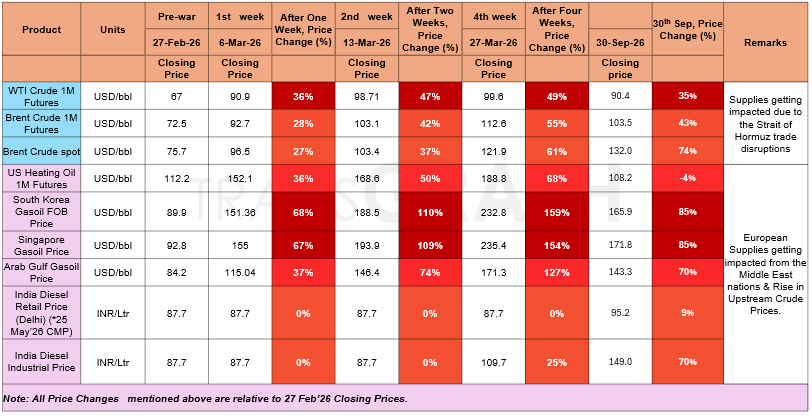
War Impact on Crude Oil & Gasoil/Diesel Prices
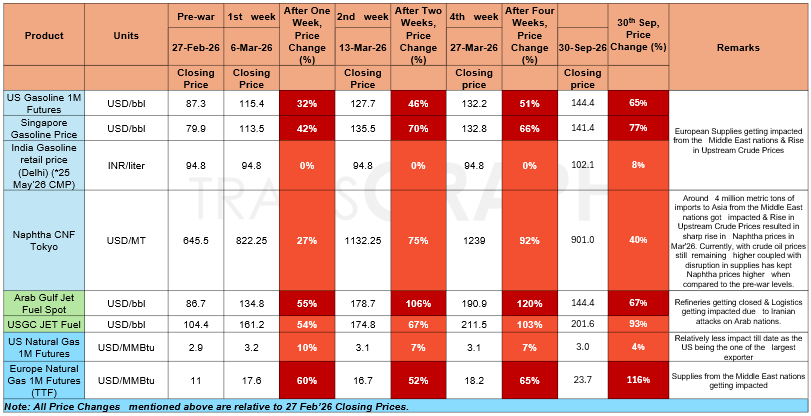
War Impact on Gasoline, ATF & Natural Gas Prices
GCC Bypass Pipelines Running Near Capacity — But Shah Gas Field Ablaze and Fujairah Zone Struck
- Saudi Arabia's East-West pipeline is pumping oil at its full capacity of 7 MBpd, bypassing the Strait of Hormuz. Crude oil exports from Yanbu port have reached 5 MBpd, and the country is also exporting 0.70 to 0.90 MBpd of oil products.
- Of approximately 15 MBpd of crude transiting the Strait of Hormuz in OND'25, combined SPR releases and bypass pipeline capacity can offset roughly two-thirds — or slightly more — for the next 20 to 30 days, providing the Trump administration a window to assess strategic direction.
- New strikes directly threaten this buffer — Iranian drones struck the UAE's Shah gas field (currently ablaze) and the Fujairah Oil Industry Zone on Mar 17. A tanker was also hit near the Strait of Hormuz. Saudi Arabia intercepted over a dozen drones; Kuwait and Bahrain sustained additional attacks. These represent the first direct strikes on GCC energy export infrastructure since the conflict began.
War Scenarios Point to Global Supply Deficit of 0.92–1.07 MBpd in 2026 and AMJ Quarter Most Severe with a deficit of 4.10 MBpd.
Pre-war, global supply and demand were near-balanced with a modest surplus of +0.55 MBpd projected for 2026. Both conflict scenarios introduce significant supply deficits driven by Strait of Hormuz disruptions and impacts on Iraq and Kuwait crude production.
- Scenario 1 (Preferred): Ceasefire talks continue to progress positively, with tanker flows through the Strait of Hormuz gradually normalizing over the next 4–5 weeks. Supply recovers steadily, while demand improves at a slower pace and remains below pre-war expectations, resulting in a moderate market surplus.
- Scenario 2 (Alternate): The Strait of Hormuz normalizes over the next 4–5 weeks, supporting a gradual recovery in oil exports and supply. Demand rebounds more strongly than in Scenario 1, reducing the market surplus, although overall consumption remains below pre-war levels.
Geopolitical backdrop:

War Front: President Trump has indicated that US has rejected the latest peace deal. Fears of fresh attacks have risen amid breakdown in negotiations weighing on base metals. US President Donald Trump has rejected a news report claiming his administration offered Iran sanctions relief and access to frozen funds, calling the story a hoax on social media. Iranian Foreign Minister Abbas Araghchi says Tehran has held further indirect talks with the United States through Qatari mediators in New York, with Washington’s formal response expected by Tuesday.
The United States and China have agreed to reduce tariffs on $30 billion of goods and launch a dialogue on AI, both countries said following President Xi Jinping's visit to Washington. The tariff reductions would apply to US exports such as agricultural goods, wood and cosmetics, as well as US imports including small appliances, toys, decorations, a White House statement said on Friday.
Recently New York Fed President John Williams said there was “no urgency” to raise rates again. This reduced expectations of an immediate/October Fed hike: Saudi Arabia restarted flows through its East-West pipeline after repairs following drone attacks. September crude exports from Middle Eastern producers reached about 16.3 million barrels/day. The US offered to loan up to 40 million barrels from its Strategic Petroleum Reserve. This adds another potential source of crude supply and therefore put downward pressure on prices. These factors eased near-term supply concerns, reducing inflation pressure.
Steel:
- Steel supply chains remain largely insulated from the Middle East conflict.
- Moreover, HRC prices are up by 2.9% on a monthly basis due to raw material price surge and stronger demand from auto sector.
Base metals:
- LME 3M copper are down 2.2% on a weekly basis as mid autumn festival slowed China consumption. Further, rejection of peace deal by US and stronger dollar is weighing on metals. However, high premiums and supply disruptions will provide some support.
- Aluminum prices are down 1.1% due to gradual recovery from GCC and stronger dollar despite tensions in the middle east.
Precious metals:
- Stronger U.S. yields and weak industrial offtake are suppressing any upside momentum.
- Stronger US Dollar and geopolitical tensions are weighing on precious metal prices.
LPG Market Update
- For August 2026, Saudi Aramco Contract Prices (CPs) rebounded to USD 620/ton for propane and USD 640/ton for butane, compared with USD 580/ton and USD 600/ton, respectively, in July. This represents a 6.9% month-on-month increase in propane CPs and a 6.7% month-on-month increase in butane CPs.
- Sonatrach raised its August propane OSP by 4.2% m-o-m, from $518/ton to $540/ton, while the butane OSP was cut by 5.0%, from $600/ton to $570/ton.
- India’s commercial LPG prices eased further in August, with the 19 kg cylinder price in New Delhi declining by ₹192, from ₹2,930 in July to ₹2,738 as of 3 August 2026. Despite the recent correction, commercial LPG remains substantially above its pre-war level of ₹1,741/cylinder. In contrast, the 14.2 kg domestic LPG cylinder remained unchanged at ₹942, reflecting continued price stability for household consumers.
Impact Assessment of US/Israel-Iran Conflict
- Qatar is seeking to broker a US-Iran peace deal to end the eight-month war and reopen the Strait of Hormuz, despite Trump rejecting reports of sanctions relief, while the conflict continues to disrupt oil supplies and drive global energy prices higher.
- Middle East crude exports rose to 16.328 Mbpd in Sep’26, the highest since the war began in late Feb’26, with Saudi Arabia’s exports rebounding to about 5.4 Mbpd from 2.446 Mbpd in Aug’26 as Strait of Hormuz flows recovered to around 9.719 Mbpd.
- Despite the rebound, regional exports remained 3.2 Mbpd below February’s 19.513 Mbpd, at just under 80% of pre-conflict levels, while 19 VLCCs carrying about 2 Mbpd each of Saudi crude crossed the Strait of Hormuz last week.
- Indian refiners expect Russian crude supplies to tighten further in Oct’26–Nov’26 as Chinese demand outbids India, with Russian oil arrivals already falling 16.5% to 2.1 MBpd in Aug’26 and projected to decline to around 1.75 MBpd in Sep’26, prompting India to seek costlier alternatives such as UAE Murban, Iraqi Basrah and Angolan crude.
- Crude oil flows through the Strait of Hormuz totaled 33.7 mln bbl in the week ending 25th Sep’26, with 19 tankers including, 17 VLCCs, keeping exports broadly in line with the previous week’s 49.2 mln bbl.
- Libya’s National Oil Corporation said on Saturday that it had reopened Valve No. 7 on the main Sharara–Zawiya crude pipeline, allowing pumping operations to resume.
- Crude flows are gradually returning to normal after the pipeline was shut earlier last week, with the Sharara field’s output capacity of around 0.30 MBpd expected to progressively come back online.
- The US government is offering energy companies up to 40 mln bbl of crude from the Strategic Petroleum Reserve, following a broader 400 mln bbl global reserve release involving about 30 IEA countries, with the US initially committed to 172 mln bbl.
- The latest offer comes as US SPR stocks have fallen below 284 mln bbl, while gasoline prices have risen nearly 50% to about 4.45 USD/gallon and diesel prices have surged around 70% to roughly $6.50 USD/gallon since the Iran war began.
- The White House is urging EU countries to release more emergency diesel and oil reserves to ease surging fuel prices ahead of the US midterm elections, while considering additional measures to boost domestic diesel supplies.
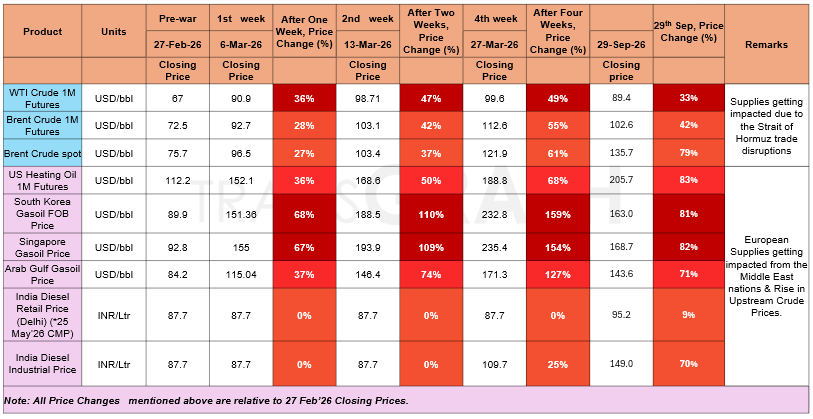
War Impact on Crude Oil & Gasoil/Diesel Prices
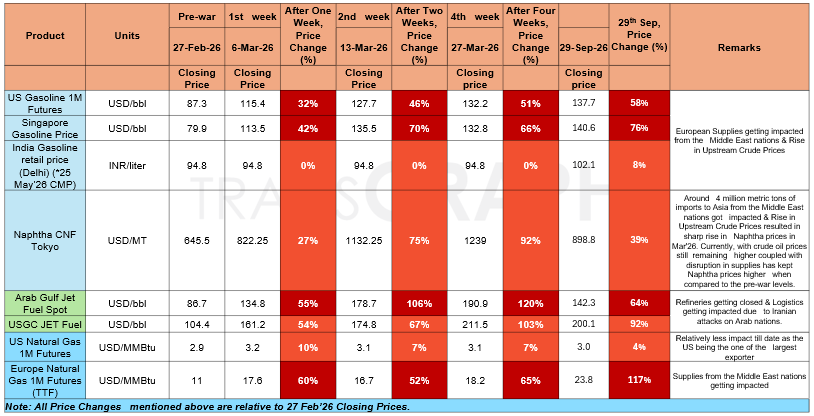
War Impact on Gasoline, ATF & Natural Gas Prices
GCC Bypass Pipelines Running Near Capacity — But Shah Gas Field Ablaze and Fujairah Zone Struck
- Saudi Arabia's East-West pipeline is pumping oil at its full capacity of 7 MBpd, bypassing the Strait of Hormuz. Crude oil exports from Yanbu port have reached 5 MBpd, and the country is also exporting 0.70 to 0.90 MBpd of oil products.
- Of approximately 15 MBpd of crude transiting the Strait of Hormuz in OND'25, combined SPR releases and bypass pipeline capacity can offset roughly two-thirds — or slightly more — for the next 20 to 30 days, providing the Trump administration a window to assess strategic direction.
- New strikes directly threaten this buffer — Iranian drones struck the UAE's Shah gas field (currently ablaze) and the Fujairah Oil Industry Zone on Mar 17. A tanker was also hit near the Strait of Hormuz. Saudi Arabia intercepted over a dozen drones; Kuwait and Bahrain sustained additional attacks. These represent the first direct strikes on GCC energy export infrastructure since the conflict began.
War Scenarios Point to Global Supply Deficit of 0.92–1.07 MBpd in 2026 and AMJ Quarter Most Severe with a deficit of 4.10 MBpd.
Pre-war, global supply and demand were near-balanced with a modest surplus of +0.55 MBpd projected for 2026. Both conflict scenarios introduce significant supply deficits driven by Strait of Hormuz disruptions and impacts on Iraq and Kuwait crude production.
- Scenario 1 (Preferred): Ceasefire talks continue to progress positively, with tanker flows through the Strait of Hormuz gradually normalizing over the next 4–5 weeks. Supply recovers steadily, while demand improves at a slower pace and remains below pre-war expectations, resulting in a moderate market surplus.
- Scenario 2 (Alternate): The Strait of Hormuz normalizes over the next 4–5 weeks, supporting a gradual recovery in oil exports and supply. Demand rebounds more strongly than in Scenario 1, reducing the market surplus, although overall consumption remains below pre-war levels.
Geopolitical backdrop:
War Front: President Trump has indicated that US has rejected the latest peace deal. Fears of fresh attacks have risen amid breakdown in negotiations weighing on base metals. US President Donald Trump has rejected a news report claiming his administration offered Iran sanctions relief and access to frozen funds, calling the story a hoax on social media. Iranian Foreign Minister Abbas Araghchi says Tehran has held further indirect talks with the United States through Qatari mediators in New York, with Washington’s formal response expected by Tuesday.
The United States and China have agreed to reduce tariffs on $30 billion of goods and launch a dialogue on AI, both countries said following President Xi Jinping's visit to Washington. The tariff reductions would apply to US exports such as agricultural goods, wood and cosmetics, as well as US imports including small appliances, toys, decorations, a White House statement said on Friday.
Recently New York Fed President John Williams said there was “no urgency” to raise rates again. This reduced expectations of an immediate/October Fed hike: Saudi Arabia restarted flows through its East-West pipeline after repairs following drone attacks. September crude exports from Middle Eastern producers reached about 16.3 million barrels/day. The US offered to loan up to 40 million barrels from its Strategic Petroleum Reserve. This adds another potential source of crude supply and therefore put downward pressure on prices. These factors eased near-term supply concerns, reducing inflation pressure.
Steel:
- Steel supply chains remain largely insulated from the Middle East conflict.
- Moreover, HRC prices are up by 2.9% on a monthly basis due to raw material price surge and stronger demand from auto sector.
Base metals:
- LME 3M copper are down 2.2% on a weekly basis as mid autumn festival slowed China consumption. Further, rejection of peace deal by US and stronger dollar is weighing on metals. However, high premiums and supply disruptions will provide some support.
- Aluminum prices are down 1.1% due to gradual recovery from GCC and stronger dollar despite tensions in the middle east.
Precious metals:
- Stronger U.S. yields and weak industrial offtake are suppressing any upside momentum.
- Stronger US Dollar and geopolitical tensions are weighing on precious metal prices.
LPG Market Update
- For August 2026, Saudi Aramco Contract Prices (CPs) rebounded to USD 620/ton for propane and USD 640/ton for butane, compared with USD 580/ton and USD 600/ton, respectively, in July. This represents a 6.9% month-on-month increase in propane CPs and a 6.7% month-on-month increase in butane CPs.
- Sonatrach raised its August propane OSP by 4.2% m-o-m, from $518/ton to $540/ton, while the butane OSP was cut by 5.0%, from $600/ton to $570/ton.
- India’s commercial LPG prices eased further in August, with the 19 kg cylinder price in New Delhi declining by ₹192, from ₹2,930 in July to ₹2,738 as of 3 August 2026. Despite the recent correction, commercial LPG remains substantially above its pre-war level of ₹1,741/cylinder. In contrast, the 14.2 kg domestic LPG cylinder remained unchanged at ₹942, reflecting continued price stability for household consumers.
Impact Assessment of US/Israel-Iran Conflict
- On 26th Sep’26, Trump said he rejected Iran’s proposal to reopen the Strait of Hormuz and halt regional fighting within seven days, while leaving the door open for further negotiations.
- Market grapevine indicates that Saudi Aramco is considering discounts of around 9 USD/bbl on its official selling prices for crude loaded off Oman, where Asian buyers have recently paid 10–20 USD/bbl premiums, as it seeks to offset record freight costs and regain market share amid disruptions to Strait of Hormuz shipments, with Saudi exports through the strait projected at 7.4 MBpd this month.
- Market grapevine indicates that crude exports from major Middle Eastern producers rose to 12.8 MBpd in Sep’26, the highest level since February, supported by increased shipments from Saudi Arabia and the UAE.
- Indian refiners expect Russian crude supplies to tighten further in Oct’26–Nov’26 as Chinese demand outbids India, with Russian oil arrivals already falling 16.5% to 2.1 MBpd in Aug’26 and projected to decline to around 1.75 MBpd in Sep’26, prompting India to seek costlier alternatives such as UAE Murban, Iraqi Basrah and Angolan crude.
- Ship-to-ship transfers off Oman have reached capacity as Saudi Arabia redirected more crude through the Strait of Hormuz, with Saudi exports via Hormuz expected to rise to 3.6 MBpd in Sep’26 from 0.9 MBpd in Aug’26, increasing tanker demand and causing congestion.
- Crude oil flows through the Strait of Hormuz totaled 33.7 mln bbl in the week ending 25th Sep’26, with 19 tankers including, 17 VLCCs, keeping exports broadly in line with the previous week’s 49.2 mln bbl.
- On 24th Sep’26, commodity-vessel transits fell to 9 from 14 a day earlier and remained well below the 10-day average of 18, while the strait typically handled around 125 large commercial vessels daily before the Iran war.
- Libya’s National Oil Corporation said on Saturday that it had reopened Valve No. 7 on the main Sharara–Zawiya crude pipeline, allowing pumping operations to resume.
- Crude flows are gradually returning to normal after the pipeline was shut earlier last week, with the Sharara field’s output capacity of around 0.30 MBpd expected to progressively come back online.
- On 28th Sep’26 Russian President Putin signed a decree further restricting the disclosure of Russian energy and oil trade data, including information on prices, buyers, sellers, routes and destinations, to make Western sanctions harder to enforce.
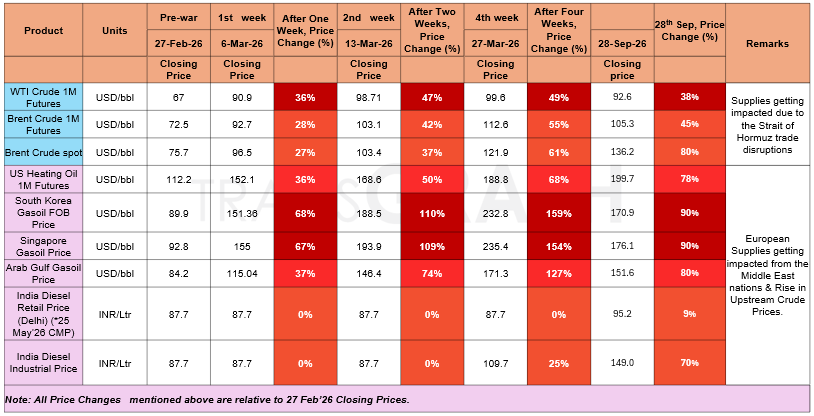
War Impact on Crude Oil & Gasoil/Diesel Prices
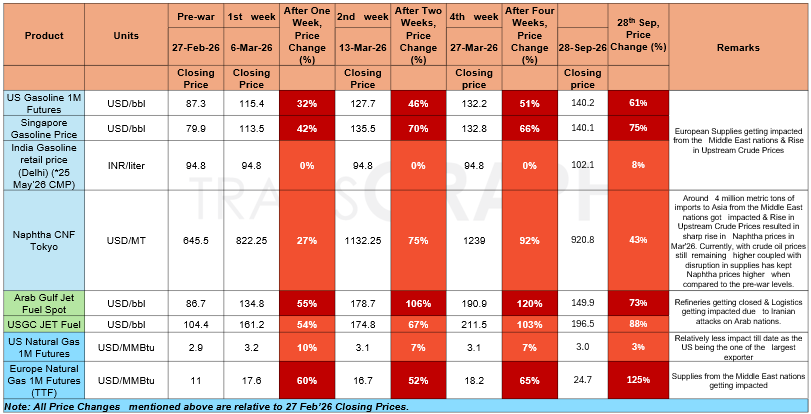
War Impact on Gasoline, ATF & Natural Gas Prices
GCC Bypass Pipelines Running Near Capacity — But Shah Gas Field Ablaze and Fujairah Zone Struck
- Saudi Arabia's East-West pipeline is pumping oil at its full capacity of 7 MBpd, bypassing the Strait of Hormuz. Crude oil exports from Yanbu port have reached 5 MBpd, and the country is also exporting 0.70 to 0.90 MBpd of oil products.
- Of approximately 15 MBpd of crude transiting the Strait of Hormuz in OND'25, combined SPR releases and bypass pipeline capacity can offset roughly two-thirds — or slightly more — for the next 20 to 30 days, providing the Trump administration a window to assess strategic direction.
- New strikes directly threaten this buffer — Iranian drones struck the UAE's Shah gas field (currently ablaze) and the Fujairah Oil Industry Zone on Mar 17. A tanker was also hit near the Strait of Hormuz. Saudi Arabia intercepted over a dozen drones; Kuwait and Bahrain sustained additional attacks. These represent the first direct strikes on GCC energy export infrastructure since the conflict began.
War Scenarios Point to Global Supply Deficit of 0.92–1.07 MBpd in 2026 and AMJ Quarter Most Severe with a deficit of 4.10 MBpd.
Pre-war, global supply and demand were near-balanced with a modest surplus of +0.55 MBpd projected for 2026. Both conflict scenarios introduce significant supply deficits driven by Strait of Hormuz disruptions and impacts on Iraq and Kuwait crude production.
- Scenario 1 (Preferred): Ceasefire talks continue to progress positively, with tanker flows through the Strait of Hormuz gradually normalizing over the next 4–5 weeks. Supply recovers steadily, while demand improves at a slower pace and remains below pre-war expectations, resulting in a moderate market surplus.
- Scenario 2 (Alternate): The Strait of Hormuz normalizes over the next 4–5 weeks, supporting a gradual recovery in oil exports and supply. Demand rebounds more strongly than in Scenario 1, reducing the market surplus, although overall consumption remains below pre-war levels.
Geopolitical backdrop:

War Front: U.S.–Iran Talks Raise Hopes of De-escalation and Ease Oil Prices: U.S. and Iranian officials held around three hours of talks on the sidelines of the UN General Assembly in New York, with President Trump describing the discussions as “very good” and productive and indicating that another meeting could take place soon. The talks, mediated through regional officials, focused on conditions for ending the conflict and potentially reopening the Strait of Hormuz. The renewed diplomatic engagement, together with the restart of Saudi Arabia’s East-West oil pipeline and expectations of improving Gulf supply, has eased concerns over a prolonged disruption to energy flows, with Brent crude falling below USD 100/bbl and extending its recent decline.
The U.S Federal Reserve raised its benchmark interest rate by 25 bps to 3.75%-4.00%, marking its first rate hike since July 2023. The decision came amid persistent inflationary pressures, with the Fed stating that inflation remains elevated and that the latest rate increase would support a more timely return toward its 2% inflation target. The Fed’s updated projections indicate that 16 of 18 policymakers expect at least one more 25-bps rate hike by the end of 2026, taking the policy rate to 4.00%-4.25%. Policymakers also raised their 2026 inflation forecast, reflecting continued concerns over price pressures, particularly from higher energy costs. The Fed’s hawkish stance provides a positive backdrop for the USD and weigh on metal prices. This may keep the impact on INR relatively contained, with oil prices, capital flows and RBI intervention remaining key drivers.
Steel:
- Steel supply chains remain largely insulated from the Middle East conflict.
- Moreover, HRC prices are up by 6.8% on a monthly basis due to raw material price surge.
Base metals:
- LME 3M copper are up 2.5% on a weekly basis supported by high China premium, disruptions in Escondida mine, calls for strike at major Chile mining operations, and drawdown in SHFE inventory ahead of mid autumn festival. However upside remains capped by rate hike pressures, stronger dollar, and geopolitical tensions.
- Aluminum prices are down 2.3% due to gradual recovery from GCC and rate hike expectations despite tensions in the middle east.
Precious metals:
- Stronger U.S. yields and weak industrial offtake are suppressing any upside momentum.
- Stronger US Dollar and geopolitical tensions are weighing on precious metal prices.
LPG Market Update
- For August 2026, Saudi Aramco Contract Prices (CPs) rebounded to USD 620/ton for propane and USD 640/ton for butane, compared with USD 580/ton and USD 600/ton, respectively, in July. This represents a 6.9% month-on-month increase in propane CPs and a 6.7% month-on-month increase in butane CPs.
- Sonatrach raised its August propane OSP by 4.2% m-o-m, from $518/ton to $540/ton, while the butane OSP was cut by 5.0%, from $600/ton to $570/ton.
- India’s commercial LPG prices eased further in August, with the 19 kg cylinder price in New Delhi declining by ₹192, from ₹2,930 in July to ₹2,738 as of 3 August 2026. Despite the recent correction, commercial LPG remains substantially above its pre-war level of ₹1,741/cylinder. In contrast, the 14.2 kg domestic LPG cylinder remained unchanged at ₹942, reflecting continued price stability for household consumers.
Impact Assessment of US/Israel-Iran Conflict
- On 26th Sep’26, Trump said he rejected Iran’s proposal to reopen the Strait of Hormuz and halt regional fighting within seven days, while leaving the door open for further negotiations.
- Saudi Arabia intercepted six ballistic missiles launched by the Houthis toward Taif and the Yanbu area on 24th Sep’26, with the Houthis claiming attacks targeting Riyadh and Saudi Aramco facilities in Yanbu. The strikes raised concerns over the security of Saudi oil infrastructure and crude export flows through Yanbu.
- War risk insurance premiums for tankers loading at Saudi Arabia’s Yanbu port surged to around 3% of vessel value, up from below 1% in early Jul’26, as reported on 25th Sep’26, amid heightened Houthi attacks and security risks in the Red Sea.
- Ship-to-ship transfers off Oman have reached capacity as Saudi Arabia redirected more crude through the Strait of Hormuz, with Saudi exports via Hormuz expected to rise to 3.6 MBpd in Sep’26 from 0.9 MBpd in Aug’26, increasing tanker demand and causing congestion.
- Crude oil flows through the Strait of Hormuz totaled 33.7 mln bbl in the week ending 25th Sep’26, with 19 tankers including, 17 VLCCs, keeping exports broadly in line with the previous week’s 49.2 mln bbl.
- On 24th Sep’26, commodity-vessel transits fell to 9 from 14 a day earlier and remained well below the 10-day average of 18, while the strait typically handled around 125 large commercial vessels daily before the Iran war.
- Libya’s National Oil Corporation said on Saturday that it had reopened Valve No. 7 on the main Sharara–Zawiya crude pipeline, allowing pumping operations to resume.
- Crude flows are gradually returning to normal after the pipeline was shut earlier last week, with the Sharara field’s output capacity of around 0.30 MBpd expected to progressively come back online.
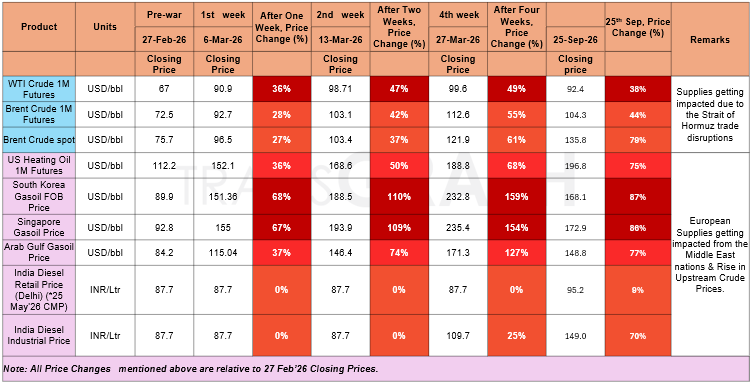
War Impact on Crude Oil & Gasoil/Diesel Prices
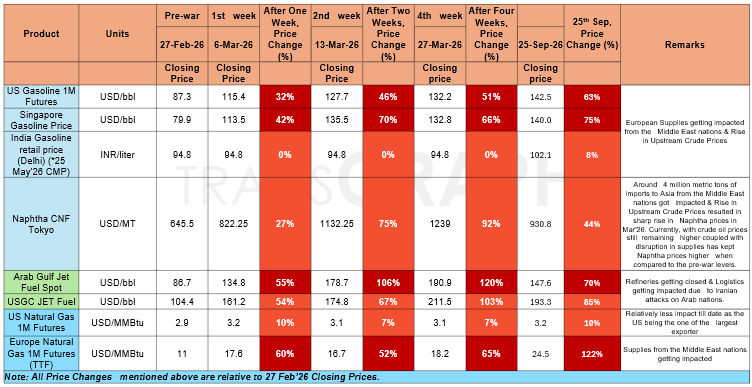
War Impact on Gasoline, ATF & Natural Gas Prices
GCC Bypass Pipelines Running Near Capacity — But Shah Gas Field Ablaze and Fujairah Zone Struck
- Saudi Arabia's East-West pipeline is pumping oil at its full capacity of 7 MBpd, bypassing the Strait of Hormuz. Crude oil exports from Yanbu port have reached 5 MBpd, and the country is also exporting 0.70 to 0.90 MBpd of oil products.
- Of approximately 15 MBpd of crude transiting the Strait of Hormuz in OND'25, combined SPR releases and bypass pipeline capacity can offset roughly two-thirds — or slightly more — for the next 20 to 30 days, providing the Trump administration a window to assess strategic direction.
- New strikes directly threaten this buffer — Iranian drones struck the UAE's Shah gas field (currently ablaze) and the Fujairah Oil Industry Zone on Mar 17. A tanker was also hit near the Strait of Hormuz. Saudi Arabia intercepted over a dozen drones; Kuwait and Bahrain sustained additional attacks. These represent the first direct strikes on GCC energy export infrastructure since the conflict began.
War Scenarios Point to Global Supply Deficit of 0.92–1.07 MBpd in 2026 and AMJ Quarter Most Severe with a deficit of 4.10 MBpd.
Pre-war, global supply and demand were near-balanced with a modest surplus of +0.55 MBpd projected for 2026. Both conflict scenarios introduce significant supply deficits driven by Strait of Hormuz disruptions and impacts on Iraq and Kuwait crude production.
- Scenario 1 (Preferred): Ceasefire talks continue to progress positively, with tanker flows through the Strait of Hormuz gradually normalizing over the next 4–5 weeks. Supply recovers steadily, while demand improves at a slower pace and remains below pre-war expectations, resulting in a moderate market surplus.
- Scenario 2 (Alternate): The Strait of Hormuz normalizes over the next 4–5 weeks, supporting a gradual recovery in oil exports and supply. Demand rebounds more strongly than in Scenario 1, reducing the market surplus, although overall consumption remains below pre-war levels.
Geopolitical backdrop:
War Front: U.S.–Iran Talks Raise Hopes of De-escalation and Ease Oil Prices: U.S. and Iranian officials held around three hours of talks on the sidelines of the UN General Assembly in New York, with President Trump describing the discussions as “very good” and productive and indicating that another meeting could take place soon. The talks, mediated through regional officials, focused on conditions for ending the conflict and potentially reopening the Strait of Hormuz. The renewed diplomatic engagement, together with the restart of Saudi Arabia’s East-West oil pipeline and expectations of improving Gulf supply, has eased concerns over a prolonged disruption to energy flows, with Brent crude falling below USD 100/bbl and extending its recent decline.
The U.S Federal Reserve raised its benchmark interest rate by 25 bps to 3.75%-4.00%, marking its first rate hike since July 2023. The decision came amid persistent inflationary pressures, with the Fed stating that inflation remains elevated and that the latest rate increase would support a more timely return toward its 2% inflation target. The Fed’s updated projections indicate that 16 of 18 policymakers expect at least one more 25-bps rate hike by the end of 2026, taking the policy rate to 4.00%-4.25%. Policymakers also raised their 2026 inflation forecast, reflecting continued concerns over price pressures, particularly from higher energy costs. The Fed’s hawkish stance provides a positive backdrop for the USD and weigh on metal prices. This may keep the impact on INR relatively contained, with oil prices, capital flows and RBI intervention remaining key drivers.
Steel:
- Steel supply chains remain largely insulated from the Middle East conflict.
- Moreover, HRC prices are up by 6.8% on a monthly basis due to raw material price surge.
Base metals:
- LME 3M copper are up 2.5% on a weekly basis supported by high China premium, disruptions in Escondida mine, calls for strike at major Chile mining operations, and drawdown in SHFE inventory ahead of mid autumn festival. However upside remains capped by rate hike pressures, stronger dollar, and geopolitical tensions.
- Aluminum prices are down 2.3% due to gradual recovery from GCC and rate hike expectations despite tensions in the middle east.
Precious metals:
- Stronger U.S. yields and weak industrial offtake are suppressing any upside momentum.
- Stronger US Dollar and geopolitical tensions are weighing on precious metal prices.
LPG Market Update
- For August 2026, Saudi Aramco Contract Prices (CPs) rebounded to USD 620/ton for propane and USD 640/ton for butane, compared with USD 580/ton and USD 600/ton, respectively, in July. This represents a 6.9% month-on-month increase in propane CPs and a 6.7% month-on-month increase in butane CPs.
- Sonatrach raised its August propane OSP by 4.2% m-o-m, from $518/ton to $540/ton, while the butane OSP was cut by 5.0%, from $600/ton to $570/ton.
- India’s commercial LPG prices eased further in August, with the 19 kg cylinder price in New Delhi declining by ₹192, from ₹2,930 in July to ₹2,738 as of 3 August 2026. Despite the recent correction, commercial LPG remains substantially above its pre-war level of ₹1,741/cylinder. In contrast, the 14.2 kg domestic LPG cylinder remained unchanged at ₹942, reflecting continued price stability for household consumers.
Impact Assessment of US/Israel-Iran Conflict
- Iranian officials say diplomacy is continuing as both sides review proposals involving the Strait of Hormuz, sanctions, and the US naval blockade.
- Market grapevine indicates that Asia’s crude oil imports are projected to reach 23.96 MBpd in Sep’26, up from 23.38 MBpd in Aug’26 and the highest since Feb’26, but still 13% below the pre-conflict average of 27.55 MBpd, Middle East supplies rose to 12.56 MBpd from 11.66 million bpd, yet remained 3.53 MBpd below the pre-war average.
- Asian imports of light and middle distillates are expected at 5.84 MBpd in Sep’26, up from 5.25 MBpd in Aug’26 but more than 1 MBpd below the pre-conflict average of 7.06 MBpd, keeping refined-fuel prices elevated.
- Saudi Arabia restarted its East-West Pipeline at a low rate after drone attacks forced its shutdown on 11th Sep’26, with plans to restore flows toward 4 MBpd (against 7 MBpd capacity) and potentially resume Yanbu exports, although a full restart could take 6–8 weeks.
- South Korea plans to reduce its reliance on Middle Eastern crude to 50% by 2035 from 70% in 2025, while adding 20 mln bbl to crude reserves by 2030, cutting Middle Eastern natural-gas dependence below 30%, and diversifying critical-mineral and naphtha supplies after disruptions from the Iran war.
- Global crude oil floating inventories declining in Sep’26 from the previous month, indicating some easing in offshore stock accumulation after the sharp build-up seen earlier in the year.
- floating crude oil storage declined across Asia, Europe, the Middle East and North Sea, likely reflecting stronger crude movements and reduced volumes held offshore. Meanwhile, West Africa and other regions saw an increase, indicating higher export-related inventories or slower cargo movements, while the Gulf Coast remained broadly stable.
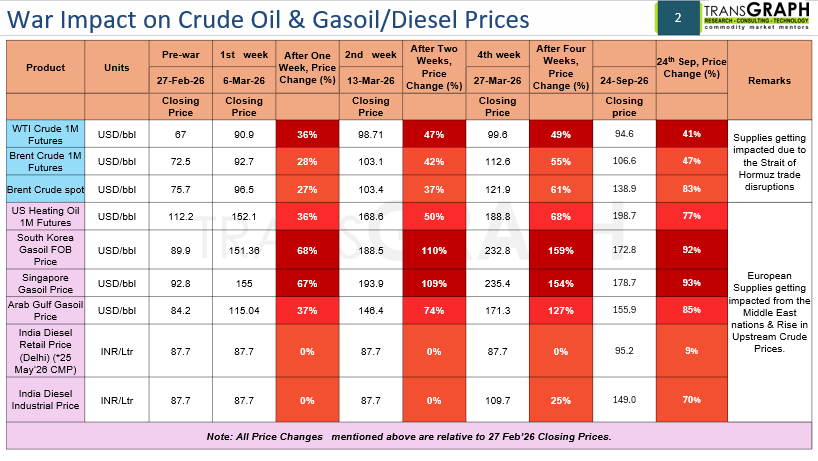
War Impact on Crude Oil & Gasoil/Diesel Prices
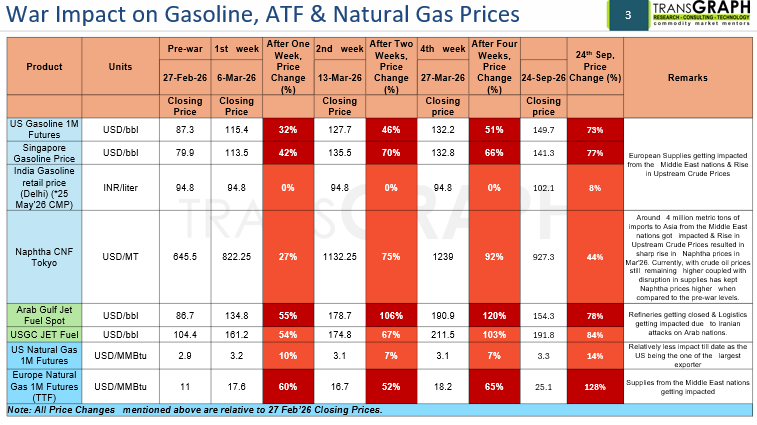
War Impact on Gasoline, ATF & Natural Gas Prices
GCC Bypass Pipelines Running Near Capacity — But Shah Gas Field Ablaze and Fujairah Zone Struck
- Saudi Arabia's East-West pipeline is pumping oil at its full capacity of 7 MBpd, bypassing the Strait of Hormuz. Crude oil exports from Yanbu port have reached 5 MBpd, and the country is also exporting 0.70 to 0.90 MBpd of oil products.
- Of approximately 15 MBpd of crude transiting the Strait of Hormuz in OND'25, combined SPR releases and bypass pipeline capacity can offset roughly two-thirds — or slightly more — for the next 20 to 30 days, providing the Trump administration a window to assess strategic direction.
- New strikes directly threaten this buffer — Iranian drones struck the UAE's Shah gas field (currently ablaze) and the Fujairah Oil Industry Zone on Mar 17. A tanker was also hit near the Strait of Hormuz. Saudi Arabia intercepted over a dozen drones; Kuwait and Bahrain sustained additional attacks. These represent the first direct strikes on GCC energy export infrastructure since the conflict began.
War Scenarios Point to Global Supply Deficit of 0.92–1.07 MBpd in 2026 and AMJ Quarter Most Severe with a deficit of 4.10 MBpd.
Pre-war, global supply and demand were near-balanced with a modest surplus of +0.55 MBpd projected for 2026. Both conflict scenarios introduce significant supply deficits driven by Strait of Hormuz disruptions and impacts on Iraq and Kuwait crude production.
- Scenario 1 (Preferred): Ceasefire talks continue to progress positively, with tanker flows through the Strait of Hormuz gradually normalizing over the next 4–5 weeks. Supply recovers steadily, while demand improves at a slower pace and remains below pre-war expectations, resulting in a moderate market surplus.
- Scenario 2 (Alternate): The Strait of Hormuz normalizes over the next 4–5 weeks, supporting a gradual recovery in oil exports and supply. Demand rebounds more strongly than in Scenario 1, reducing the market surplus, although overall consumption remains below pre-war levels.
Geopolitical backdrop:
War Front: U.S.–Iran Talks Raise Hopes of De-escalation and Ease Oil Prices: U.S. and Iranian officials held around three hours of talks on the sidelines of the UN General Assembly in New York, with President Trump describing the discussions as “very good” and productive and indicating that another meeting could take place soon. The talks, mediated through regional officials, focused on conditions for ending the conflict and potentially reopening the Strait of Hormuz. The renewed diplomatic engagement, together with the restart of Saudi Arabia’s East-West oil pipeline and expectations of improving Gulf supply, has eased concerns over a prolonged disruption to energy flows, with Brent crude falling below USD 100/bbl and extending its recent decline.
The U.S Federal Reserve raised its benchmark interest rate by 25 bps to 3.75%-4.00%, marking its first rate hike since July 2023. The decision came amid persistent inflationary pressures, with the Fed stating that inflation remains elevated and that the latest rate increase would support a more timely return toward its 2% inflation target. The Fed’s updated projections indicate that 16 of 18 policymakers expect at least one more 25-bps rate hike by the end of 2026, taking the policy rate to 4.00%-4.25%. Policymakers also raised their 2026 inflation forecast, reflecting continued concerns over price pressures, particularly from higher energy costs. The Fed’s hawkish stance provides a positive backdrop for the USD and weigh on metal prices. This may keep the impact on INR relatively contained, with oil prices, capital flows and RBI intervention remaining key drivers.
Steel:
- Steel supply chains remain largely insulated from the Middle East conflict.
- Moreover, HRC prices are up by 6.8% on a monthly basis due to raw material price surge.
Base metals:
- LME 3M copper are up 2.5% on a weekly basis supported by high China premium, disruptions in Escondida mine, calls for strike at major Chile mining operations, and drawdown in SHFE inventory ahead of mid autumn festival. However upside remains capped by rate hike pressures, stronger dollar, and geopolitical tensions.
- Aluminum prices are down 2.3% due to gradual recovery from GCC and rate hike expectations despite tensions in the middle east.
Precious metals:
- Stronger U.S. yields and weak industrial offtake are suppressing any upside momentum.
- Stronger US Dollar and geopolitical tensions are weighing on precious metal prices.
LPG Market Update
- For August 2026, Saudi Aramco Contract Prices (CPs) rebounded to USD 620/ton for propane and USD 640/ton for butane, compared with USD 580/ton and USD 600/ton, respectively, in July. This represents a 6.9% month-on-month increase in propane CPs and a 6.7% month-on-month increase in butane CPs.
- Sonatrach raised its August propane OSP by 4.2% m-o-m, from $518/ton to $540/ton, while the butane OSP was cut by 5.0%, from $600/ton to $570/ton.
- India’s commercial LPG prices eased further in August, with the 19 kg cylinder price in New Delhi declining by ₹192, from ₹2,930 in July to ₹2,738 as of 3 August 2026. Despite the recent correction, commercial LPG remains substantially above its pre-war level of ₹1,741/cylinder. In contrast, the 14.2 kg domestic LPG cylinder remained unchanged at ₹942, reflecting continued price stability for household consumers.