
- The US President Trump and Iran's foreign minister further dented hopes of a deal to end ship attacks and seizures around the Strait of Hormuz.
- Iraq's oil exports via the Strait of Hormuz fell to 10 mln bbl in Apr'26, down from 93 mln bbl before the Iran war, as the closure of the Strait has curtailed exports from multiple countries, causing prices to rise.
- Iraq is currently producing 1.4 MBpd and plans to boost production and export capacity to 5 MBpd through dialogue with OPEC, while also engaging with US companies to develop oil and gas projects.
- The US energy firms added oil and natural gas rigs for a fourth week in a row for the first time since Sep'25, with the oil and gas rig count rising to 551, its highest since late Mar'26. Despite the increase, the total count is still down 25 rigs, or 4% below this time last year.
- The rise in oil and gas rigs comes as US West Texas Intermediate crude spot prices are expected to rise in 2026 due to the Iran war, leading to an increase in crude output from 13.6 mln bbl per day in 2025 to 13.7 MBpd in 2026.
- Iran's state media said about 30 vessels had crossed the Strait of Hormuz, though attacks on one ship and the seizure of another kept stoking concerns over the flow of energy supplies during the Iran war.
- Market grapevine indicates that Iran has begun allowing some Chinese vessels to transit through the Strait of Hormuz following an understanding over Iranian management protocols for the waterway.
- The move came as US President Trump and Chinese leader Jinping agreed that the Strait of Hormuz must be open for the free flow of energy. A Chinese supertanker carrying 2 mln bbl of Iraqi crude sailed through the Strait of Hormuz on 13th May'26, after being stranded in the Gulf for more than two months due to the US-Iran war.
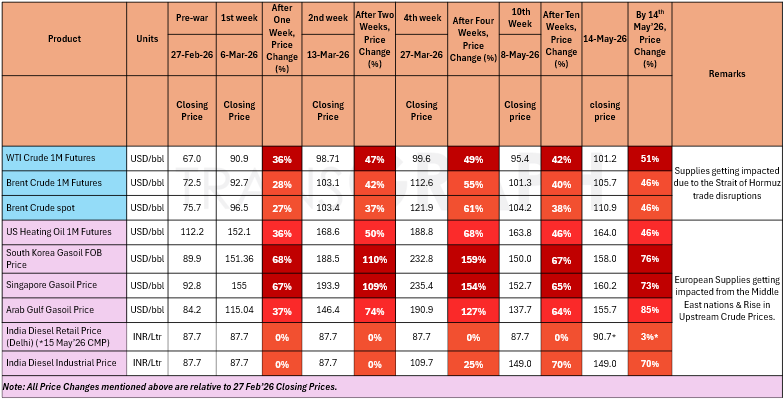
War Impact on Crude Oil & Gasoil/Diesel Prices
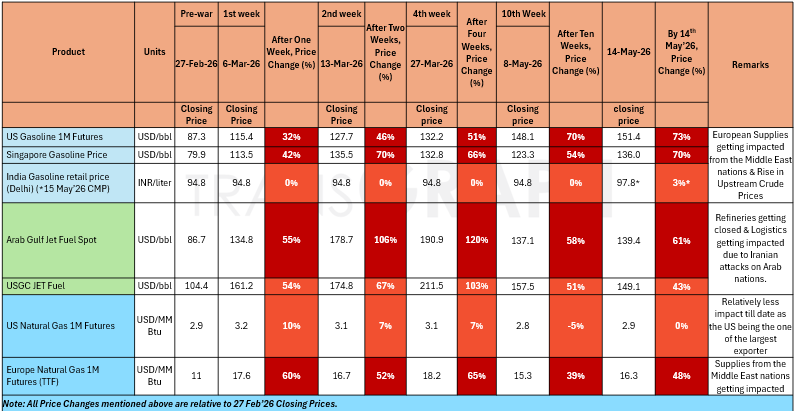
War Impact on Gasoline, ATF & Natural Gas Prices
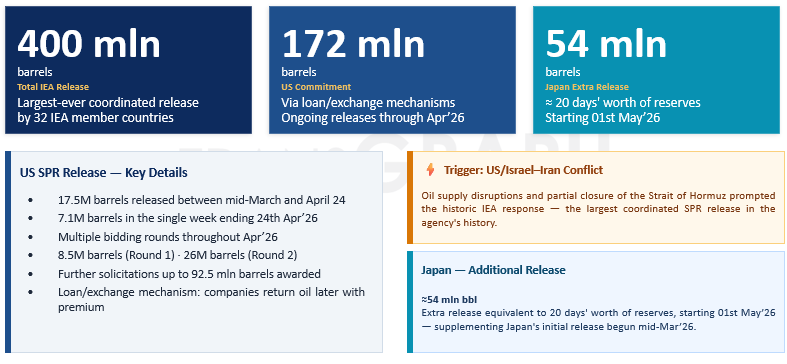
GCC Bypass Pipelines Running Near Capacity — But Shah Gas Field Ablaze and Fujairah Zone Struck
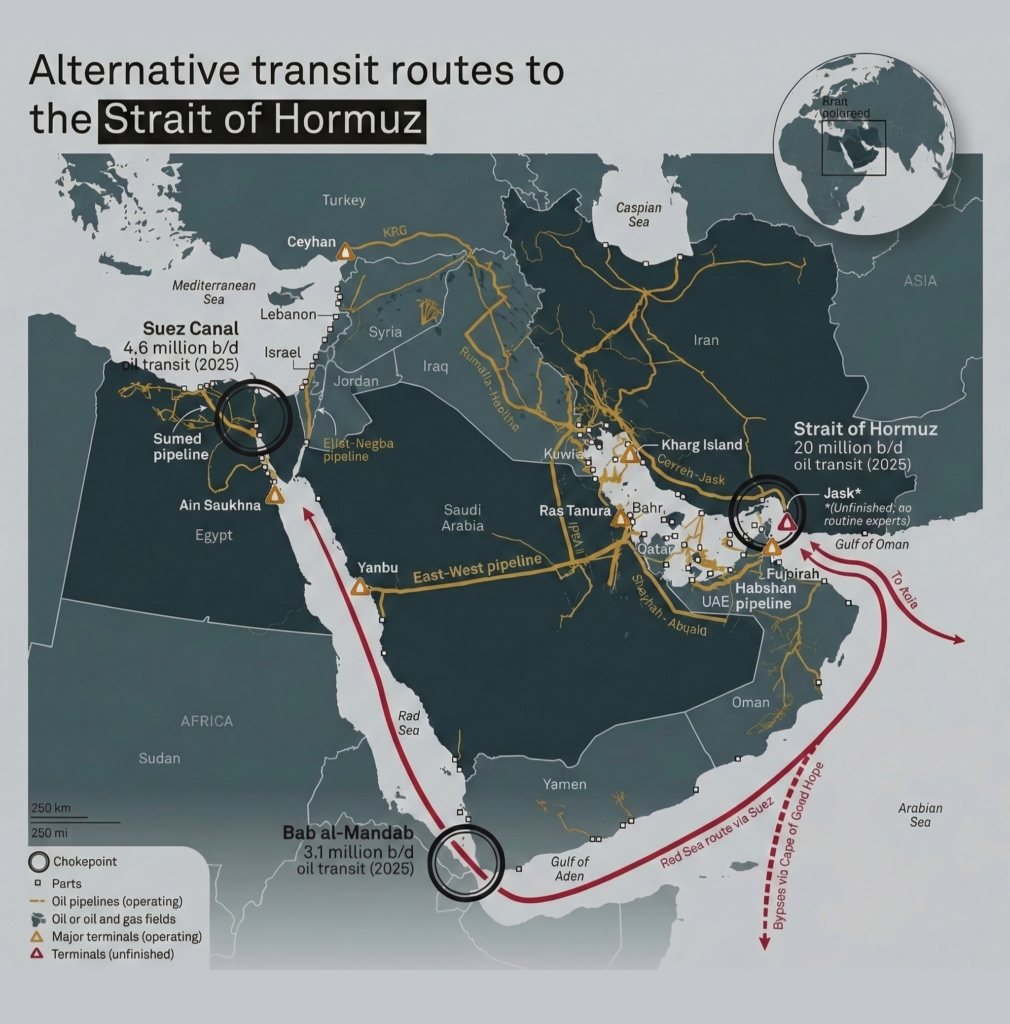
- Saudi Arabia's East-West pipeline is pumping oil at its full capacity of 7 MBpd, bypassing the Strait of Hormuz. Crude oil exports from Yanbu port have reached 5 MBpd, and the country is also exporting 0.70 to 0.90 MBpd of oil products.
- Of approximately 15 MBpd of crude transiting the Strait of Hormuz in OND'25, combined SPR releases and bypass pipeline capacity can offset roughly two-thirds — or slightly more — for the next 20 to 30 days, providing the Trump administration a window to assess strategic direction.
- New strikes directly threaten this buffer — Iranian drones struck the UAE's Shah gas field (currently ablaze) and the Fujairah Oil Industry Zone on Mar 17. A tanker was also hit near the Strait of Hormuz. Saudi Arabia intercepted over a dozen drones; Kuwait and Bahrain sustained additional attacks. These represent the first direct strikes on GCC energy export infrastructure since the conflict began.
Supply & Demand Analysis
War Scenarios Point to Global Supply Deficit of 1.35–1.90 MBpd in 2026 and AMJ Quarter Most Severe with a deficit of 3.00 - 4.50 MBpd.
Pre-war, global supply and demand were near-balanced with a modest surplus of +0.55 MBpd projected for 2026. Both conflict scenarios introduce significant supply deficits driven by Strait of Hormuz disruptions and impacts on Iraq and Kuwait crude production.
- Scenario 1 (Preferred): Ceasefire talks to remain on a progressive note and flows through the Strait of Hormuz improving over the coming weeks; however crude oil production losses will be there due to further non-availability of storage on on-shore in Iraq, Kuwait and other small Middle East nations.
- Scenario 2 (Alternate): No major deal being achieved from ceasefire talks and post completion of ceasefire talks, tensions continuing to remain in the Middle East and flows through the Strait of Hormuz continuing to remain restrained. Crude Oil Production Facilities & Refining Centers in the Middle East region getting affected and trade disruptions in Strait of Hormuz will be there for medium to long term (4 to 7 months).
Brent Crude 1M Futures are expected to trade in a range of 100 USD/bbl to 125 USD/bbl over the coming 1 to 2 weeks. The coordinated SPR release and GCC bypass capacity provide a meaningful supply cushion that limits sustained upside beyond these levels.
Metals & Energy Market Update – Geopolitical Context (Iran Conflict)
Geopolitical backdrop: U.S.-Iran ceasefire negotiations advance, but long-term deal remains uncertain, extending uncertainty in the region and sustaining volatility across commodities.

The United States and Iran are reportedly approaching a limited short-term ceasefire agreement aimed at preventing further escalation in the Middle East conflict, although prospects for a comprehensive settlement remain constrained by persistent disagreements surrounding Iran’s nuclear program and its stockpile of highly enriched uranium. Current negotiations, are focused on establishing an interim framework that would formalize a cessation of hostilities, ensure the reopening and stabilization of shipping flows through the Strait of Hormuz, and create a 30-day window for broader diplomatic negotiations. Nevertheless, substantial gaps between Washington and Tehran continue to limit visibility on a durable long-term resolution.
Steel:
- Domestic steel prices have moderated from recent highs.
- Steel supply chains remain largely insulated from the Middle East conflict.
- Hot-rolled coil prices declined by ~INR 1,800/ton in April ’26, ending at ~INR 57,850/ton (BigMint).
- Initial war-driven risk premium has been partially unwound.
Base metals:
- Copper ended last week up by 7%, primarily due to supply risks linked to sulphuric acid and Grasberg mine.
- Aluminum rose by 0.2% linked to Gulf region supply disruptions. However, demand softness now driving price action.
- IMF downgraded 2026 global growth to 3.1% (from 3.3% earlier and 3.4% in 2025), highlighting war-related downside risks.
Precious metals:
- Volatility has eased, but prices face upward pressure, due to improving market sentiment in peace talks.
- However, any esclation and halt in a resolution will pressure on Precious Metals.
- Stronger U.S. yields and weak industrial offtake—especially auto—are suppressing any upside momentum.
LPG Market Update - 18 May 2026

- VLGC freight on the Houston to Chiba route hit an all-time high of USD 307.50/ton on 11 May, a 126% rise since January, reflecting structurally rerouted Atlantic-to-Asia trade.
- The China tariff cut on US propane to 11%, effective 14 May just ahead of the Trump-Xi summit, opens a tentative window for trade flow normalization.
- Saudi Aramco's May contract prices held firm at USD 750/ton for propane, and CEO Amin Nasser warned on the company's earnings call that even a Hormuz reopening tomorrow would take months to rebalance markets, possibly stretching into 2027.
- India finds itself at the sharpest end of the Hormuz disruption, with import volumes down roughly 35% from pre-conflict levels and the oil minister publicly confirming the country holds only 45 days of LPG reserves as of 12 May.
- The three state oil marketing companies, IOC, BPCL, and HPCL, have pivoted aggressively toward US cargoes under a 2.2 million ton/year term agreement, with multiple VLGC fixtures confirmed for late May and June loading from the US Gulf.
- On the domestic production side, refinery LPG output has been pushed up around 50% to 54,000 t/day, with nearly all locally produced propane and butane redirected into LPG blending, effectively halting alkylate exports.