
Impact Assessment of US/Israel-Iran Conflict
Impact Assessment of US/Israel-Iran Conflict
The US and Iran have reached an interim framework agreement aimed at ending immediate hostilities and creating a pathway for broader negotiations. The agreement is not a final comprehensive treaty but rather a temporary arrangement designed to stabilise the situation and provide a 60-day period for diplomatic discussions on unresolved issues. Both sides have confirmed the agreement, with formal signing expected around 19th Jun’26, in Switzerland.
Core Agreed Elements
- The agreement calls for an immediate cessation of military operations and hostile activities on all fronts, including Lebanon. The ceasefire extends the existing truce for an initial period of 60 days and may be extended further through mutual consent. The objective is to prevent further escalation and create conditions conducive to diplomacy.
- The Strait of Hormuz will be reopened to international commercial shipping. Iran has committed to clearing naval mines and restoring safe navigation through the waterway. Both sides aim to return shipping traffic to pre-conflict levels within approximately 30 days. While US officials have described access as toll-free, Iranian authorities maintain that environmental and maritime traffic management fees may still be collected. Iran retains sovereignty and control over the Strait.
- The US will lift its naval blockade of Iranian ports, allowing normal maritime access and facilitating the resumption of international trade and commercial shipping activities involving Iran.
- The agreement does not resolve the most contentious nuclear issues. Instead, these matters will be addressed during the 60-day negotiation period. Iran has reaffirmed its commitment in principle not to pursue nuclear weapons and has agreed to discuss the future of its enriched uranium stockpile. Specific arrangements concerning uranium removal or reduction, enrichment limits, international inspections, and the potential dismantlement of nuclear facilities remain subject to future negotiations.
- The framework provides for limited and temporary sanctions relief, particularly regarding Iranian oil exports. Discussions will also begin regarding the release of certain frozen Iranian assets. Any broader or permanent sanctions relief will be tied to compliance with future agreements and performance benchmarks established during subsequent negotiations.
Production/Supply Recovery
- A tentative US-Iran framework agreement to end the conflict and reopen the Strait of Hormuz has eased immediate concerns over global energy supplies, sending oil prices lower.
- However, industry experts caution that restoring oil and gas production, refining operations, and shipping flows will take considerable time, with some oil output returning within weeks but full recovery potentially requiring months or years.
- More than 14 MBpd of oil production and significant refining and LNG capacity were disrupted during the conflict, while global oil inventories have fallen sharply.
- Market grapevines expect a gradual recovery, ongoing repair costs running into tens of billions of dollars, and a prolonged period of inventory rebuilding as countries seek to strengthen energy security against future geopolitical risks.
- Although the US and Iran have reached a preliminary agreement to reopen the Strait of Hormuz, maritime security experts warn that normal shipping operations may not resume for 40–50 days due to the need to detect and clear potential naval mines.
- Shipping companies, insurers, and oil traders remain cautious, as even a single mine poses a serious threat to vessels carrying cargoes worth hundreds of millions of dollars.
- Traffic through the strait remains far below pre-war levels, and uncertainty over the extent of Iran's mine deployments continues to hinder confidence. While international naval forces have begun preparations for mine-clearing operations, industry officials say restoring full safety and normal shipping volumes could take weeks or even months, prolonging disruptions to global energy supplies and trade.
War Impact on Crude Oil & Gasoil/Diesel Prices
War Impact on Gasoline, ATF & Natural Gas Prices
GCC Bypass Pipelines Running Near Capacity — But Shah Gas Field Ablaze and Fujairah Zone Struck
- Saudi Arabia's East-West pipeline is pumping oil at its full capacity of 7 MBpd, bypassing the Strait of Hormuz. Crude oil exports from Yanbu port have reached 5 MBpd, and the country is also exporting 0.70 to 0.90 MBpd of oil products.
- Of approximately 15 MBpd of crude transiting the Strait of Hormuz in OND'25, combined SPR releases and bypass pipeline capacity can offset roughly two-thirds — or slightly more — for the next 20 to 30 days, providing the Trump administration a window to assess strategic direction.
- New strikes directly threaten this buffer — Iranian drones struck the UAE's Shah gas field (currently ablaze) and the Fujairah Oil Industry Zone on Mar 17. A tanker was also hit near the Strait of Hormuz. Saudi Arabia intercepted over a dozen drones; Kuwait and Bahrain sustained additional attacks. These represent the first direct strikes on GCC energy export infrastructure since the conflict began.
Supply & Demand Analysis
War Scenarios Point to Global Supply Deficit of 1.35–1.90 MBpd in 2026 and AMJ Quarter Most Severe with a deficit of 3.00 - 4.50 MBpd.
Pre-war, global supply and demand were near-balanced with a modest surplus of +0.55 MBpd projected for 2026. Both conflict scenarios introduce significant supply deficits driven by Strait of Hormuz disruptions and impacts on Iraq and Kuwait crude production.
- Scenario 1 (Preferred): Ceasefire talks to remain on a progressive note and flows through the Strait of Hormuz improving over the coming weeks; however crude oil production losses will be there due to further non-availability of storage on on-shore in Iraq, Kuwait and other small Middle East nations.
- Scenario 2 (Alternate): No major deal being achieved from ceasefire talks and post completion of ceasefire talks, tensions continuing to remain in the Middle East and flows through the Strait of Hormuz continuing to remain restrained. Crude Oil Production Facilities & Refining Centers in the Middle East region getting affected and trade disruptions in Strait of Hormuz will be there for medium to long term (4 to 7 months).
Brent Crude 1M Futures are expected to trade in a range of 100 USD/bbl to 125 USD/bbl over the coming 1 to 2 weeks. The coordinated SPR release and GCC bypass capacity provide a meaningful supply cushion that limits sustained upside beyond these levels.
Metals & Energy Market Update – Geopolitical Context (Iran Conflict)
Geopolitical backdrop:

The United States and Iran have signed a 14-point Memorandum of Understanding (MoU) aimed at extending the ceasefire and establishing a framework for a broader peace agreement. The deal includes the reopening of the Strait of Hormuz, a commitment by Iran not to pursue nuclear weapons, and the creation of a proposed $300 billion reconstruction and economic development fund, largely expected to be financed by regional partners rather than the U.S. The agreement outlines a 60-day negotiation period to finalize a comprehensive deal, alongside phased sanctions relief, the release of certain frozen Iranian assets, and the gradual removal of U.S. military and naval restrictions.
Steel:
- Domestic steel prices have moderated from recent highs.
- Steel supply chains remain largely insulated from the Middle East conflict.
- Since, the start of war steel HRC prices are up by 8.7%.
Base metals:
- Copper ended last week up by 2.4%, primarily due to progress in negotiation talks.
- Aluminum rose by 7.9% since start of war linked to Gulf region supply disruptions. However, demand softness and possible peace deal now driving price action.
Precious metals:
- Volatility has eased, but prices face upward pressure, due to improving market sentiment in peace talks.
- However, any esclation and halt in a resolution will pressure on Precious Metals.
- Stronger U.S. yields and weak industrial offtake—especially auto—are suppressing any upside momentum.
LPG Market Update
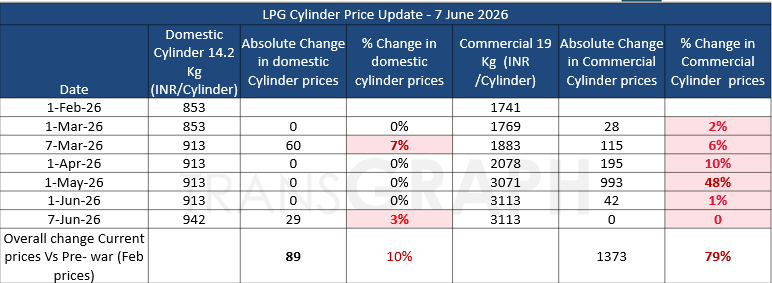
- India’s LPG market saw another upward revision on 1st June 2026 , with oil marketing companies increasing commercial cylinder prices. Commercial LPG prices were raised across major cities, with the 19 kg cylinder in Delhi increasing by Rs 42 to Rs 3,113.50. Similar hikes were reported nationwide, ranging from Rs 42 to Rs 53.50 per cylinder.
India’s domestic LPG market witnessed a price revision on 7 June 2026, with Oil Marketing Companies (OMCs) increasing the price of the 14.2 kg domestic LPG cylinder by ₹29 per cylinder across the country. - In addition to commercial cylinders, oil marketing companies also increased the price of 5 kg Free Trade LPG (FTL) cylinders by Rs 11. Following the revision, the retail price of a 5 kg FTL cylinder in Delhi now stands at Rs 821.50. FTL cylinders are sold outside the subsidized domestic LPG system and are commonly used by migrant workers, temporary households, street vendors, and consumers requiring smaller LPG packs.
Impact Assessment of US/Israel-Iran Conflict
The US and Iran have reached an interim framework agreement aimed at ending immediate hostilities and creating a pathway for broader negotiations. The agreement is not a final comprehensive treaty but rather a temporary arrangement designed to stabilise the situation and provide a 60-day period for diplomatic discussions on unresolved issues. Both sides have confirmed the agreement, with formal signing expected around 19th Jun’26, in Switzerland.
Core Agreed Elements
- The agreement calls for an immediate cessation of military operations and hostile activities on all fronts, including Lebanon. The ceasefire extends the existing truce for an initial period of 60 days and may be extended further through mutual consent. The objective is to prevent further escalation and create conditions conducive to diplomacy.
- The Strait of Hormuz will be reopened to international commercial shipping. Iran has committed to clearing naval mines and restoring safe navigation through the waterway. Both sides aim to return shipping traffic to pre-conflict levels within approximately 30 days. While US officials have described access as toll-free, Iranian authorities maintain that environmental and maritime traffic management fees may still be collected. Iran retains sovereignty and control over the Strait.
- The US will lift its naval blockade of Iranian ports, allowing normal maritime access and facilitating the resumption of international trade and commercial shipping activities involving Iran.
- The agreement does not resolve the most contentious nuclear issues. Instead, these matters will be addressed during the 60-day negotiation period. Iran has reaffirmed its commitment in principle not to pursue nuclear weapons and has agreed to discuss the future of its enriched uranium stockpile. Specific arrangements concerning uranium removal or reduction, enrichment limits, international inspections, and the potential dismantlement of nuclear facilities remain subject to future negotiations.
- The framework provides for limited and temporary sanctions relief, particularly regarding Iranian oil exports. Discussions will also begin regarding the release of certain frozen Iranian assets. Any broader or permanent sanctions relief will be tied to compliance with future agreements and performance benchmarks established during subsequent negotiations.
Production/Supply Recovery
- A tentative US-Iran framework agreement to end the conflict and reopen the Strait of Hormuz has eased immediate concerns over global energy supplies, sending oil prices lower.
- However, industry experts caution that restoring oil and gas production, refining operations, and shipping flows will take considerable time, with some oil output returning within weeks but full recovery potentially requiring months or years.
- More than 14 MBpd of oil production and significant refining and LNG capacity were disrupted during the conflict, while global oil inventories have fallen sharply.
- Market grapevines expect a gradual recovery, ongoing repair costs running into tens of billions of dollars, and a prolonged period of inventory rebuilding as countries seek to strengthen energy security against future geopolitical risks.
- Although the US and Iran have reached a preliminary agreement to reopen the Strait of Hormuz, maritime security experts warn that normal shipping operations may not resume for 40–50 days due to the need to detect and clear potential naval mines.
- Shipping companies, insurers, and oil traders remain cautious, as even a single mine poses a serious threat to vessels carrying cargoes worth hundreds of millions of dollars.
- Traffic through the strait remains far below pre-war levels, and uncertainty over the extent of Iran's mine deployments continues to hinder confidence. While international naval forces have begun preparations for mine-clearing operations, industry officials say restoring full safety and normal shipping volumes could take weeks or even months, prolonging disruptions to global energy supplies and trade.
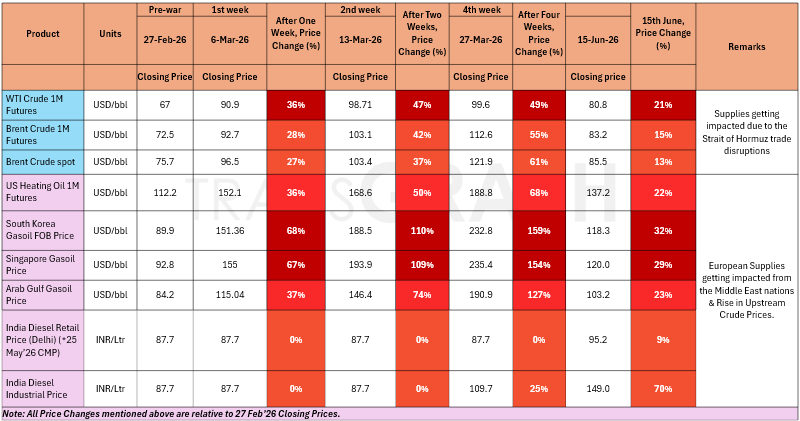
War Impact on Crude Oil & Gasoil/Diesel Prices
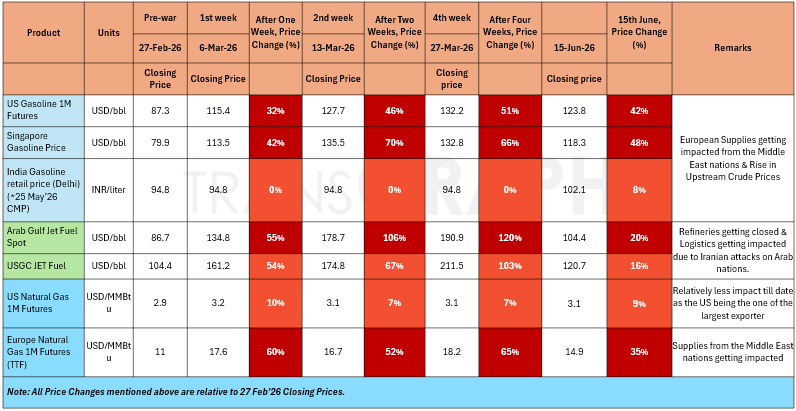
War Impact on Gasoline, ATF & Natural Gas Prices
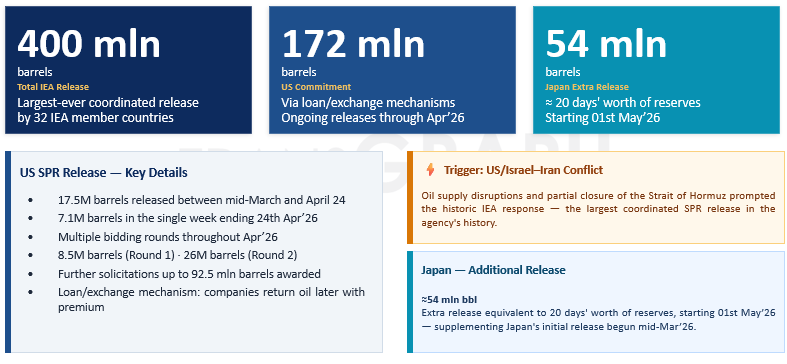
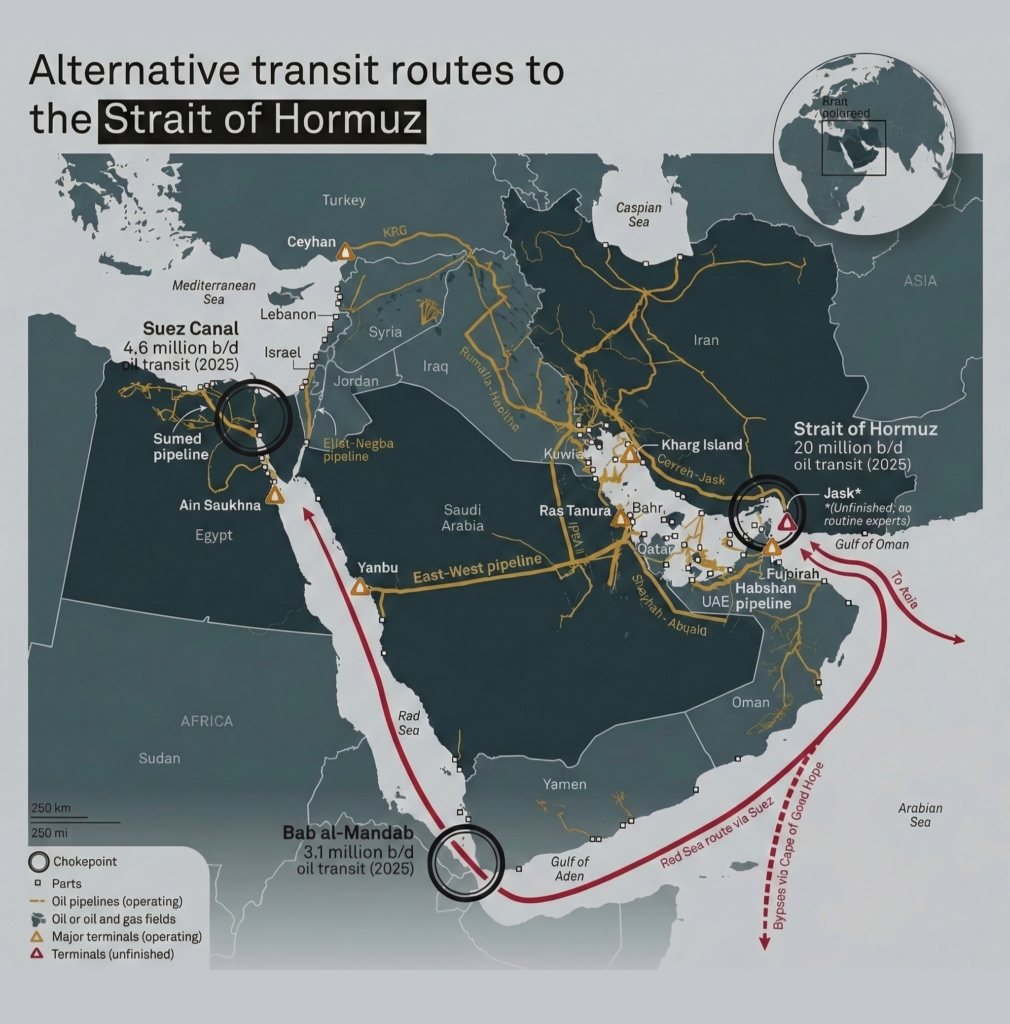
GCC Bypass Pipelines Running Near Capacity — But Shah Gas Field Ablaze and Fujairah Zone Struck
- Saudi Arabia's East-West pipeline is pumping oil at its full capacity of 7 MBpd, bypassing the Strait of Hormuz. Crude oil exports from Yanbu port have reached 5 MBpd, and the country is also exporting 0.70 to 0.90 MBpd of oil products.
- Of approximately 15 MBpd of crude transiting the Strait of Hormuz in OND'25, combined SPR releases and bypass pipeline capacity can offset roughly two-thirds — or slightly more — for the next 20 to 30 days, providing the Trump administration a window to assess strategic direction.
- New strikes directly threaten this buffer — Iranian drones struck the UAE's Shah gas field (currently ablaze) and the Fujairah Oil Industry Zone on Mar 17. A tanker was also hit near the Strait of Hormuz. Saudi Arabia intercepted over a dozen drones; Kuwait and Bahrain sustained additional attacks. These represent the first direct strikes on GCC energy export infrastructure since the conflict began.
Supply & Demand Analysis
War Scenarios Point to Global Supply Deficit of 1.35–1.90 MBpd in 2026 and AMJ Quarter Most Severe with a deficit of 3.00 - 4.50 MBpd.
Pre-war, global supply and demand were near-balanced with a modest surplus of +0.55 MBpd projected for 2026. Both conflict scenarios introduce significant supply deficits driven by Strait of Hormuz disruptions and impacts on Iraq and Kuwait crude production.
- Scenario 1 (Preferred): Ceasefire talks to remain on a progressive note and flows through the Strait of Hormuz improving over the coming weeks; however crude oil production losses will be there due to further non-availability of storage on on-shore in Iraq, Kuwait and other small Middle East nations.
- Scenario 2 (Alternate): No major deal being achieved from ceasefire talks and post completion of ceasefire talks, tensions continuing to remain in the Middle East and flows through the Strait of Hormuz continuing to remain restrained. Crude Oil Production Facilities & Refining Centers in the Middle East region getting affected and trade disruptions in Strait of Hormuz will be there for medium to long term (4 to 7 months).
Brent Crude 1M Futures are expected to trade in a range of 100 USD/bbl to 125 USD/bbl over the coming 1 to 2 weeks. The coordinated SPR release and GCC bypass capacity provide a meaningful supply cushion that limits sustained upside beyond these levels.
Metals & Energy Market Update – Geopolitical Context (Iran Conflict)
Geopolitical backdrop:

Israel and Iran traded the worst exchange of fire since the April truce, with Iran firing missiles at Israeli targets and Israel carrying out strikes on western and central Iran. Brent bounced back strongly as renewed tensions stoked fresh supply fears and Hormuz near-closure continues to put a structural floor under prices. Equities saw sharp selloff in Asia at the open as well, with Kospi down by 14%, Nikkei down by 1.31% and Nifty down by 1.2%, S&P down by 2.64%, and Nasdaq registered a heavy sell-off and marked a 4.18% loss. Higher energy, slower growth, and limited room for rate cuts keep yields elevated. Safe-haven flows are rotating into money markets and short-duration paper.
Steel:
- Domestic steel prices have moderated from recent highs.
- Steel supply chains remain largely insulated from the Middle East conflict.
- Since, the start of war steel HRC prices are up by 8.7%.
Base metals:
- Copper ended last week down by 1%, primarily due to stronger dollar and weak demand.
- Aluminum rose by 18.3% since start of war linked to Gulf region supply disruptions. However, demand softness now driving price action.
- IMF downgraded 2026 global growth to 3.1% (from 3.3% earlier and 3.4% in 2025), highlighting war-related downside risks.
Precious metals:
- Volatility has eased, but prices face upward pressure, due to improving market sentiment in peace talks.
- However, any esclation and halt in a resolution will pressure on Precious Metals.
- Stronger U.S. yields and weak industrial offtake—especially auto—are suppressing any upside momentum.
LPG Market Update - 09 June 2026
- India’s LPG market saw another upward revision on 1st June 2026 , with oil marketing companies increasing commercial cylinder prices. Commercial LPG prices were raised across major cities, with the 19 kg cylinder in Delhi increasing by Rs 42 to Rs 3,113.50. Similar hikes were reported nationwide, ranging from Rs 42 to Rs 53.50 per cylinder.
India’s domestic LPG market witnessed a price revision on 7 June 2026, with Oil Marketing Companies (OMCs) increasing the price of the 14.2 kg domestic LPG cylinder by ₹29 per cylinder across the country. - In addition to commercial cylinders, oil marketing companies also increased the price of 5 kg Free Trade LPG (FTL) cylinders by Rs 11. Following the revision, the retail price of a 5 kg FTL cylinder in Delhi now stands at Rs 821.50. FTL cylinders are sold outside the subsidized domestic LPG system and are commonly used by migrant workers, temporary households, street vendors, and consumers requiring smaller LPG packs.
Impact Assessment of US/Israel-Iran Conflict
The US and Iran have reached an interim framework agreement aimed at ending immediate hostilities and creating a pathway for broader negotiations. The agreement is not a final comprehensive treaty but rather a temporary arrangement designed to stabilize the situation and provide a 60-day period for diplomatic discussions on unresolved issues. Both sides have confirmed the agreement, with formal signing expected around 19th Jun’26, in Switzerland.
Core Agreed Elements
- The agreement calls for an immediate cessation of military operations and hostile activities on all fronts, including Lebanon. The ceasefire extends the existing truce for an initial period of 60 days and may be extended further through mutual consent. The objective is to prevent further escalation and create conditions conducive to diplomacy.
- The Strait of Hormuz will be reopened to international commercial shipping. Iran has committed to clearing naval mines and restoring safe navigation through the waterway. Both sides aim to return shipping traffic to pre-conflict levels within approximately 30 days. While US officials have described access as toll-free, Iranian authorities maintain that environmental and maritime traffic management fees may still be collected. Iran retains sovereignty and control over the Strait.
- The US will lift its naval blockade of Iranian ports, allowing normal maritime access and facilitating the resumption of international trade and commercial shipping activities involving Iran.
- The agreement does not resolve the most contentious nuclear issues. Instead, these matters will be addressed during the 60-day negotiation period. Iran has reaffirmed its commitment in principle not to pursue nuclear weapons and has agreed to discuss the future of its enriched uranium stockpile. Specific arrangements concerning uranium removal or reduction, enrichment limits, international inspections, and the potential dismantlement of nuclear facilities remain subject to future negotiations.
- The framework provides for limited and temporary sanctions relief, particularly regarding Iranian oil exports. Discussions will also begin regarding the release of certain frozen Iranian assets. Any broader or permanent sanctions relief will be tied to compliance with future agreements and performance benchmarks established during subsequent negotiations.
Production/Supply Recovery
- A tentative US-Iran framework agreement to end the conflict and reopen the Strait of Hormuz has eased immediate concerns over global energy supplies, sending oil prices lower.
- However, industry experts caution that restoring oil and gas production, refining operations, and shipping flows will take considerable time, with some oil output returning within weeks but full recovery potentially requiring months or years.
- More than 14 MBpd of oil production and significant refining and LNG capacity were disrupted during the conflict, while global oil inventories have fallen sharply.
- Market grapevines expect a gradual recovery, ongoing repair costs running into tens of billions of dollars, and a prolonged period of inventory rebuilding as countries seek to strengthen energy security against future geopolitical risks.
- Although the US and Iran have reached a preliminary agreement to reopen the Strait of Hormuz, maritime security experts warn that normal shipping operations may not resume for 40–50 days due to the need to detect and clear potential naval mines.
- Shipping companies, insurers, and oil traders remain cautious, as even a single mine poses a serious threat to vessels carrying cargoes worth hundreds of millions of dollars.
- Traffic through the strait remains far below pre-war levels, and uncertainty over the extent of Iran's mine deployments continues to hinder confidence. While international naval forces have begun preparations for mine-clearing operations, industry officials say restoring full safety and normal shipping volumes could take weeks or even months, prolonging disruptions to global energy supplies and trade.
War Impact on Crude Oil & Gasoil/Diesel Prices
War Impact on Gasoline, ATF & Natural Gas Prices
GCC Bypass Pipelines Running Near Capacity — But Shah Gas Field Ablaze and Fujairah Zone Struck
- Saudi Arabia's East-West pipeline is pumping oil at its full capacity of 7 MBpd, bypassing the Strait of Hormuz. Crude oil exports from Yanbu port have reached 5 MBpd, and the country is also exporting 0.70 to 0.90 MBpd of oil products.
- Of approximately 15 MBpd of crude transiting the Strait of Hormuz in OND'25, combined SPR releases and bypass pipeline capacity can offset roughly two-thirds — or slightly more — for the next 20 to 30 days, providing the Trump administration a window to assess strategic direction.
- New strikes directly threaten this buffer — Iranian drones struck the UAE's Shah gas field (currently ablaze) and the Fujairah Oil Industry Zone on Mar 17. A tanker was also hit near the Strait of Hormuz. Saudi Arabia intercepted over a dozen drones; Kuwait and Bahrain sustained additional attacks. These represent the first direct strikes on GCC energy export infrastructure since the conflict began.
Supply & Demand Analysis
War Scenarios Point to Global Supply Deficit of 1.35–1.90 MBpd in 2026 and AMJ Quarter Most Severe with a deficit of 3.00 - 4.50 MBpd.
Pre-war, global supply and demand were near-balanced with a modest surplus of +0.55 MBpd projected for 2026. Both conflict scenarios introduce significant supply deficits driven by Strait of Hormuz disruptions and impacts on Iraq and Kuwait crude production.
- Scenario 1 (Preferred): Ceasefire talks to remain on a progressive note and flows through the Strait of Hormuz improving over the coming weeks; however crude oil production losses will be there due to further non-availability of storage on on-shore in Iraq, Kuwait and other small Middle East nations.
- Scenario 2 (Alternate): No major deal being achieved from ceasefire talks and post completion of ceasefire talks, tensions continuing to remain in the Middle East and flows through the Strait of Hormuz continuing to remain restrained. Crude Oil Production Facilities & Refining Centers in the Middle East region getting affected and trade disruptions in Strait of Hormuz will be there for medium to long term (4 to 7 months).
Brent Crude 1M Futures are expected to trade in a range of 100 USD/bbl to 125 USD/bbl over the coming 1 to 2 weeks. The coordinated SPR release and GCC bypass capacity provide a meaningful supply cushion that limits sustained upside beyond these levels.
Metals & Energy Market Update – Geopolitical Context (Iran Conflict)
Geopolitical backdrop:
Israel and Iran traded the worst exchange of fire since the April truce, with Iran firing missiles at Israeli targets and Israel carrying out strikes on western and central Iran. Brent bounced back strongly as renewed tensions stoked fresh supply fears and Hormuz near-closure continues to put a structural floor under prices. Equities saw sharp selloff in Asia at the open as well, with Kospi down by 14%, Nikkei down by 1.31% and Nifty down by 1.2%, S&P down by 2.64%, and Nasdaq registered a heavy sell-off and marked a 4.18% loss. Higher energy, slower growth, and limited room for rate cuts keep yields elevated. Safe-haven flows are rotating into money markets and short-duration paper.
Steel:
- Domestic steel prices have moderated from recent highs.
- Steel supply chains remain largely insulated from the Middle East conflict.
- Since, the start of war steel HRC prices are up by 8.7%.
Base metals:
- Copper ended last week down by 1%, primarily due to stronger dollar and weak demand.
- Aluminum rose by 18.3% since start of war linked to Gulf region supply disruptions. However, demand softness now driving price action.
- IMF downgraded 2026 global growth to 3.1% (from 3.3% earlier and 3.4% in 2025), highlighting war-related downside risks.
Precious metals:
- Volatility has eased, but prices face upward pressure, due to improving market sentiment in peace talks.
- However, any esclation and halt in a resolution will pressure on Precious Metals.
- Stronger U.S. yields and weak industrial offtake—especially auto—are suppressing any upside momentum.
LPG Market Update - 09 June 2026
- India’s LPG market saw another upward revision on 1st June 2026 , with oil marketing companies increasing commercial cylinder prices. Commercial LPG prices were raised across major cities, with the 19 kg cylinder in Delhi increasing by Rs 42 to Rs 3,113.50. Similar hikes were reported nationwide, ranging from Rs 42 to Rs 53.50 per cylinder.
India’s domestic LPG market witnessed a price revision on 7 June 2026, with Oil Marketing Companies (OMCs) increasing the price of the 14.2 kg domestic LPG cylinder by ₹29 per cylinder across the country. - In addition to commercial cylinders, oil marketing companies also increased the price of 5 kg Free Trade LPG (FTL) cylinders by Rs 11. Following the revision, the retail price of a 5 kg FTL cylinder in Delhi now stands at Rs 821.50. FTL cylinders are sold outside the subsidized domestic LPG system and are commonly used by migrant workers, temporary households, street vendors, and consumers requiring smaller LPG packs.
Impact Assessment of US/Israel-Iran Conflict
The US and Iran have reached an interim framework agreement aimed at ending immediate hostilities and creating a pathway for broader negotiations. The agreement is not a final comprehensive treaty but rather a temporary arrangement designed to stabilize the situation and provide a 60-day period for diplomatic discussions on unresolved issues. Both sides have confirmed the agreement, with formal signing expected around 19th Jun’26, in Switzerland.
- Core Agreed Elements
- The agreement calls for an immediate cessation of military operations and hostile activities on all fronts, including Lebanon. The ceasefire extends the existing truce for an initial period of 60 days and may be extended further through mutual consent. The objective is to prevent further escalation and create conditions conducive to diplomacy.
- The Strait of Hormuz will be reopened to international commercial shipping. Iran has committed to clearing naval mines and restoring safe navigation through the waterway. Both sides aim to return shipping traffic to pre-conflict levels within approximately 30 days. While US officials have described access as toll-free, Iranian authorities maintain that environmental and maritime traffic management fees may still be collected. Iran retains sovereignty and control over the Strait.
- The US will lift its naval blockade of Iranian ports, allowing normal maritime access and facilitating the resumption of international trade and commercial shipping activities involving Iran.
- The agreement does not resolve the most contentious nuclear issues. Instead, these matters will be addressed during the 60-day negotiation period. Iran has reaffirmed its commitment in principle not to pursue nuclear weapons and has agreed to discuss the future of its enriched uranium stockpile. Specific arrangements concerning uranium removal or reduction, enrichment limits, international inspections, and the potential dismantlement of nuclear facilities remain subject to future negotiations.
- The framework provides for limited and temporary sanctions relief, particularly regarding Iranian oil exports. Discussions will also begin regarding the release of certain frozen Iranian assets. Any broader or permanent sanctions relief will be tied to compliance with future agreements and performance benchmarks established during subsequent negotiations.
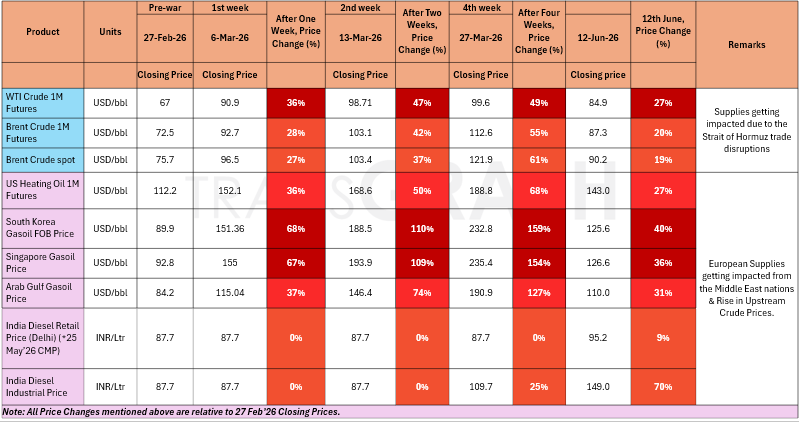
War Impact on Crude Oil & Gasoil/Diesel Prices
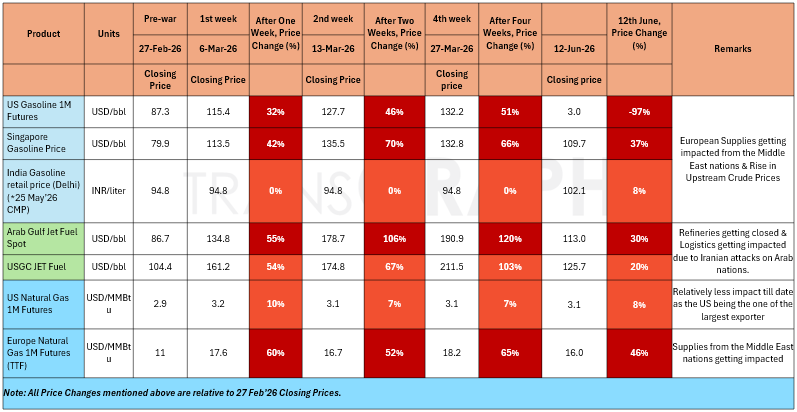
War Impact on Gasoline, ATF & Natural Gas Prices
GCC Bypass Pipelines Running Near Capacity — But Shah Gas Field Ablaze and Fujairah Zone Struck
- Saudi Arabia's East-West pipeline is pumping oil at its full capacity of 7 MBpd, bypassing the Strait of Hormuz. Crude oil exports from Yanbu port have reached 5 MBpd, and the country is also exporting 0.70 to 0.90 MBpd of oil products.
- Of approximately 15 MBpd of crude transiting the Strait of Hormuz in OND'25, combined SPR releases and bypass pipeline capacity can offset roughly two-thirds — or slightly more — for the next 20 to 30 days, providing the Trump administration a window to assess strategic direction.
- New strikes directly threaten this buffer — Iranian drones struck the UAE's Shah gas field (currently ablaze) and the Fujairah Oil Industry Zone on Mar 17. A tanker was also hit near the Strait of Hormuz. Saudi Arabia intercepted over a dozen drones; Kuwait and Bahrain sustained additional attacks. These represent the first direct strikes on GCC energy export infrastructure since the conflict began.
Supply & Demand Analysis
War Scenarios Point to Global Supply Deficit of 1.35–1.90 MBpd in 2026 and AMJ Quarter Most Severe with a deficit of 3.00 - 4.50 MBpd.
Pre-war, global supply and demand were near-balanced with a modest surplus of +0.55 MBpd projected for 2026. Both conflict scenarios introduce significant supply deficits driven by Strait of Hormuz disruptions and impacts on Iraq and Kuwait crude production.
- Scenario 1 (Preferred): Ceasefire talks to remain on a progressive note and flows through the Strait of Hormuz improving over the coming weeks; however crude oil production losses will be there due to further non-availability of storage on on-shore in Iraq, Kuwait and other small Middle East nations.
- Scenario 2 (Alternate): No major deal being achieved from ceasefire talks and post completion of ceasefire talks, tensions continuing to remain in the Middle East and flows through the Strait of Hormuz continuing to remain restrained. Crude Oil Production Facilities & Refining Centers in the Middle East region getting affected and trade disruptions in Strait of Hormuz will be there for medium to long term (4 to 7 months).
Brent Crude 1M Futures are expected to trade in a range of 100 USD/bbl to 125 USD/bbl over the coming 1 to 2 weeks. The coordinated SPR release and GCC bypass capacity provide a meaningful supply cushion that limits sustained upside beyond these levels.
Metals & Energy Market Update – Geopolitical Context (Iran Conflict)
Geopolitical backdrop:
Israel and Iran traded the worst exchange of fire since the April truce, with Iran firing missiles at Israeli targets and Israel carrying out strikes on western and central Iran. Brent bounced back strongly as renewed tensions stoked fresh supply fears and Hormuz near-closure continues to put a structural floor under prices. Equities saw sharp selloff in Asia at the open as well, with Kospi down by 14%, Nikkei down by 1.31% and Nifty down by 1.2%, S&P down by 2.64%, and Nasdaq registered a heavy sell-off and marked a 4.18% loss. Higher energy, slower growth, and limited room for rate cuts keep yields elevated. Safe-haven flows are rotating into money markets and short-duration paper.
Steel:
- Domestic steel prices have moderated from recent highs.
- Steel supply chains remain largely insulated from the Middle East conflict.
- Since, the start of war steel HRC prices are up by 8.7%.
Base metals:
- Copper ended last week down by 1%, primarily due to stronger dollar and weak demand.
- Aluminum rose by 18.3% since start of war linked to Gulf region supply disruptions. However, demand softness now driving price action.
- IMF downgraded 2026 global growth to 3.1% (from 3.3% earlier and 3.4% in 2025), highlighting war-related downside risks.
Precious metals:
- Volatility has eased, but prices face upward pressure, due to improving market sentiment in peace talks.
- However, any esclation and halt in a resolution will pressure on Precious Metals.
- Stronger U.S. yields and weak industrial offtake—especially auto—are suppressing any upside momentum.
LPG Market Update - 09 June 2026
- India’s LPG market saw another upward revision on 1st June 2026 , with oil marketing companies increasing commercial cylinder prices. Commercial LPG prices were raised across major cities, with the 19 kg cylinder in Delhi increasing by Rs 42 to Rs 3,113.50. Similar hikes were reported nationwide, ranging from Rs 42 to Rs 53.50 per cylinder.
India’s domestic LPG market witnessed a price revision on 7 June 2026, with Oil Marketing Companies (OMCs) increasing the price of the 14.2 kg domestic LPG cylinder by ₹29 per cylinder across the country. - In addition to commercial cylinders, oil marketing companies also increased the price of 5 kg Free Trade LPG (FTL) cylinders by Rs 11. Following the revision, the retail price of a 5 kg FTL cylinder in Delhi now stands at Rs 821.50. FTL cylinders are sold outside the subsidized domestic LPG system and are commonly used by migrant workers, temporary households, street vendors, and consumers requiring smaller LPG packs.
Impact Assessment of US/Israel-Iran Conflict
- Sharp escalation in the US–Iran conflict, with both sides exchanging air and missile attacks after the downing of a US helicopter near the Strait of Hormuz, while President Trump threatened further bombing unless Iran immediately agrees to a peace deal.
- The fighting has raised oil prices, disrupted global energy supplies, increased regional tensions involving Lebanon and Hezbollah, and further endangered efforts to negotiate an end to the months-long war.
- The US EIA forecasts OECD oil inventories will fall below 2.3 bln bbl by Dec'26, the lowest level since records began in 2003, as the market compensates for roughly MBpd of lost Middle Eastern oil output linked to disruptions around the Strait of Hormuz.
- The agency expects elevated oil prices, with Brent crude averaging about 105 USD/bbl in Jun'26 and Jul'26, and now forecasts global oil demand to decline by 1.1 MBpd in 2026, reversing its earlier expectation of a 0.2 MBpd increase due to high prices, reduced fuel availability, and conservation measures.
- On 10th Jun'26, the US launched strikes on Iranian military targets near the Strait of Hormuz after Trump said Iran had downed a US Apache helicopter, prompting Iranian retaliatory drone attacks against the US Fifth Fleet in Bahrain and increasing concerns over the fragile ceasefire and ongoing peace negotiations.
- Russia's crude exports from its western ports (Primorsk, Ust-Luga, and Novorossiysk) are expected to fall sharply to 1.7 MBpd in Jun'26 from 2.5 MBpd in May'26, as the country diverts more crude to domestic refineries and seeks to increase refinery runs by 0.25–0.40 MBpd to address seasonal fuel shortages.
- Russian oil production has been declining due to refinery maintenance and Ukrainian drone attacks, with output estimated to have fallen 0.30–0.40 MBpd in Apr'26 (the largest drop since 2020) and a further 0.10 MBpd in May'26, while recovery is expected to take time.
- Abu Dhabi National Oil Company has issued its second crude oil tender within a week, offering up to 2 mln bbl of Upper Zakum, Umm Lulu, and Das crude for Jun'26–Aug'26 loading.
- The move highlights ADNOC's efforts to maintain exports despite disruptions around the Strait of Hormuz, with some shipments reportedly transported using tankers with tracking systems turned off and completed via ship-to-ship transfers or direct deliveries to buyers.
- India recently increased the price of aviation turbine fuel (ATF) for domestic airlines by 10%, raising it from ₹105 per litre to ₹115 per litre under a new government-backed price stabilization scheme that allows carriers to lock in fuel rates for up to three years.
- The hike, which took effect on 09th Jun'26, comes despite earlier efforts to shield airlines from volatile global oil prices and is expected to increase airline operating costs and put upward pressure on airfares.
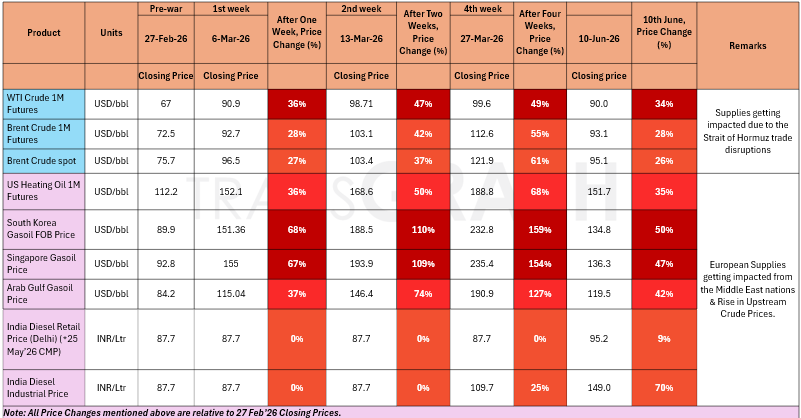
War Impact on Crude Oil & Gasoil/Diesel Prices
War Impact on Gasoline, ATF & Natural Gas Prices
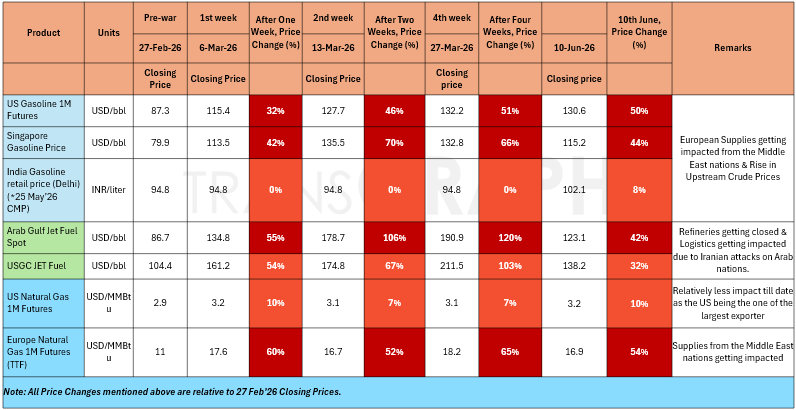
GCC Bypass Pipelines Running Near Capacity — But Shah Gas Field Ablaze and Fujairah Zone Struck
- Saudi Arabia's East-West pipeline is pumping oil at its full capacity of 7 MBpd, bypassing the Strait of Hormuz. Crude oil exports from Yanbu port have reached 5 MBpd, and the country is also exporting 0.70 to 0.90 MBpd of oil products.
- Of approximately 15 MBpd of crude transiting the Strait of Hormuz in OND'25, combined SPR releases and bypass pipeline capacity can offset roughly two-thirds — or slightly more — for the next 20 to 30 days, providing the Trump administration a window to assess strategic direction.
- New strikes directly threaten this buffer — Iranian drones struck the UAE's Shah gas field (currently ablaze) and the Fujairah Oil Industry Zone on Mar 17. A tanker was also hit near the Strait of Hormuz. Saudi Arabia intercepted over a dozen drones; Kuwait and Bahrain sustained additional attacks. These represent the first direct strikes on GCC energy export infrastructure since the conflict began.
Supply & Demand Analysis
War Scenarios Point to Global Supply Deficit of 1.35–1.90 MBpd in 2026 and AMJ Quarter Most Severe with a deficit of 3.00 - 4.50 MBpd.
Pre-war, global supply and demand were near-balanced with a modest surplus of +0.55 MBpd projected for 2026. Both conflict scenarios introduce significant supply deficits driven by Strait of Hormuz disruptions and impacts on Iraq and Kuwait crude production.
- Scenario 1 (Preferred): Ceasefire talks to remain on a progressive note and flows through the Strait of Hormuz improving over the coming weeks; however crude oil production losses will be there due to further non-availability of storage on on-shore in Iraq, Kuwait and other small Middle East nations.
- Scenario 2 (Alternate): No major deal being achieved from ceasefire talks and post completion of ceasefire talks, tensions continuing to remain in the Middle East and flows through the Strait of Hormuz continuing to remain restrained. Crude Oil Production Facilities & Refining Centers in the Middle East region getting affected and trade disruptions in Strait of Hormuz will be there for medium to long term (4 to 7 months).
Brent Crude 1M Futures are expected to trade in a range of 100 USD/bbl to 125 USD/bbl over the coming 1 to 2 weeks. The coordinated SPR release and GCC bypass capacity provide a meaningful supply cushion that limits sustained upside beyond these levels.
Metals & Energy Market Update – Geopolitical Context (Iran Conflict)
Geopolitical backdrop:
Israel and Iran traded the worst exchange of fire since the April truce, with Iran firing missiles at Israeli targets and Israel carrying out strikes on western and central Iran. Brent bounced back strongly as renewed tensions stoked fresh supply fears and Hormuz near-closure continues to put a structural floor under prices. Equities saw sharp selloff in Asia at the open as well, with Kospi down by 14%, Nikkei down by 1.31% and Nifty down by 1.2%, S&P down by 2.64%, and Nasdaq registered a heavy sell-off and marked a 4.18% loss. Higher energy, slower growth, and limited room for rate cuts keep yields elevated. Safe-haven flows are rotating into money markets and short-duration paper.
Steel:
- Domestic steel prices have moderated from recent highs.
- Steel supply chains remain largely insulated from the Middle East conflict.
- Since, the start of war steel HRC prices are up by 8.7%.
Base metals:
- Copper ended last week down by 1%, primarily due to stronger dollar and weak demand.
- Aluminum rose by 18.3% since start of war linked to Gulf region supply disruptions. However, demand softness now driving price action.
- IMF downgraded 2026 global growth to 3.1% (from 3.3% earlier and 3.4% in 2025), highlighting war-related downside risks.
Precious metals:
- Volatility has eased, but prices face upward pressure, due to improving market sentiment in peace talks.
- However, any esclation and halt in a resolution will pressure on Precious Metals.
- Stronger U.S. yields and weak industrial offtake—especially auto—are suppressing any upside momentum.
LPG Market Update - 09 June 2026
- India’s LPG market saw another upward revision on 1st June 2026 , with oil marketing companies increasing commercial cylinder prices. Commercial LPG prices were raised across major cities, with the 19 kg cylinder in Delhi increasing by Rs 42 to Rs 3,113.50. Similar hikes were reported nationwide, ranging from Rs 42 to Rs 53.50 per cylinder.
India’s domestic LPG market witnessed a price revision on 7 June 2026, with Oil Marketing Companies (OMCs) increasing the price of the 14.2 kg domestic LPG cylinder by ₹29 per cylinder across the country. - In addition to commercial cylinders, oil marketing companies also increased the price of 5 kg Free Trade LPG (FTL) cylinders by Rs 11. Following the revision, the retail price of a 5 kg FTL cylinder in Delhi now stands at Rs 821.50. FTL cylinders are sold outside the subsidized domestic LPG system and are commonly used by migrant workers, temporary households, street vendors, and consumers requiring smaller LPG packs.
Impact Assessment of US/Israel-Iran Conflict
- According to market sources citing data from the American Petroleum Institute, US crude oil inventories declined by 9.12 mln bbl in the week ended 05th Jun'26, marking the eighth consecutive weekly draw down.
- Gasoline stocks also fell by 1.19 mln bbl, while distillate inventories, which include diesel and heating oil, increased by 1.32 mln bbl compared with the previous week.
- The US EIA forecasts OECD oil inventories will fall below 2.3 bln bbl by Dec'26, the lowest level since records began in 2003, as the market compensates for roughly MBpd of lost Middle Eastern oil output linked to disruptions around the Strait of Hormuz.
- The agency expects elevated oil prices, with Brent crude averaging about 105 USD/bbl in Jun'26 and Jul'26, and now forecasts global oil demand to decline by 1.1 MBpd in 2026, reversing its earlier expectation of a 0.2 MBpd increase due to high prices, reduced fuel availability, and conservation measures.
- On 10th Jun'26, the US launched strikes on Iranian military targets near the Strait of Hormuz after Trump said Iran had downed a US Apache helicopter, prompting Iranian retaliatory drone attacks against the US Fifth Fleet in Bahrain and increasing concerns over the fragile ceasefire and ongoing peace negotiations.
- On 08th Jun'26, Iran backed militant group Houthis indicates that they would ban Israeli maritime navigation through the red sea, adding pressure on global shipment flows through the key transit routes.
- Russia's crude exports from its western ports (Primorsk, Ust-Luga, and Novorossiysk) are expected to fall sharply to 1.7 MBpd in Jun'26 from 2.5 MBpd in May'26, as the country diverts more crude to domestic refineries and seeks to increase refinery runs by 0.25–0.40 MBpd to address seasonal fuel shortages.
- Russian oil production has been declining due to refinery maintenance and Ukrainian drone attacks, with output estimated to have fallen 0.30–0.40 MBpd in Apr'26 (the largest drop since 2020) and a further 0.10 MBpd in May'26, while recovery is expected to take time.
- Abu Dhabi National Oil Company has issued its second crude oil tender within a week, offering up to 2 mln bbl of Upper Zakum, Umm Lulu, and Das crude for Jun'26–Aug'26 loading.
- The move highlights ADNOC's efforts to maintain exports despite disruptions around the Strait of Hormuz, with some shipments reportedly transported using tankers with tracking systems turned off and completed via ship-to-ship transfers or direct deliveries to buyers.
- India recently increased the price of aviation turbine fuel (ATF) for domestic airlines by 10%, raising it from ₹105 per litre to ₹115 per litre under a new government-backed price stabilization scheme that allows carriers to lock in fuel rates for up to three years.
- The hike, which took effect on 09th Jun'26, comes despite earlier efforts to shield airlines from volatile global oil prices and is expected to increase airline operating costs and put upward pressure on airfares.
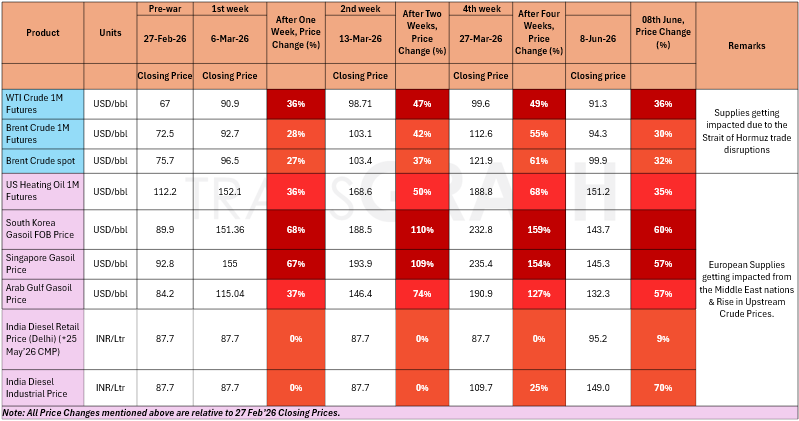
War Impact on Crude Oil & Gasoil/Diesel Prices
War Impact on Gasoline, ATF & Natural Gas Prices
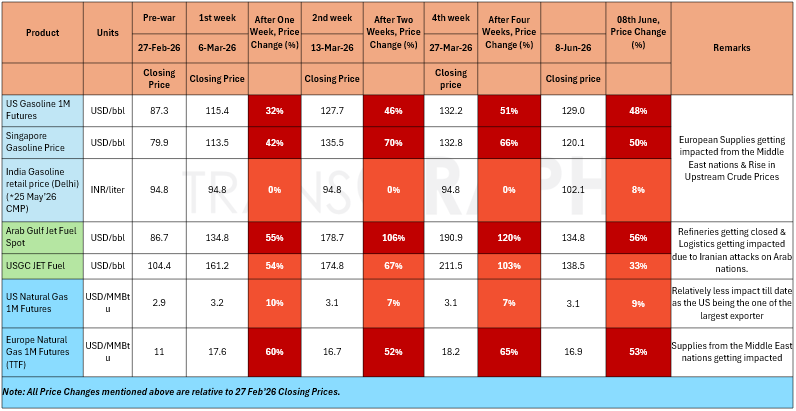
GCC Bypass Pipelines Running Near Capacity — But Shah Gas Field Ablaze and Fujairah Zone Struck
- Saudi Arabia's East-West pipeline is pumping oil at its full capacity of 7 MBpd, bypassing the Strait of Hormuz. Crude oil exports from Yanbu port have reached 5 MBpd, and the country is also exporting 0.70 to 0.90 MBpd of oil products.
- Of approximately 15 MBpd of crude transiting the Strait of Hormuz in OND'25, combined SPR releases and bypass pipeline capacity can offset roughly two-thirds — or slightly more — for the next 20 to 30 days, providing the Trump administration a window to assess strategic direction.
- New strikes directly threaten this buffer — Iranian drones struck the UAE's Shah gas field (currently ablaze) and the Fujairah Oil Industry Zone on Mar 17. A tanker was also hit near the Strait of Hormuz. Saudi Arabia intercepted over a dozen drones; Kuwait and Bahrain sustained additional attacks. These represent the first direct strikes on GCC energy export infrastructure since the conflict began.
Supply & Demand Analysis
War Scenarios Point to Global Supply Deficit of 1.35–1.90 MBpd in 2026 and AMJ Quarter Most Severe with a deficit of 3.00 - 4.50 MBpd.
Pre-war, global supply and demand were near-balanced with a modest surplus of +0.55 MBpd projected for 2026. Both conflict scenarios introduce significant supply deficits driven by Strait of Hormuz disruptions and impacts on Iraq and Kuwait crude production.
- Scenario 1 (Preferred): Ceasefire talks to remain on a progressive note and flows through the Strait of Hormuz improving over the coming weeks; however crude oil production losses will be there due to further non-availability of storage on on-shore in Iraq, Kuwait and other small Middle East nations.
- Scenario 2 (Alternate): No major deal being achieved from ceasefire talks and post completion of ceasefire talks, tensions continuing to remain in the Middle East and flows through the Strait of Hormuz continuing to remain restrained. Crude Oil Production Facilities & Refining Centers in the Middle East region getting affected and trade disruptions in Strait of Hormuz will be there for medium to long term (4 to 7 months).
Brent Crude 1M Futures are expected to trade in a range of 100 USD/bbl to 125 USD/bbl over the coming 1 to 2 weeks. The coordinated SPR release and GCC bypass capacity provide a meaningful supply cushion that limits sustained upside beyond these levels.
Metals & Energy Market Update – Geopolitical Context (Iran Conflict)
Geopolitical backdrop:
Israel and Iran traded the worst exchange of fire since the April truce, with Iran firing missiles at Israeli targets and Israel carrying out strikes on western and central Iran. Brent bounced back strongly as renewed tensions stoked fresh supply fears and Hormuz near-closure continues to put a structural floor under prices. Equities saw sharp selloff in Asia at the open as well, with Kospi down by 14%, Nikkei down by 1.31% and Nifty down by 1.2%, S&P down by 2.64%, and Nasdaq registered a heavy sell-off and marked a 4.18% loss. Higher energy, slower growth, and limited room for rate cuts keep yields elevated. Safe-haven flows are rotating into money markets and short-duration paper.
Steel:
- Domestic steel prices have moderated from recent highs.
- Steel supply chains remain largely insulated from the Middle East conflict.
- Since, the start of war steel HRC prices are up by 8.7%.
Base metals:
- Copper ended last week down by 1%, primarily due to stronger dollar and weak demand.
- Aluminum rose by 18.3% since start of war linked to Gulf region supply disruptions. However, demand softness now driving price action.
- IMF downgraded 2026 global growth to 3.1% (from 3.3% earlier and 3.4% in 2025), highlighting war-related downside risks.
Precious metals:
- Volatility has eased, but prices face upward pressure, due to improving market sentiment in peace talks.
- However, any esclation and halt in a resolution will pressure on Precious Metals.
- Stronger U.S. yields and weak industrial offtake—especially auto—are suppressing any upside momentum.
LPG Market Update - 09 June 2026
- India’s LPG market saw another upward revision on 1st June 2026 , with oil marketing companies increasing commercial cylinder prices. Commercial LPG prices were raised across major cities, with the 19 kg cylinder in Delhi increasing by Rs 42 to Rs 3,113.50. Similar hikes were reported nationwide, ranging from Rs 42 to Rs 53.50 per cylinder.
India’s domestic LPG market witnessed a price revision on 7 June 2026, with Oil Marketing Companies (OMCs) increasing the price of the 14.2 kg domestic LPG cylinder by ₹29 per cylinder across the country. - In addition to commercial cylinders, oil marketing companies also increased the price of 5 kg Free Trade LPG (FTL) cylinders by Rs 11. Following the revision, the retail price of a 5 kg FTL cylinder in Delhi now stands at Rs 821.50. FTL cylinders are sold outside the subsidized domestic LPG system and are commonly used by migrant workers, temporary households, street vendors, and consumers requiring smaller LPG packs.
Impact Assessment of US/Israel-Iran Conflict
- On 08th Jun'26, Iran backed militant group Houthis indicates that they would ban Israeli maritime navigation through the red sea, adding pressure on global shipment flows through the key transit routes.
- Russia's crude exports from its western ports (Primorsk, Ust-Luga, and Novorossiysk) are expected to fall sharply to 1.7 MBpd in Jun'26 from 2.5 MBpd in May'26, as the country diverts more crude to domestic refineries and seeks to increase refinery runs by 0.25–0.40 MBpd to address seasonal fuel shortages.
- Russian oil production has been declining due to refinery maintenance and Ukrainian drone attacks, with output estimated to have fallen 0.30–0.40 MBpd in Apr'26 (the largest drop since 2020) and a further 0.10 MBpd in May'26, while recovery is expected to take time.
- Abu Dhabi National Oil Company has issued its second crude oil tender within a week, offering up to 2 mln bbl of Upper Zakum, Umm Lulu, and Das crude for Jun'26–Aug'26 loading.
- The move highlights ADNOC's efforts to maintain exports despite disruptions around the Strait of Hormuz, with some shipments reportedly transported using tankers with tracking systems turned off and completed via ship-to-ship transfers or direct deliveries to buyers.
- Israel said it struck military targets in western and central Iran on 08th Jun'26 after Iran launched missiles at Israeli targets, despite reports that US President Trump had urged Israeli Prime Minister Benjamin Netanyahu to avoid further attacks while US-Iran peace talks continue.
- Saudi Aramco cut its July crude oil official selling prices (OSPs) to Asia for a second consecutive month, lowering the premium for Arab Light crude by 6.0 USD/bbl to 9.5 USD/bbl above the Dubai/Oman benchmark, reflecting weaker spot market premiums and sluggish demand, particularly from China.
- Despite the reduction, OSPs remain elevated compared to pre-war levels due to ongoing disruptions to energy flows through the Strait of Hormuz caused by the Iran conflict, while prices to other regions were also reduced.
War Impact on Crude Oil & Gasoil/Diesel Prices
War Impact on Gasoline, ATF & Natural Gas Prices
GCC Bypass Pipelines Running Near Capacity — But Shah Gas Field Ablaze and Fujairah Zone Struck
- Saudi Arabia's East-West pipeline is pumping oil at its full capacity of 7 MBpd, bypassing the Strait of Hormuz. Crude oil exports from Yanbu port have reached 5 MBpd, and the country is also exporting 0.70 to 0.90 MBpd of oil products.
- Of approximately 15 MBpd of crude transiting the Strait of Hormuz in OND'25, combined SPR releases and bypass pipeline capacity can offset roughly two-thirds — or slightly more — for the next 20 to 30 days, providing the Trump administration a window to assess strategic direction.
- New strikes directly threaten this buffer — Iranian drones struck the UAE's Shah gas field (currently ablaze) and the Fujairah Oil Industry Zone on Mar 17. A tanker was also hit near the Strait of Hormuz. Saudi Arabia intercepted over a dozen drones; Kuwait and Bahrain sustained additional attacks. These represent the first direct strikes on GCC energy export infrastructure since the conflict began.
Supply & Demand Analysis
War Scenarios Point to Global Supply Deficit of 1.35–1.90 MBpd in 2026 and AMJ Quarter Most Severe with a deficit of 3.00 - 4.50 MBpd.
Pre-war, global supply and demand were near-balanced with a modest surplus of +0.55 MBpd projected for 2026. Both conflict scenarios introduce significant supply deficits driven by Strait of Hormuz disruptions and impacts on Iraq and Kuwait crude production.
- Scenario 1 (Preferred): Ceasefire talks to remain on a progressive note and flows through the Strait of Hormuz improving over the coming weeks; however crude oil production losses will be there due to further non-availability of storage on on-shore in Iraq, Kuwait and other small Middle East nations.
- Scenario 2 (Alternate): No major deal being achieved from ceasefire talks and post completion of ceasefire talks, tensions continuing to remain in the Middle East and flows through the Strait of Hormuz continuing to remain restrained. Crude Oil Production Facilities & Refining Centers in the Middle East region getting affected and trade disruptions in Strait of Hormuz will be there for medium to long term (4 to 7 months).
Brent Crude 1M Futures are expected to trade in a range of 100 USD/bbl to 125 USD/bbl over the coming 1 to 2 weeks. The coordinated SPR release and GCC bypass capacity provide a meaningful supply cushion that limits sustained upside beyond these levels.
Metals & Energy Market Update – Geopolitical Context (Iran Conflict)
Geopolitical backdrop:
Israel and Iran traded the worst exchange of fire since the April truce, with Iran firing missiles at Israeli targets and Israel carrying out strikes on western and central Iran. Brent bounced back strongly as renewed tensions stoked fresh supply fears and Hormuz near-closure continues to put a structural floor under prices. Equities saw sharp selloff in Asia at the open as well, with Kospi down by 14%, Nikkei down by 1.31% and Nifty down by 1.2%, S&P down by 2.64%, and Nasdaq registered a heavy sell-off and marked a 4.18% loss. Higher energy, slower growth, and limited room for rate cuts keep yields elevated. Safe-haven flows are rotating into money markets and short-duration paper.
Steel:
- Domestic steel prices have moderated from recent highs.
- Steel supply chains remain largely insulated from the Middle East conflict.
- Since, the start of war steel HRC prices are up by 8.7%.
Base metals:
- Copper ended last week down by 1%, primarily due to stronger dollar and weak demand.
- Aluminum rose by 18.3% since start of war linked to Gulf region supply disruptions. However, demand softness now driving price action.
- IMF downgraded 2026 global growth to 3.1% (from 3.3% earlier and 3.4% in 2025), highlighting war-related downside risks.
Precious metals:
- Volatility has eased, but prices face upward pressure, due to improving market sentiment in peace talks.
- However, any esclation and halt in a resolution will pressure on Precious Metals.
- Stronger U.S. yields and weak industrial offtake—especially auto—are suppressing any upside momentum.
LPG Market Update - 09 June 2026
- India’s LPG market saw another upward revision on 1st June 2026 , with oil marketing companies increasing commercial cylinder prices. Commercial LPG prices were raised across major cities, with the 19 kg cylinder in Delhi increasing by Rs 42 to Rs 3,113.50. Similar hikes were reported nationwide, ranging from Rs 42 to Rs 53.50 per cylinder.
India’s domestic LPG market witnessed a price revision on 7 June 2026, with Oil Marketing Companies (OMCs) increasing the price of the 14.2 kg domestic LPG cylinder by ₹29 per cylinder across the country. - In addition to commercial cylinders, oil marketing companies also increased the price of 5 kg Free Trade LPG (FTL) cylinders by Rs 11. Following the revision, the retail price of a 5 kg FTL cylinder in Delhi now stands at Rs 821.50. FTL cylinders are sold outside the subsidized domestic LPG system and are commonly used by migrant workers, temporary households, street vendors, and consumers requiring smaller LPG packs.
Impact Assessment of US/Israel-Iran Conflict
- Israel said it struck military targets in western and central Iran on 08th Jun'26 after Iran launched missiles at Israeli targets, despite reports that US President Trump had urged Israeli Prime Minister Benjamin Netanyahu to avoid further attacks while US-Iran peace talks continue.
- Saudi Aramco cut its July crude oil official selling prices (OSPs) to Asia for a second consecutive month, lowering the premium for Arab Light crude by 6.0 USD/bbl to 9.5 USD/bbl above the Dubai/Oman benchmark, reflecting weaker spot market premiums and sluggish demand, particularly from China.
- Despite the reduction, OSPs remain elevated compared to pre-war levels due to ongoing disruptions to energy flows through the Strait of Hormuz caused by the Iran conflict, while prices to other regions were also reduced.
- Trump insisted that the latest strikes would not derail efforts to reach a deal with Iran, claiming the negotiations remain close to success, while Iran warned that US bases and Israeli assets remain legitimate targets if hostilities continue.
- The US crude stocks drew more than expected last week as export and refining demand remained strong, with many countries in Asia and Europe seeking to replace Middle Eastern oil and fuel supplies cut off by the Iran war. Crude inventories fell by 8 mln bbl to 433.7 mln bbl, and oil exports touched 5.9 MBpd, the second-highest level on record.
- According to the International Energy Agency, global oil inventories could reach critical levels before the peak summer demand period if stock draws continue at their current pace.
- Demand typically peaks during Northern Hemisphere summer holidays. In the best-case scenario, it could take six to eight months to reopen the Strait of Hormuz if an agreement was reached today, which could lead to a possible coordinated emergency stock release by the IEA, but not currently being discussed as half of the initial 400 mln bbl coordinated release from Mar'26 is yet to hit the market.
- The US crude exports reached a record high of 5.6 MBpd in May'26 due to the Middle East crisis, which increased demand from Asian and European refiners. The US and Israel's war with Iran disrupted global energy markets, causing refiners to seek alternatives to Middle Eastern supply. US crude exports surged past the previous record set in Apr'26 of 5.2 MBpd, with Asia taking 2.45 MBpd and Europe 2.4 MBpd of the barrels exported in May'26.
War Impact on Crude Oil & Gasoil/Diesel Prices
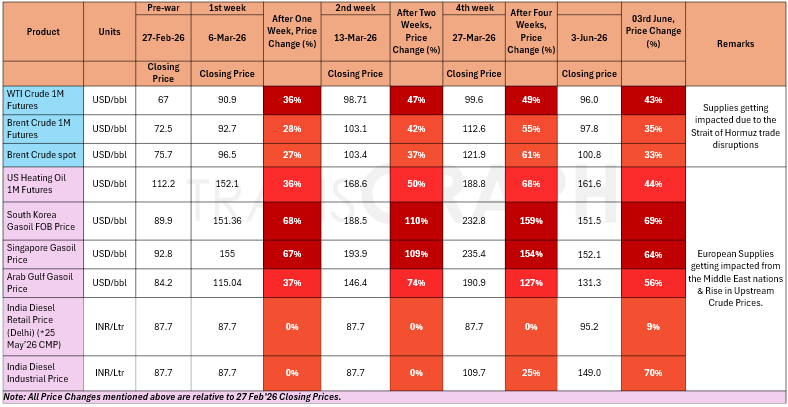
War Impact on Gasoline, ATF & Natural Gas Prices
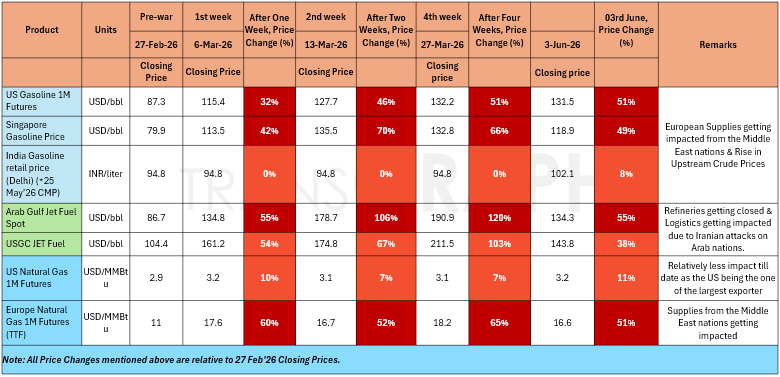
GCC Bypass Pipelines Running Near Capacity — But Shah Gas Field Ablaze and Fujairah Zone Struck
- Saudi Arabia's East-West pipeline is pumping oil at its full capacity of 7 MBpd, bypassing the Strait of Hormuz. Crude oil exports from Yanbu port have reached 5 MBpd, and the country is also exporting 0.70 to 0.90 MBpd of oil products.
- Of approximately 15 MBpd of crude transiting the Strait of Hormuz in OND'25, combined SPR releases and bypass pipeline capacity can offset roughly two-thirds — or slightly more — for the next 20 to 30 days, providing the Trump administration a window to assess strategic direction.
- New strikes directly threaten this buffer — Iranian drones struck the UAE's Shah gas field (currently ablaze) and the Fujairah Oil Industry Zone on Mar 17. A tanker was also hit near the Strait of Hormuz. Saudi Arabia intercepted over a dozen drones; Kuwait and Bahrain sustained additional attacks. These represent the first direct strikes on GCC energy export infrastructure since the conflict began.
Supply & Demand Analysis
War Scenarios Point to Global Supply Deficit of 1.35–1.90 MBpd in 2026 and AMJ Quarter Most Severe with a deficit of 3.00 - 4.50 MBpd.
Pre-war, global supply and demand were near-balanced with a modest surplus of +0.55 MBpd projected for 2026. Both conflict scenarios introduce significant supply deficits driven by Strait of Hormuz disruptions and impacts on Iraq and Kuwait crude production.
- Scenario 1 (Preferred): Ceasefire talks to remain on a progressive note and flows through the Strait of Hormuz improving over the coming weeks; however crude oil production losses will be there due to further non-availability of storage on on-shore in Iraq, Kuwait and other small Middle East nations.
- Scenario 2 (Alternate): No major deal being achieved from ceasefire talks and post completion of ceasefire talks, tensions continuing to remain in the Middle East and flows through the Strait of Hormuz continuing to remain restrained. Crude Oil Production Facilities & Refining Centers in the Middle East region getting affected and trade disruptions in Strait of Hormuz will be there for medium to long term (4 to 7 months).
Brent Crude 1M Futures are expected to trade in a range of 100 USD/bbl to 125 USD/bbl over the coming 1 to 2 weeks. The coordinated SPR release and GCC bypass capacity provide a meaningful supply cushion that limits sustained upside beyond these levels.
Metals & Energy Market Update – Geopolitical Context (Iran Conflict)
Geopolitical backdrop:
Israel and Iran traded the worst exchange of fire since the April truce, with Iran firing missiles at Israeli targets and Israel carrying out strikes on western and central Iran. Brent bounced back strongly as renewed tensions stoked fresh supply fears and Hormuz near-closure continues to put a structural floor under prices. Equities saw sharp selloff in Asia at the open as well, with Kospi down by 14%, Nikkei down by 1.31% and Nifty down by 1.2%, S&P down by 2.64%, and Nasdaq registered a heavy sell-off and marked a 4.18% loss. Higher energy, slower growth, and limited room for rate cuts keep yields elevated. Safe-haven flows are rotating into money markets and short-duration paper.
Steel:
- Domestic steel prices have moderated from recent highs.
- Steel supply chains remain largely insulated from the Middle East conflict.
- Since, the start of war steel HRC prices are up by 8.7%.
Base metals:
- Copper ended last week down by 1%, primarily due to stronger dollar and weak demand.
- Aluminum rose by 18.3% since start of war linked to Gulf region supply disruptions. However, demand softness now driving price action.
- IMF downgraded 2026 global growth to 3.1% (from 3.3% earlier and 3.4% in 2025), highlighting war-related downside risks.
Precious metals:
- Volatility has eased, but prices face upward pressure, due to improving market sentiment in peace talks.
- However, any esclation and halt in a resolution will pressure on Precious Metals.
- Stronger U.S. yields and weak industrial offtake—especially auto—are suppressing any upside momentum.
LPG Market Update - 02 June 2026
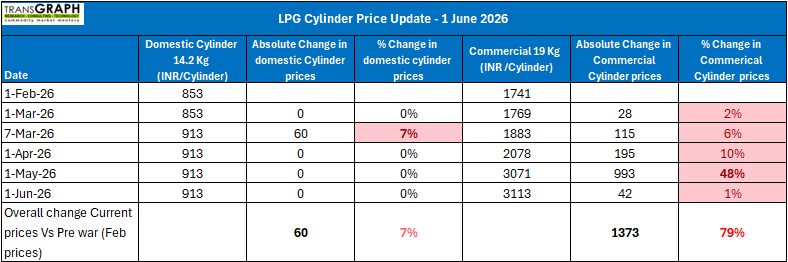
- India's LPG market saw another upward revision on 1st June 2026 , with oil marketing companies increasing commercial cylinder prices Commercial LPG prices were raised across major cities, with the 19 kg cylinder in Delhi increasing by Rs 42 to Rs 3,113.50. Similar hikes were reported nationwide, ranging from Rs 42 to Rs 53.50 per cylinder. Kolkata recorded the sharpest increase of Rs 53.50, taking prices to Rs 3,255.50, while Hyderabad and Bhubaneswar saw hikes of Rs 52 each. Mumbai's commercial LPG price rose by Rs 43.50 to Rs 3,067.50, and Chennai's rate increased by Rs 46 to Rs 3,283.00.
- In addition to commercial cylinders, oil marketing companies also increased the price of 5 kg Free Trade LPG (FTL) cylinders by Rs 11. Following the revision, the retail price of a 5 kg FTL cylinder in Delhi now stands at Rs 821.50. FTL cylinders are sold outside the subsidized domestic LPG system and are commonly used by migrant workers, temporary households, street vendors, and consumers requiring smaller LPG packs.
- For June, Saudi Aramco CPs increased further to USD 760/ton for propane and USD 820/ton for butane, reflecting continued market tightness and persistent concerns over Middle East supply security.
In contrast, Algeria's Sonatrach moved in the opposite direction, implementing substantial reductions in its June LPG benchmarks. Propane prices were cut by USD 125/ton to USD 575/ton, representing an 18% decline from May levels. Butane experienced an even sharper correction, falling by USD 270/ton to USD 610/ton, a drop of approximately 31%.
Impact Assessment of US/Israel-Iran Conflict
- The US crude exports reached a record high of 5.6 MBpd in May'26 due to the Middle East crisis, which increased demand from Asian and European refiners. The US and Israel's war with Iran disrupted global energy markets, causing refiners to seek alternatives to Middle Eastern supply. US crude exports surged past the previous record set in Apr'26 of 5.2 MBpd, with Asia taking 2.45 MBpd and Europe 2.4 MBpd of the barrels exported in May'26.
- According to market grapevines the Lukoil-owned Volgograd oil refinery in Russia's south has suspended oil processing since 29th May'26 due to a Ukrainian drone attack that caused fire and damages. The attack has halted the crude distillation unit CDU-1, which accounts for 40% of the plant's capacity, and stopped other units CDU-6 and CDU-5.
- The refinery processed 13.5 million metric tons of oil in 2024, accounting for 5% of total Russian refinery volume, producing 6 million tons of diesel, 1.9 million tons of gasoline, and 700,000 tons of fuel oil.
- Iran is seeking a limited interim agreement with the United States to ease economic pressure, stabilise the situation at home, and avoid major concessions on its nuclear programme. The approach reflects a familiar playbook for the Islamic Republic: absorb pressure, avoid irreversible compromises and keep negotiations alive without shifting core positions.
- India will cut its export duties on petrol, diesel, and aviation turbine fuel (ATF) for the fortnight starting 01st Jun'26, based on average international prices of crude oil, petrol, diesel, and ATF since the last review. The duty on exports of petrol has been set at 1.5 rupees per litre, while that on diesel has been set at 13.5 rupees per litre.
- Export duties on ATF have been set at 9.5 rupees per litre. There is no change in the existing excise duty rates on petrol and diesel cleared for domestic consumption.
- China's seaborne crude oil imports fell to their lowest in almost 10 years in May, dropping to 6.36 MBpd, due to the impact of the Iran war and the closure of the Strait of Hormuz.
- The collapse in China's imports is being framed as helping Asia adjust to the loss of at least 10 MBpd of crude, but it is a serendipitous side effect rather than any altruism on Beijing's part.
- The primary driver behind the collapse in China's oil imports is the conflict in the Middle East, but the real challenge is in working out the why and how of what China is doing to adapt to the loss of as much as 10% of global crude supplies from the Iran conflict.
- According to the Energy Information Administration the US crude production remained steady at 13.7 MBpd in Mar'26. Texas crude output fell to a four-month low, while New Mexico production was unchanged. The US crude production is expected to rise as operators increase output in response to high oil prices due to the Iran war.
- Venezuela's oil exports rose to 1.25 MBpd in May'26, marking the third consecutive month of increase, driven by more cargoes to the US, India, and Europe. Under the US-supported government of interim President Rodriguez, Venezuelan crude production and exports have bounced this year as Washington eased sanctions and foreign companies expanded oil and gas projects in the OPEC nation.
War Impact on Crude Oil & Gasoil/Diesel Prices
War Impact on Gasoline, ATF & Natural Gas Prices
GCC Bypass Pipelines Running Near Capacity — But Shah Gas Field Ablaze and Fujairah Zone Struck
- Saudi Arabia's East-West pipeline is pumping oil at its full capacity of 7 MBpd, bypassing the Strait of Hormuz. Crude oil exports from Yanbu port have reached 5 MBpd, and the country is also exporting 0.70 to 0.90 MBpd of oil products.
- Of approximately 15 MBpd of crude transiting the Strait of Hormuz in OND'25, combined SPR releases and bypass pipeline capacity can offset roughly two-thirds — or slightly more — for the next 20 to 30 days, providing the Trump administration a window to assess strategic direction.
- New strikes directly threaten this buffer — Iranian drones struck the UAE's Shah gas field (currently ablaze) and the Fujairah Oil Industry Zone on Mar 17. A tanker was also hit near the Strait of Hormuz. Saudi Arabia intercepted over a dozen drones; Kuwait and Bahrain sustained additional attacks. These represent the first direct strikes on GCC energy export infrastructure since the conflict began.
Supply & Demand Analysis
War Scenarios Point to Global Supply Deficit of 1.35–1.90 MBpd in 2026 and AMJ Quarter Most Severe with a deficit of 3.00 - 4.50 MBpd.
Pre-war, global supply and demand were near-balanced with a modest surplus of +0.55 MBpd projected for 2026. Both conflict scenarios introduce significant supply deficits driven by Strait of Hormuz disruptions and impacts on Iraq and Kuwait crude production.
- Scenario 1 (Preferred): Ceasefire talks to remain on a progressive note and flows through the Strait of Hormuz improving over the coming weeks; however crude oil production losses will be there due to further non-availability of storage on on-shore in Iraq, Kuwait and other small Middle East nations.
- Scenario 2 (Alternate): No major deal being achieved from ceasefire talks and post completion of ceasefire talks, tensions continuing to remain in the Middle East and flows through the Strait of Hormuz continuing to remain restrained. Crude Oil Production Facilities & Refining Centers in the Middle East region getting affected and trade disruptions in Strait of Hormuz will be there for medium to long term (4 to 7 months).
Brent Crude 1M Futures are expected to trade in a range of 100 USD/bbl to 125 USD/bbl over the coming 1 to 2 weeks. The coordinated SPR release and GCC bypass capacity provide a meaningful supply cushion that limits sustained upside beyond these levels.
Metals & Energy Market Update – Geopolitical Context (Iran Conflict)
Geopolitical backdrop:

The ongoing conflict in the Middle East, continues to weigh on global markets and keeping inflation expectations elevated. The war-driven rise in energy prices has heightened concerns about higher transportation and manufacturing costs globally, adding further pressure to already elevated inflation. At the same time, elevated crude prices continue to weigh on emerging markets and developing economies, particularly large energy-importing nations, as higher import bills and currency pressures weaken economic stability and complicate monetary policy decisions in the nearterm.
Steel:
- Domestic steel prices have moderated from recent highs.
- Steel supply chains remain largely insulated from the Middle East conflict.
- Since, the start of war steel HRC prices are up by 9.0%.
Base metals:
- Copper ended last week up by 0.5%, primarily due to widening LME-CME spread.
- Aluminum rose by 19.4% since start of war linked to Gulf region supply disruptions. However, demand softness now driving price action.
- IMF downgraded 2026 global growth to 3.1% (from 3.3% earlier and 3.4% in 2025), highlighting war-related downside risks.
Precious metals:
- Volatility has eased, but prices face upward pressure, due to improving market sentiment in peace talks.
- However, any esclation and halt in a resolution will pressure on Precious Metals.
- Stronger U.S. yields and weak industrial offtake—especially auto—are suppressing any upside momentum.
LPG Market Update - 02 June 2026
- India's LPG market saw another upward revision on 1st June 2026 , with oil marketing companies increasing commercial cylinder prices Commercial LPG prices were raised across major cities, with the 19 kg cylinder in Delhi increasing by Rs 42 to Rs 3,113.50. Similar hikes were reported nationwide, ranging from Rs 42 to Rs 53.50 per cylinder. Kolkata recorded the sharpest increase of Rs 53.50, taking prices to Rs 3,255.50, while Hyderabad and Bhubaneswar saw hikes of Rs 52 each. Mumbai's commercial LPG price rose by Rs 43.50 to Rs 3,067.50, and Chennai's rate increased by Rs 46 to Rs 3,283.00.
- In addition to commercial cylinders, oil marketing companies also increased the price of 5 kg Free Trade LPG (FTL) cylinders by Rs 11. Following the revision, the retail price of a 5 kg FTL cylinder in Delhi now stands at Rs 821.50. FTL cylinders are sold outside the subsidized domestic LPG system and are commonly used by migrant workers, temporary households, street vendors, and consumers requiring smaller LPG packs.
- For June, Saudi Aramco CPs increased further to USD 760/ton for propane and USD 820/ton for butane, reflecting continued market tightness and persistent concerns over Middle East supply security.
In contrast, Algeria's Sonatrach moved in the opposite direction, implementing substantial reductions in its June LPG benchmarks. Propane prices were cut by USD 125/ton to USD 575/ton, representing an 18% decline from May levels. Butane experienced an even sharper correction, falling by USD 270/ton to USD 610/ton, a drop of approximately 31%.
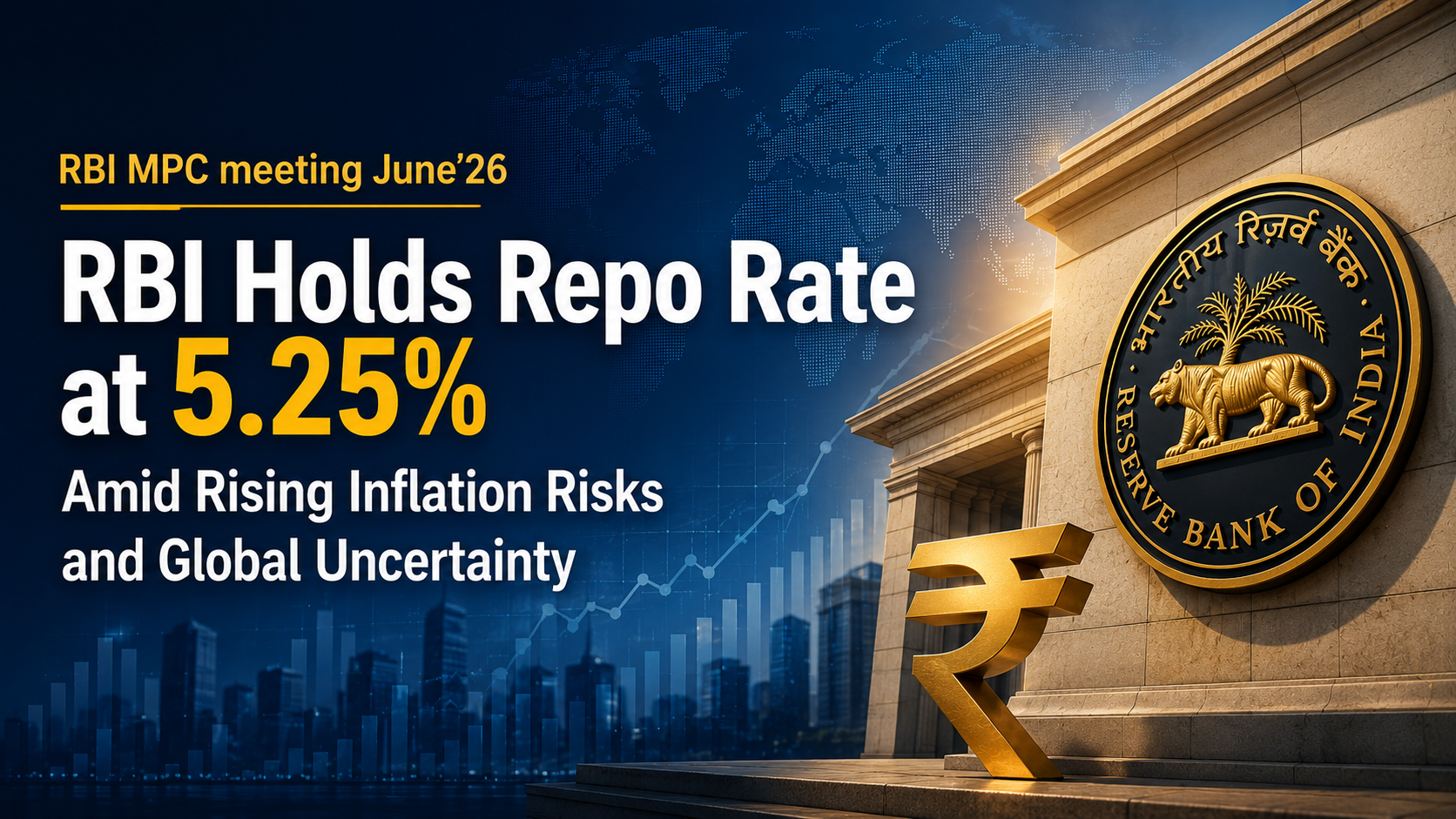
RBI MPC meeting June’26
RBI Holds Repo Rate at 5.25% Amid Rising Inflation Risks and Global Uncertainty
- The Reserve Bank of India’s Monetary Policy Committee (MPC) unanimously decided to keep the repo rate unchanged at 5.25% during its June 3–5, 2026 meeting, while maintaining a neutral policy stance. The Standing Deposit Facility (SDF), the Marginal Standing Facility (MSF) and Bank Rate were also held constantly at the level observed at April MPC meet.
| RBI June Policy Decision | Policy Repo Rate | SDF (Standing Facility Rate) | MSF (Marginal Standing Facility) | Bank Rate |
| Previous Rate | 5.25% | 5.00% | 5.50% | 5.50% |
| New Rate | 5.25% | 5.00% | 5.50% | 5.50% |
| New Change | Neutral | Neutral | Neutral | Neutral |
- The decision reflects growing uncertainty stemming from prolonged geopolitical tensions in West Asia, rising energy prices, supply chain disruptions, and weather-related risks.
- The RBI noted that domestic economic activity has remained relatively stable despite external challenges, supported by steady private consumption, ongoing investment activity, strong services exports, and capital expenditure. However, elevated commodity prices, higher import costs, potential supply disruptions, and a forecast of a deficient southwest monsoon are expected to weigh on growth prospects going forward.
- Considering these factors, On the Growth side, RBI projected India’s real GDP growth at 6.6% for FY2026-27, while warning that prolonged global disruptions, financial market volatility, and adverse weather conditions remain key downside risks.
- On inflation front, headline CPI rose to 3.48% in April 2026, but the RBI expects price pressures to strengthen in the coming quarters due to higher fuel prices, rising input costs, and possible second-round effects on wages and inflation expectations. Consequently, CPI inflation is projected at 5.1% for FY2026-27, with inflation expected to approach the upper end of the RBI’s tolerance band during the third quarter.
|
RBI Economic Projections — Jun’26 Policy Meet |
|||||
|
FY27 |
|||||
| Q1 | Q2 | Q3 | Q4 | Full Year | |
| Growth Projection | 6.6% | 6.3% | 6.5% | 6.8% | 6.6% |
| Apr’26 projections | 6.8% | 6.7% | 7.0% | 7.2% | 6.9% |
| Change from Apr’26 | -0.2% | -0.4% | -0.5% | -0.4% | -0.3% |
| CPI projections | 4.2% | 5.1% | 5.9% | 5.4% | 5.1% |
| Apr’26 projections | 4.0% | 4.4% | 5.2% | 4.7% | 4.6% |
| Change from Apr’26 | 0.2% | 0.7% | 0.7% | 0.7% | 0.5% |
| Source- RBI April and June Projection | |||||
- In addition to it, RBI has opted to support the Indian Rupee by attracting foreign currency inflows. As part of this effort, the central bank announced a series of measures, including relaxation of regulations governing FCNR(B) and NRE deposits to encourage greater participation from Non-Resident Indians, easing overseas borrowing norms for banks and corporates, and providing incentives aimed at attracting foreign investment into Indian debt markets.
In conclusion, while these measures are supportive for the currency in the near term, their effectiveness will largely depend on external factors such as crude oil prices, geopolitical developments in the Middle East, and the direction of foreign capital flows. With FII outflows remaining elevated and energy market risks persisting, the Rupee could continue to face depreciation pressures despite the RBI’s efforts to bolster dollar inflows.
- The next meeting of the MPC is scheduled for August 3 to 5, 2026.
Stay ahead of market shifts with timely macroeconomic insights, inflation outlooks, currency trends, and commodity market intelligence. Strengthen your procurement and sourcing decisions with data-driven forecasts and expert analysis: Subscribe to our services