
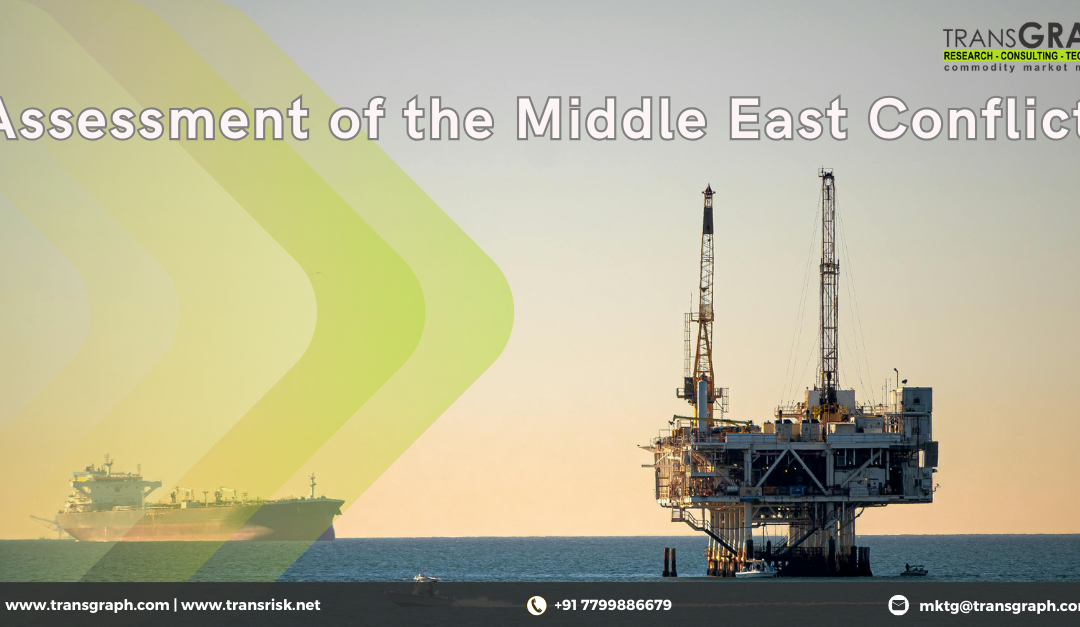
On 28th Feb’26, geopolitical tensions in the Middle East region got significantly escalated after the US-Israel joint military operation on Iran (killing top leaders including Iran’s supreme leader Ayatollah Ali Khamenei, Abdolrahim Mousavi, Ali Shamkhani, Hossein Jabal Amelian, Mohammad Shirazi, and Gholamreza Rezaian), sparking serious concerns of a broader regional conflict in the Middle East, a region vital to global oil supply. Iran swiftly retaliated against the joint US–Israel strikes by launching waves of drones and ballistic missiles towards Israeli territory, the US military assets across the Gulf region and the other Gulf nation’s major infrastructure facilities & airports, broadening the geographic scope of the confrontation beyond a single theater. Air defense systems were activated across Israel & the other Gulf nations, and heightened alerts were issued around key infrastructure and energy facilities. The escalation triggered widespread aviation disruption, with airspace closures and restrictions imposed over Iran, Israel, the UAE, Saudi Arabia, Bahrain, Iraq, and Jordan, prompting major international carriers to reroute or cancel flights. The proximity of missiles activity to critical oil infrastructure and strategic transit corridors intensified market fears of supply disruptions, compounding volatility across energy and shipping markets.
Following these developments, Brent crude oil 1M Futures prices surged by 13.6% to the highest level since 17th Jan’25 of 82.4 USD/bbl (intraday on 02nd Mar’26) from 27th Feb’26 closing price of 72.5 USD/bbl. Crude oil prices rose sharply higher at the open of markets on 02nd Mar’26, amid anticipation of Crude Oil & its products trade getting affected through the Strait of Hormuz (from where Saudi Arabia, Iraq, the UAE & Kuwait crude oil & its products exports pass through) and the Red Sea for a medium to long term. Around 20 MBpd trade of Crude oil & its products happened through the Strait of Hormuz in OND’25 (of which close to 15 MBpd trade is Crude oil & Condensates only). The threat of closing the Strait of Hormuz for medium to long term, a critical passage for around 20% of global Crude oil & its products flows has long been a strategic deterrent against Western pressure, which has intensified following the recent US-Israel joint attacks on Iran.
Amid deep & significant escalation of current tensions also, a complete & prolonged closure of the Strait of Hormuz is widely seen as unlikely, in part because Iran itself depends on the route for its exports and would face severe economic blowback if it sought to sustain a blockade. Markets nonetheless price in partial avoidance by commercial shipping and defensive reroutes by exporters for a short to medium term period like 2 to 3 months resulted in build up of current risk premium in crude prices. Limited pipeline bypasses exist but cannot replace the strait at scale. Saudi Arabia’s East–West (Petroline) crude oil pipeline runs from the Persian Gulf across the Arabian Peninsula to the Red Sea port of Yanbu and can move up to about 5.0 MBpd. The UAE’s Habshan–Fujairah pipeline bypasses Hormuz by linking Abu Dhabi’s onshore fields directly to the Gulf of Oman, with roughly 1.5–1.8 MBpd capacity. Together these alternatives might divert around 2.6–3.5 MBpd of exports, a fraction of the 20 MBpd normally transiting Hormuz.
Moving ahead, apart from trade disruptions through the Strait of Hormuz, any significant/major attacks on Crude oil production facilities & refining centers in the Middle East region are expected to result in further sharp rise of crude prices in the near to medium term based on which two scenarios are developed & indicated in the below mentioned table.
| Pre-War Scenario | Scenario 1 | Scenario 2 | |||||||||
| Global Supply | Global Demand | S&D Balance | Global Supply | Global Demand | S&D Balance | Global Supply | Global Demand | S&D Balance | |||
| 2025e | 103.57 | 102.94 | 0.63 | 103.57 | 102.94 | 0.63 | 103.57 | 102.94 | 0.63 | ||
| 2026p | Know more | Know more | Know more | Know more | Know more | Know more | Know more | Know more | Know more | ||
Price Outlook Summary
- Scenario 1 (Preferred): ICE Brent Crude Oil 1M Futures prices are likely to trade Click Here to Know more
- Scenario 2 (Alternate): ICE Brent Crude Oil 1M Futures Click Here to Know more
India also imports Liquefied Natural Gas (LNG) from RasGas in Qatar and Southi Arabia , with an annual import volume of 25 to 27 MMT, or approximately 2.1 to 2.2 MMT per month. This LNG is crucial for supplying fertilizer plants, PNG, as well as for use in the city gas distribution (CGD) infrastructure. In response to the current crisis and the blockage in the Strait of Hormuz, Petronet and RasGas have declared a Force Majeure, halting regular LNG deliveries. As a result, LNG supply to key fertilizer plants, such as IFFCO and KRIBHCO, has been marginally reduced. The Ministry of Petroleum and Natural Gas (MOPNG) has instructed Indian refiners to extract C3 molecules directly and utilize hydrogenation processes as part of efforts to mitigate supply disruptions.
Economy Analysis
In response to the heightened tensions in the Middle East region & rise in geopolitical uncertainty, safe-haven assets, including the US Dollar and Precious Metals, saw substantial gains, while emerging market currencies and equity markets experienced downward pressure.
On the domestic front, India’s high reliance on energy imports leaves it vulnerable to external shocks, particularly considering rising global oil prices. Approximately 60% of natural gas and 45-50% of crude oil imports pass through the Strait of Hormuz, heightening the risk from regional instability. In FY’25, Russia accounted for 36% of India’s crude oil supply, offering some partial mitigation. Energy imports typically make up 27% of India’s total import bill, and a USD 10 increase in oil prices could expand the current account deficit (CAD) by USD 18-20 billion, or 0.5% of GDP. This, coupled with higher freight and insurance premiums, further exacerbates the economic impact beyond just the price of oil. Following the outbreak of conflict, the USD/INR exchange rate broke 91, with Indian Rupee likely to remain under pressure in the short term.
Backdrop details of current escalation of tensions in the Middle East region
Backdrop details which led to these attacks are detailed below: From long, Iran is trying to develop a nuclear weapon. To avert this, sanctions were levied in 2012 on Iran by the United Nations Security Council to control the Iran nuclear enrichment. Economic sanctions on Iran crippled revenues from major source that is crude oil with exports declining from 2.0 MBpd in 2011 to 1.4 MBpd by the end of 2015. Later, Iran reached ‘Joint Comprehensive Plan of Action (JCOPA) deal or Iran Nuclear deal’ with P5+1 countries namely the US, the UK, France, Russia, China & Germany resulting in lifting off the sanctions on Iran in 2015.
However, on 08th May, 2018, the US came out of 2015 nuclear deal under Trump’s Presidency citing deal being one-sided and Iran taking unfair advantage of the deal. Further, the US also announced sanctions on Iran and sanctions were strictly enforced during the first tenure of Trump’s presidency resulting in strong decline of Iran’s crude oil production of 3.8 MBpd in 2017 to 2.0 MBpd in 2020.
Later, under Democratic Biden’s administration during the period 2021 to 2024, sanctions were not strictly enforced on Iran resulting in revival of Iran’s crude oil production to 3.3 MBpd by Dec’24. Since the start of Trump’s second term presidency, the US is citing to strictly enforce the existing sanctions & additional sanctions on Iran to control its involvement in the Middle East region by targeting its Oil & Gas sector revenues. One round of peace/negotiation talks happened during mid-Apr’25 to early Jun’25 & no considerable progress towards the deal had been achieved in those talks. Post that, there was sharp escalation of the tensions in Jun’25 due to Israel attacking Iran, following retaliatory attacks from both the sides and the US attacks on Iranian Nuclear facilities. Following the US attacks on Iranian Nuclear facilities, no major retaliatory attacks from Iran were observed that time and tensions started cooing off resulting in continuous decline of crude prices during the period Jul’25 to Dec’25.
From Jan’26, geopolitical tensions in the Middle East region again got escalated with the US developing its military bases in the Gulf states and increasing its Naval base in Arabian Sea. During Jan’26 & Feb’26, despite negotiation talks towards Nuclear deal between the US and Iran, tensions continued to remain on a higher note in the Middle East region and Brent Crude 1M Futures prices increased by 5.0% & 7.2% MoM to average 64.73 USD/bbl & 69.37 USD/bbl in Jan’26 & Feb’26 respectively from Dec’25 average of 61.63 USD/bbl.
Key Takeaways
In summary, the ongoing crisis in the Strait of Hormuz is significantly impacting India’s energy imports, including Crude Oil, LPG and LNG. The government is taking necessary steps to secure alternative supply mechanisms and ensure the continued operation of critical sectors such as domestic LPG supply and fertilizer production.
Download the full Impact Assessment Report to explore our detailed supply and demand forecasts and discover how the ongoing threat to the Strait of Hormuz could push Brent crude prices to XX USD/bbl.