
- Yemen’s internationally recognised government on Tuesday accused the Iran-backed Houthis of killing six people in missile attacks on a commercial vessel in the Bab al-Mandeb Strait, the strategic waterway separating the Arabian Peninsula from the Horn of Africa.
- Iran stated that the US must lift sanctions on Tehran and meet several other conditions before the Strait of Hormuz can be reopened.
- Industry data indicated that US crude oil inventories increased by 9.1 million barrels last week, recording their biggest weekly build since Feb'26.
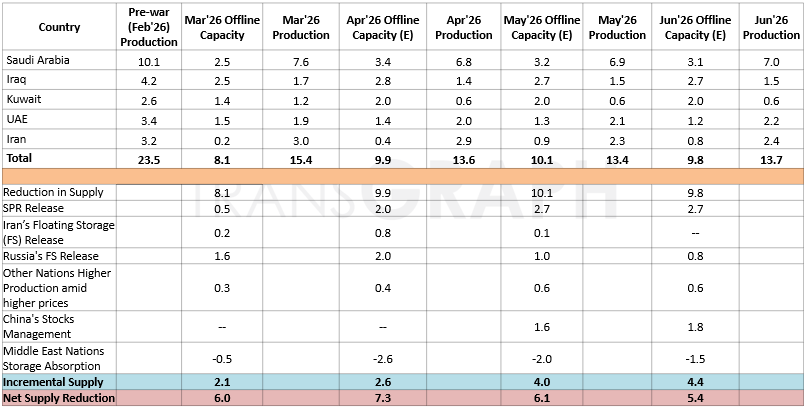
- The US Energy Information Administration (EIA) said some Middle Eastern producers may struggle to restore oil output to pre-conflict levels by the end of 2027, even if trade flows normalize by early next year. Around 5.5 million bpd of Middle Eastern oil production was reportedly shut in during July.
- President Donald Trump said on Tuesday that the U.S. could either allow Iran’s economy to deteriorate under continued pressure or launch a major military strike, as tensions remain high. His remarks came amid stalled US-Iran negotiations and continued disruption around the Strait of Hormuz, raising concerns over further escalation and global oil supplies.
- President Donald Trump has extended the Jones Act waiver for 90 days to allow foreign-flagged vessels to transport energy products between US ports, while introducing case-by-case approval requirements to balance fuel supply needs with protection of the domestic maritime industry.
- India's oil demand increased by 2.9% YoY to 19.92 million metric tons in July, supported by strong growth in diesel and gasoline consumption. Diesel and gasoline demand rose 10.0% and 9.2% respectively, while LPG, naphtha and petroleum coke consumption declined during the month.
- Angola is facing a fuel shortage due to rising domestic demand, higher global fuel prices and supply constraints, leading to long queues at fuel stations.The government is working to ease the crisis, while costly fuel subsidies continue to strain state-owned Sonangol's finances.
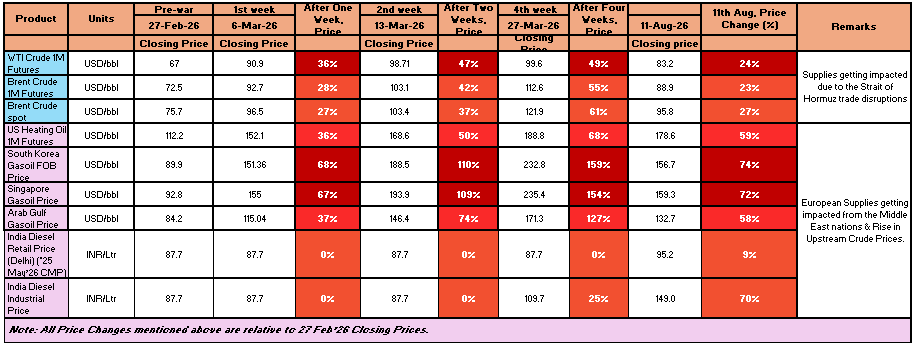
War Impact on Crude Oil & Gasoil/Diesel Prices
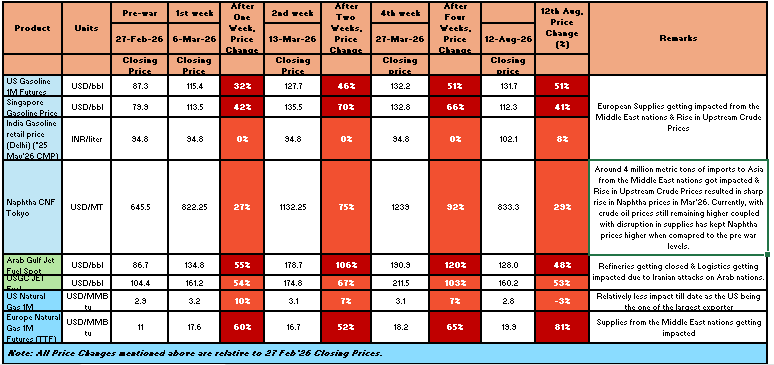
War Impact on Gasoline, ATF & Natural Gas Prices
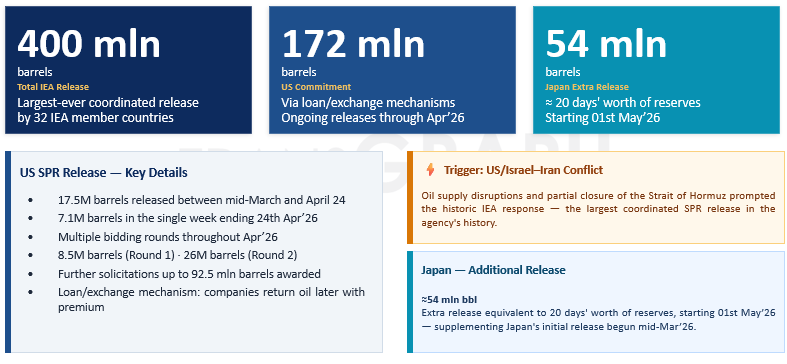
GCC Bypass Pipelines Running Near Capacity — But Shah Gas Field Ablaze and Fujairah Zone Struck
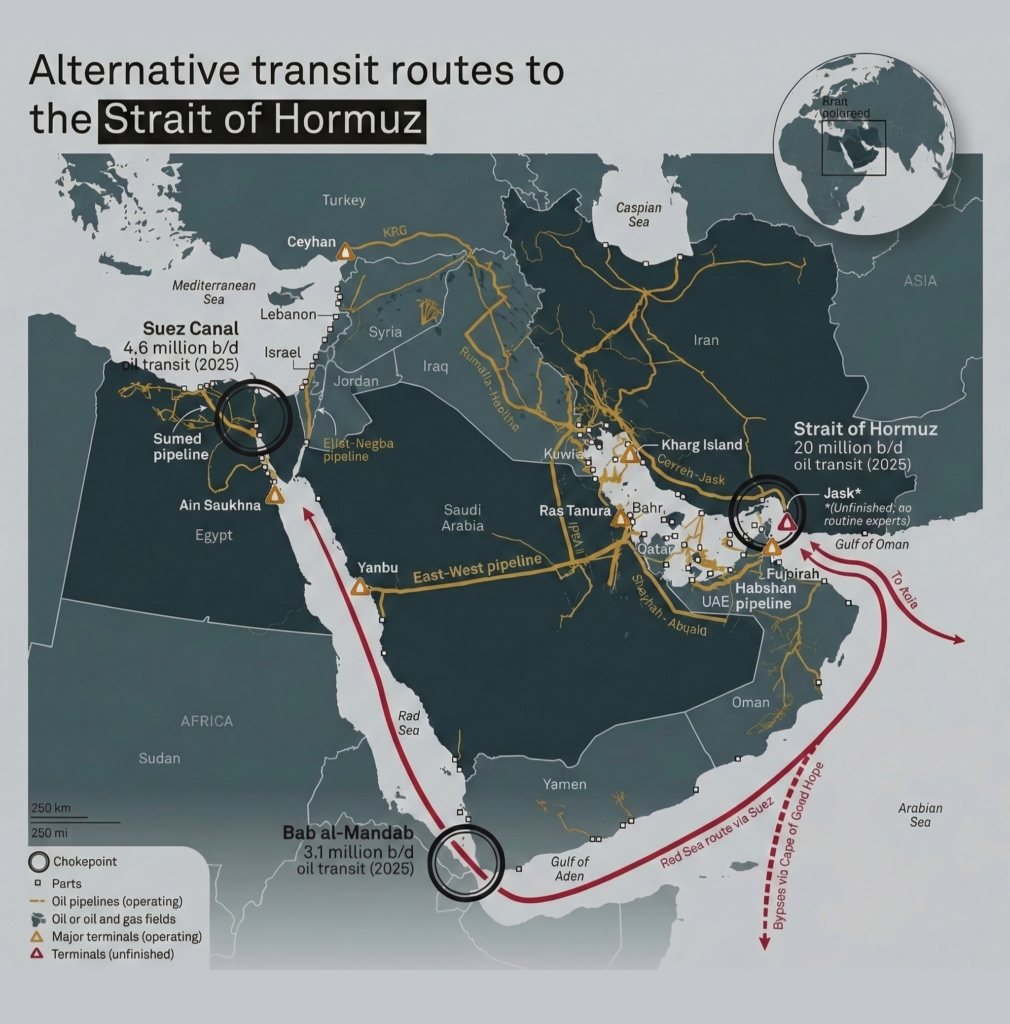
- Saudi Arabia's East-West pipeline is pumping oil at its full capacity of 7 MBpd, bypassing the Strait of Hormuz. Crude oil exports from Yanbu port have reached 5 MBpd, and the country is also exporting 0.70 to 0.90 MBpd of oil products.
- Of approximately 15 MBpd of crude transiting the Strait of Hormuz in OND'25, combined SPR releases and bypass pipeline capacity can offset roughly two-thirds — or slightly more — for the next 20 to 30 days, providing the Trump administration a window to assess strategic direction.
- New strikes directly threaten this buffer — Iranian drones struck the UAE's Shah gas field (currently ablaze) and the Fujairah Oil Industry Zone on Mar 17. A tanker was also hit near the Strait of Hormuz. Saudi Arabia intercepted over a dozen drones; Kuwait and Bahrain sustained additional attacks. These represent the first direct strikes on GCC energy export infrastructure since the conflict began.
War Scenarios Point to Global Supply Deficit of 0.92–1.07 MBpd in 2026 and AMJ Quarter Most Severe with a deficit of 4.10 MBpd.
Pre-war, global supply and demand were near-balanced with a modest surplus of +0.55 MBpd projected for 2026. Both conflict scenarios introduce significant supply deficits driven by Strait of Hormuz disruptions and impacts on Iraq and Kuwait crude production.
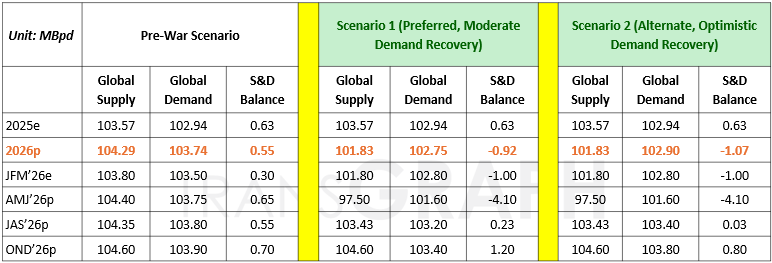
- Scenario 1 (Preferred): Ceasefire talks continue to progress positively, with tanker flows through the Strait of Hormuz gradually normalizing over the next 4–5 weeks. Supply recovers steadily, while demand improves at a slower pace and remains below pre-war expectations, resulting in a moderate market surplus.
- Scenario 2 (Alternate): The Strait of Hormuz normalizes over the next 4–5 weeks, supporting a gradual recovery in oil exports and supply. Demand rebounds more strongly than in Scenario 1, reducing the market surplus, although overall consumption remains below pre-war levels.
Geopolitical backdrop:

Prospects for a peace deal weakened as President Trump rejected Iran’s demands for sanctions relief and compensation, instead calling for Tehran to compensate those affected by wars, attacks and protests. The renewed standoff has complicated efforts to reopen the Strait of Hormuz, while attacks on regional energy infrastructure and shipping have kept concerns over oil supply disruptions elevated.
The proposed discussions aim to address the reopening of the Strait of Hormuz and Iran's nuclear program. The Strait, through which nearly 20% of global oil and LNG shipments pass, has remained largely disrupted during the conflict, contributing to elevated energy prices and broader inflationary pressures. Consequently, while the upcoming U.S–Iran talks have improved near-term market sentiment, the absence of a defined timeline and the fragile security environment suggest that geopolitical risk premiums are likely to remain elevated until tangible progress is achieved.
Steel:
- Domestic steel prices have moderated from recent highs.
- Steel supply chains remain largely insulated from the Middle East conflict.
- Since, the start of war steel HRC prices are up by 7.6%.
Base metals:
- Copper prices are up 2.5% on a weekly basis, as Fed holds interest rates, market remains in backwardation structure, and inflation pressures ease amid ceasefire. Prices receive continued support from CME-LME arbitrage, high China copper premium, exchange inventory outflows, and persistent mine supply constraints which offset pressure from geopolitical uncertainty, hawkish Fed outlook, and elevated global inventories.
- Aluminum prices are up 2.1% on a weekly basis due to renewed tensions.
Precious metals:
- Stronger U.S. yields and weak industrial offtake, especially auto are suppressing any upside momentum.
- Stronger US Dollar due to anticipation of rate hike in US is weighing on precious metal prices.
LPG Market Update
- For August 2026, Saudi Aramco Contract Prices (CPs) rebounded to USD 620/ton for propane and USD 640/ton for butane, compared with USD 580/ton and USD 600/ton, respectively, in July. This represents a 6.9% month-on-month increase in propane CPs and a 6.7% month-on-month increase in butane CPs.
- Sonatrach raised its August propane OSP by 4.2% m-o-m, from $518/ton to $540/ton, while the butane OSP was cut by 5.0%, from $600/ton to $570/ton.
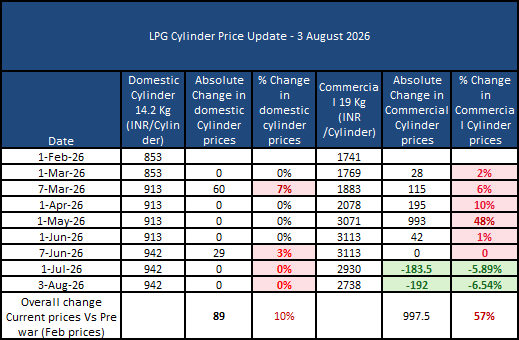
- India’s commercial LPG prices eased further in August, with the 19 kg cylinder price in New Delhi declining by ₹192, from ₹2,930 in July to ₹2,738 as of 3 August 2026. Despite the recent correction, commercial LPG remains substantially above its pre-war level of ₹1,741/cylinder. In contrast, the 14.2 kg domestic LPG cylinder remained unchanged at ₹942, reflecting continued price stability for household consumers.