
- Renewed Middle East hostilities intensified after a drone strike hit Egypt's Damietta gas port and the US and Iran exchanged fresh attacks, raising concerns over the security of key energy shipping routes through the Strait of Hormuz and Bab el-Mandeb.
- Amid the escalating tensions, China reportedly held talks with Yemen's Houthis to safeguard its oil shipments, Saudi Arabia shifted more Asia-bound crude exports via the Suez Canal.
- ADNOC sold at least 12 mln bbl of spot crude in its latest tender, part of more than 86 mln bbl sold across seven tenders since Jun'26 to Asian buyers at premiums of up to 4 USD/bbl over Dubai benchmarks as US-Iran tensions tightened regional oil supplies.
- Thirty-seven commodity ships transited the Bab el-Mandeb Strait on Tuesday (20 inbound and 17 outbound), the highest daily count since 19th Jul'26, while only five commodity ships passed through the Strait of Hormuz (three inbound and two outbound).
- Among the vessels, three laden Aframax crude tankers carried over 1.9 mln bbl of oil, while two inbound tankers transported around 0.35 mln bbl of MTBE (methyl tertiary butyl ether) and nearly 0.09 mln bbl of chemicals, even as Houthi attacks and geopolitical tensions continued to disrupt regional shipping.
- Meanwhile, transit through the Strait of Hormuz remained subdued, with 7 vessels on 26th Jul'26, 3 vessels on 25th Jul'26 (all with transponders switched off), and 7 vessels on 24th Jul'26, reflecting continued caution over disruptions to key global oil trade routes.
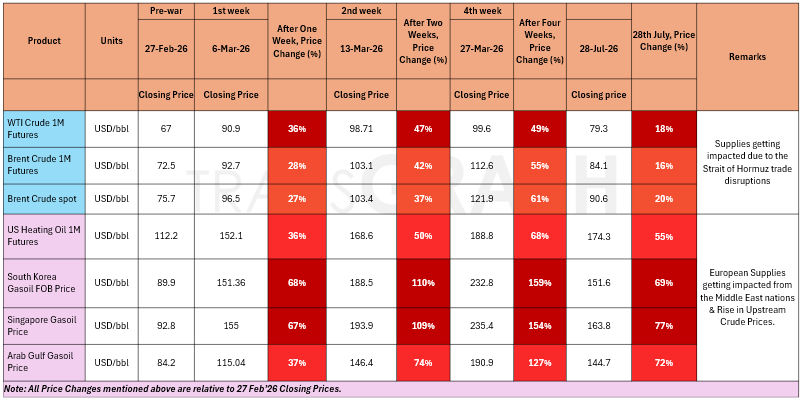
War Impact on Crude Oil & Gasoil/Diesel Prices
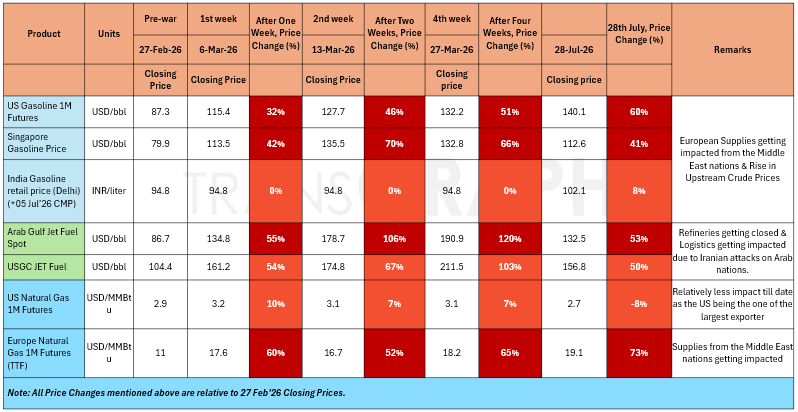
War Impact on Gasoline, ATF & Natural Gas Prices
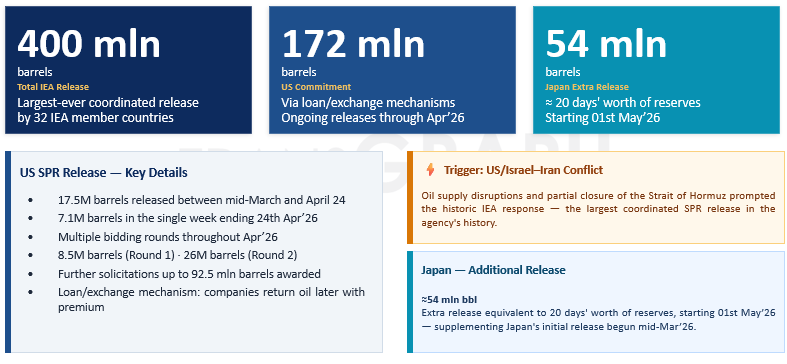
GCC Bypass Pipelines Running Near Capacity — But Shah Gas Field Ablaze and Fujairah Zone Struck
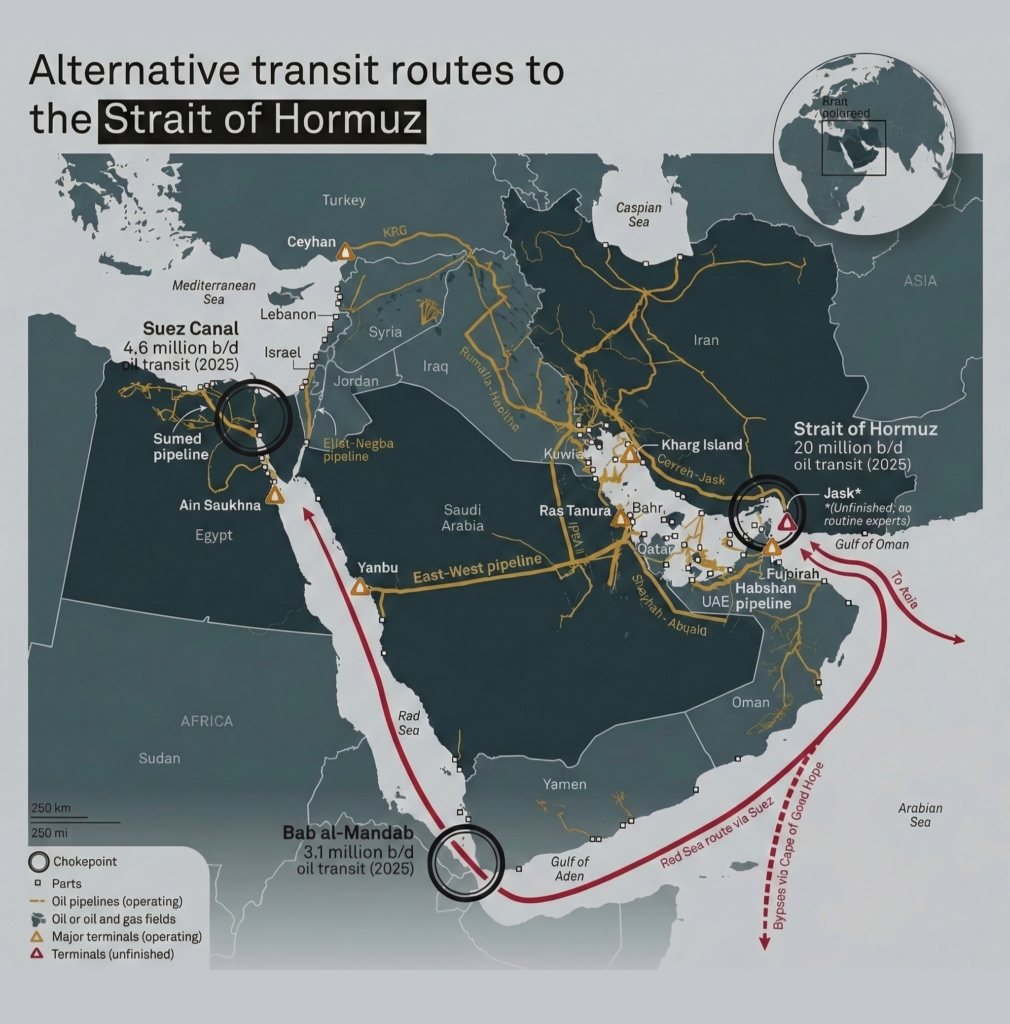
- Saudi Arabia's East-West pipeline is pumping oil at its full capacity of 7 MBpd, bypassing the Strait of Hormuz. Crude oil exports from Yanbu port have reached 5 MBpd, and the country is also exporting 0.70 to 0.90 MBpd of oil products.
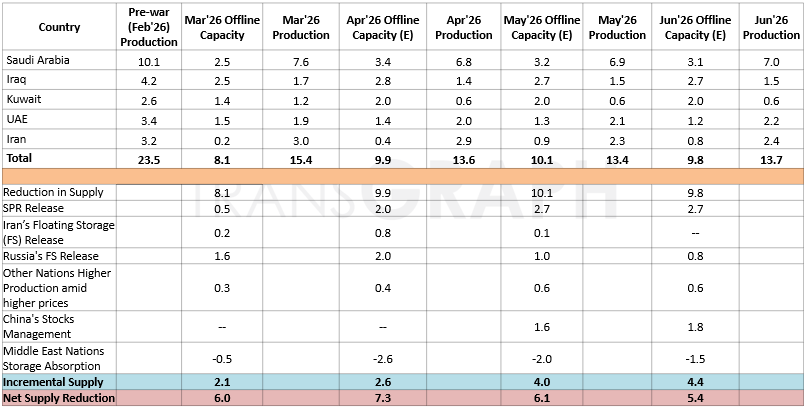
- Of approximately 15 MBpd of crude transiting the Strait of Hormuz in OND'25, combined SPR releases and bypass pipeline capacity can offset roughly two-thirds — or slightly more — for the next 20 to 30 days, providing the Trump administration a window to assess strategic direction.
- New strikes directly threaten this buffer — Iranian drones struck the UAE's Shah gas field (currently ablaze) and the Fujairah Oil Industry Zone on Mar 17. A tanker was also hit near the Strait of Hormuz. Saudi Arabia intercepted over a dozen drones; Kuwait and Bahrain sustained additional attacks. These represent the first direct strikes on GCC energy export infrastructure since the conflict began.
War Scenarios Point to Global Supply Deficit of 0.92–1.07 MBpd in 2026 and AMJ Quarter Most Severe with a deficit of 4.10 MBpd.
Pre-war, global supply and demand were near-balanced with a modest surplus of +0.55 MBpd projected for 2026. Both conflict scenarios introduce significant supply deficits driven by Strait of Hormuz disruptions and impacts on Iraq and Kuwait crude production.
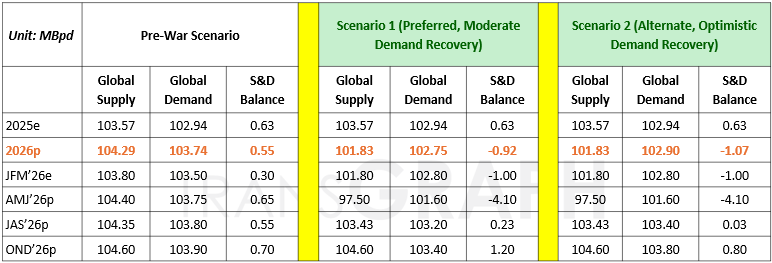
- Scenario 1 (Preferred): Ceasefire talks continue to progress positively, with tanker flows through the Strait of Hormuz gradually normalizing over the next 4–5 weeks. Supply recovers steadily, while demand improves at a slower pace and remains below pre-war expectations, resulting in a moderate market surplus.
- Scenario 2 (Alternate): The Strait of Hormuz normalizes over the next 4–5 weeks, supporting a gradual recovery in oil exports and supply. Demand rebounds more strongly than in Scenario 1, reducing the market surplus, although overall consumption remains below pre-war levels.
Geopolitical backdrop:

US-Saudi forces carried out coordinated airstrikes on Iran-aligned PMF positions in Iraq in response to alleged IRGC-directed drone attacks, while the US intercepted Iranian ballistic missiles targeting its base in Jordan, ending a five-day lull in hostilities and signaling renewed escalation. Meanwhile, Iran rejected Oman's proposal for joint management of the Strait of Hormuz, demanding greater control over shipping routes and warning the strait could remain closed if its terms are not met, raising concerns over global energy security. Despite President Trump's renewed push for peace talks, Iran remains skeptical. Markets are likely to stay cautious as the fragile situation leaves the risk of further military escalation and renewed volatility in oil and financial markets.
Steel:
- Domestic steel prices have moderated from recent highs.
- Steel supply chains remain largely insulated from the Middle East conflict.
- Since, the start of war steel HRC prices are up by 7.4%.
Base metals:
- Copper prices are down 1.5% on a weekly basis, ahead of FOMC meeting tonight. However, downside remains capped as China copper premium rises to 13 month high and inflation pressures ease with softer CPI and weaker job data despite persistent geopolitical conflicts. Prices receive continued support from CME-LME arbitrage, backwardation structure, exchange inventory outflows, and persistent mine supply constraints which offset pressure from renewed tensions, hawkish Fed outlook, and elevated global inventories.
- Aluminum prices are down 0.8% on a weekly basis due to expectations of a hawkish signal by Fed during the latest FOMC meeting.
Precious metals:
- Stronger U.S. yields and weak industrial offtake, especially auto are suppressing any upside momentum.
- Stronger US Dollar due to anticipation of rate hike in US is weighing on precious metal prices.
LPG Market Update
- India has significantly reduced its dependence on Gulf LPG cargoes, increasing spot purchases from the United States to compensate for lower arrivals from Qatar and other Gulf exporters. LPG sourcing has also diversified to suppliers such as Angola,Australia,Singapore, Nigeria and Oman.
- Freight rates for LPG carriers remain elevated, as longer voyage distances, higher war-risk insurance premiums and vessel scarcity continue to increase delivered LPG costs into Asia, even where cargo availability is adequate.