
⚡
US / Israel–Iran War · Market Update
- The US crude oil production climbed by 0.22 MBpd to a record 13.93 MBpd in Apr'26, with New Mexico reaching 2.37 MBpd, Texas rising to 5.83 MBpd, and North Dakota increasing to 1.13 MBpd as higher oil prices encouraged producers to boost output.
- The US natural gas production edged down to 135.3 bcfd (from 135.4 bcfd in March), meanwhile total petroleum demand rose to 20.81 MBpd, gasoline demand increased to 9.12 MBpd (an eight-month high), and distillate fuel demand fell to 3.89 MBpd.
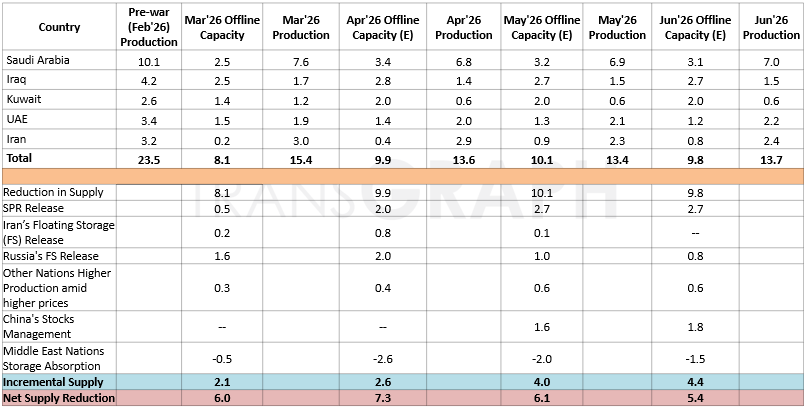
- The UAE increased crude oil and condensate exports to a record 3.7 MBpd in Jun'26, up from 3.3 MBpd earlier this year, while Abu Dhabi crude loadings reached 4.0 MBpd, supported by higher production, inventory drawdowns, and the resumption of flows through the Strait of Hormuz after leaving OPEC.
- ADNOC also expanded exports to markets beyond Asia, including Africa, Europe, and the US West Coast, while Gulf oil loadings excluding Iran rose 65% MoM to 7.0 MBpd in Jun'26.
- Asia's seaborne crude oil imports edged up to 20.71 MBpd in the Strait of Hormuz continued to limit Middle East oil shipments. Despite crude prices returning near pre-conflict levels, uncertainty persists over shipping security, China's reduced imports, and whether crude flows through the strait can recover enough to meet future demand.
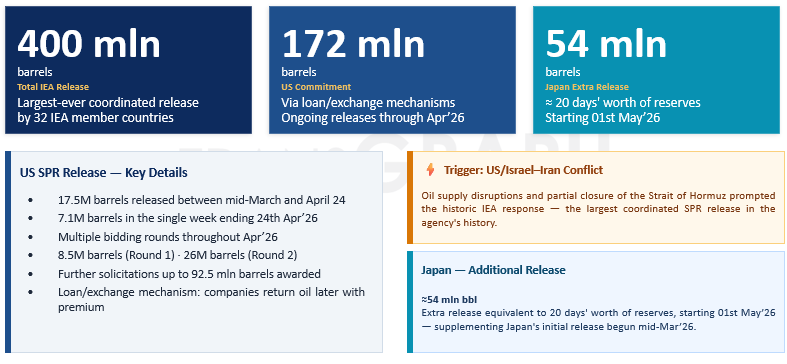
- The US Strategic Petroleum Reserve (SPR) stocks fell by 5.5 mln bbl to 325 mln bbl, their lowest level since May 1983, as part of a planned 172 mln bbl release to offset global supply disruptions following the Iran war. Overall US crude inventories, including commercial and SPR stocks, have dropped by 111 mln bbl to 743 mln bbl since late Feb'26.
- The US launched strikes on Iranian military sites after blaming Iran for a drone attack on a cargo ship in the Strait of Hormuz, while Iran claimed the US violated a recent ceasefire and said it retaliated by targeting US military positions in the region.
- Despite the renewed tensions, Israel and Lebanon signed an agreement aimed at ending fighting with Hezbollah, while oil exports through the Strait of Hormuz resumed and global oil prices fell as shipping activity recovered.
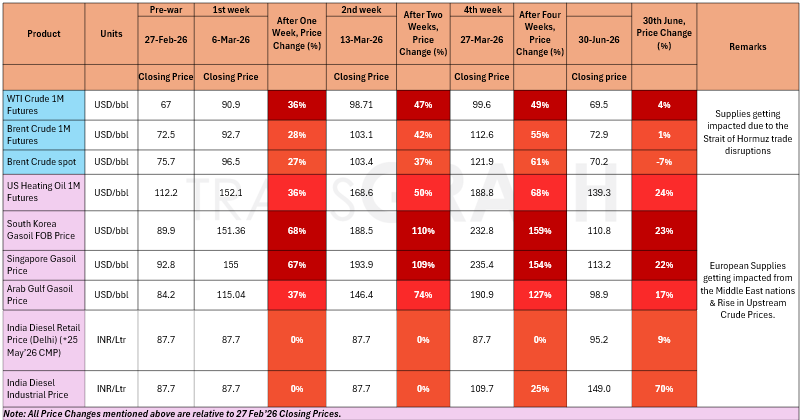
War Impact on Crude Oil & Gasoil/Diesel Prices
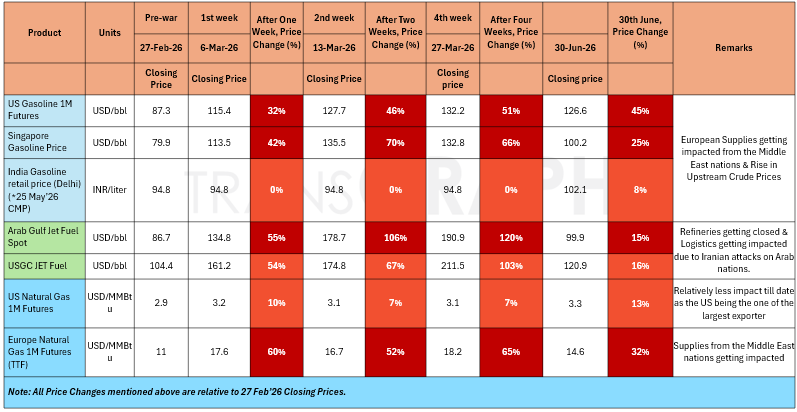
War Impact on Gasoline, ATF & Natural Gas Prices
GCC Bypass Pipelines Running Near Capacity — But Shah Gas Field Ablaze and Fujairah Zone Struck
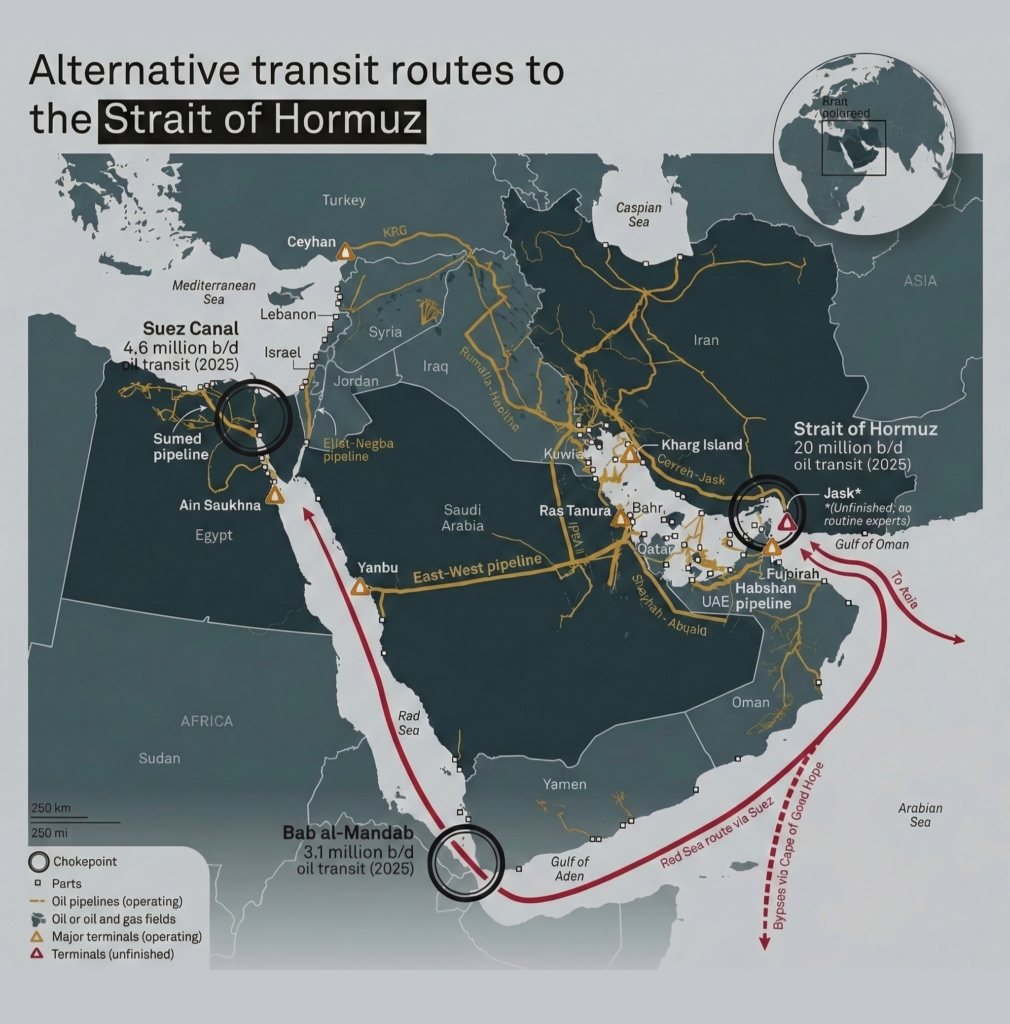
- Saudi Arabia's East-West pipeline is pumping oil at its full capacity of 7 MBpd, bypassing the Strait of Hormuz. Crude oil exports from Yanbu port have reached 5 MBpd, and the country is also exporting 0.70 to 0.90 MBpd of oil products.
- Of approximately 15 MBpd of crude transiting the Strait of Hormuz in OND'25, combined SPR releases and bypass pipeline capacity can offset roughly two-thirds — or slightly more — for the next 20 to 30 days, providing the Trump administration a window to assess strategic direction.
- New strikes directly threaten this buffer — Iranian drones struck the UAE's Shah gas field (currently ablaze) and the Fujairah Oil Industry Zone on Mar 17. A tanker was also hit near the Strait of Hormuz. Saudi Arabia intercepted over a dozen drones; Kuwait and Bahrain sustained additional attacks. These represent the first direct strikes on GCC energy export infrastructure since the conflict began.
War Scenarios Point to Global Supply Deficit of 0.92–1.07 MBpd in 2026 and AMJ Quarter Most Severe with a deficit of 4.10 MBpd.
Pre-war, global supply and demand were near-balanced with a modest surplus of +0.55 MBpd projected for 2026. Both conflict scenarios introduce significant supply deficits driven by Strait of Hormuz disruptions and impacts on Iraq and Kuwait crude production.
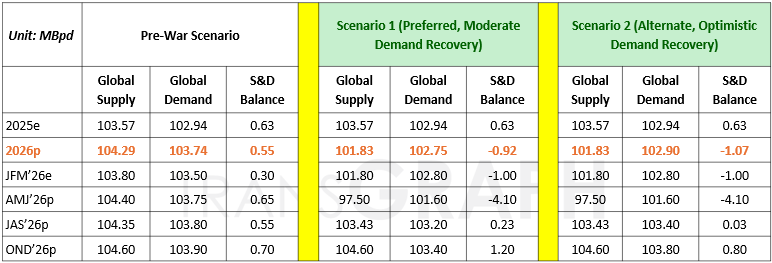
- Scenario 1 (Preferred): Ceasefire talks continue to progress positively, with tanker flows through the Strait of Hormuz gradually normalizing over the next 4–5 weeks. Supply recovers steadily, while demand improves at a slower pace and remains below pre-war expectations, resulting in a moderate market surplus.
- Scenario 2 (Alternate): The Strait of Hormuz normalizes over the next 4–5 weeks, supporting a gradual recovery in oil exports and supply. Demand rebounds more strongly than in Scenario 1, reducing the market surplus, although overall consumption remains below pre-war levels.
Geopolitical backdrop:

Iran and U.S. Agree to Pause Strikes, Qatar Talks to Focus on Strait of Hormuz
- The United States and Iran have reportedly agreed to temporarily suspend military strikes and resume diplomatic talks in Doha, Qatar, on Tuesday, with securing the Strait of Hormuz emerging as the key agenda.
- The development comes after renewed hostilities threatened the June 17 understanding under which Iran agreed to ensure safe passage for commercial vessels through the strategic waterway, while the U.S. committed to lifting its blockade on Iranian ports.
- Shipping activity through the Strait of Hormuz has slowed sharply, with only 48 vessels transiting between June 26 and June 28, down from 70 and 54 vessels on the preceding two days, highlighting market concerns over potential supply disruptions.
- The temporary truce has eased immediate fears of further escalation and reduced concerns over risks to global energy supplies and maritime trade.
- Despite ongoing uncertainties, the diplomatic progress is likely to ease immediate concerns over global energy supply disruptions and geopolitical risks.
While the Fed has kept interest rates unchanged, updated projections indicated an increased likelihood of a rate hike later this year, with Chair Kevin Warsh reaffirming the central bank's commitment to containing inflation. Higher Treasury yields and firm U.S. economic data continue to support the dollar.
Steel:
- Domestic steel prices have moderated from recent highs.
- Steel supply chains remain largely insulated from the Middle East conflict.
- Since, the start of war steel HRC prices are up by 8.7%.
Base metals:
- Copper prices are down by 0.7% since the start of war, primarily due to easing war tensions, FOMC outcome and expectations of rate hikes towards the end of the year.
- Easing U.S.–Iran tensions reduced geopolitical supply risks and pushed energy prices lower, contributing to a 17.6% decline in LME aluminum prices during the month. The decline was further reinforced by the Federal Reserve's hawkish policy stance and a stronger U.S. dollar, weighing on aluminium prices.
Precious metals:
- Stronger U.S. yields and weak industrial offtake, especially auto are suppressing any upside momentum.
- STronger US Dollar due to anticipation of rate hike in US is weighing on precious metal prices.
LPG Market Update
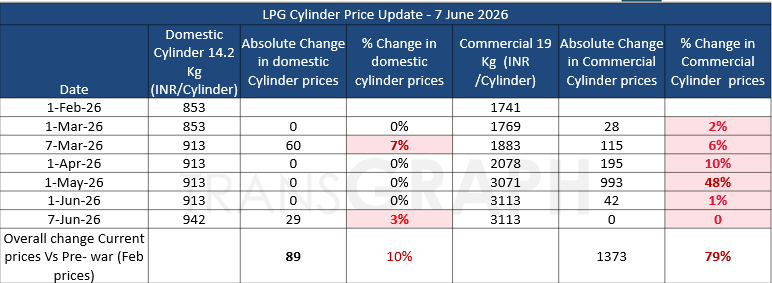
- India’s LPG market saw another upward revision on 1st June 2026 , with oil marketing companies increasing commercial cylinder prices. Commercial LPG prices were raised across major cities, with the 19 kg cylinder in Delhi increasing by Rs 42 to Rs 3,113.50. Similar hikes were reported nationwide, ranging from Rs 42 to Rs 53.50 per cylinder.
India’s domestic LPG market witnessed a price revision on 7 June 2026, with Oil Marketing Companies (OMCs) increasing the price of the 14.2 kg domestic LPG cylinder by ₹29 per cylinder across the country. - In addition to commercial cylinders, oil marketing companies also increased the price of 5 kg Free Trade LPG (FTL) cylinders by Rs 11. Following the revision, the retail price of a 5 kg FTL cylinder in Delhi now stands at Rs 821.50. FTL cylinders are sold outside the subsidized domestic LPG system and are commonly used by migrant workers, temporary households, street vendors, and consumers requiring smaller LPG packs.