
- Qatar is seeking to broker a US-Iran peace deal to end the eight-month war and reopen the Strait of Hormuz, despite Trump rejecting reports of sanctions relief, while the conflict continues to disrupt oil supplies and drive global energy prices higher.
- Middle East crude exports rose to 16.328 Mbpd in Sep’26, the highest since the war began in late Feb’26, with Saudi Arabia’s exports rebounding to about 5.4 Mbpd from 2.446 Mbpd in Aug’26 as Strait of Hormuz flows recovered to around 9.719 Mbpd.
- Despite the rebound, regional exports remained 3.2 Mbpd below February’s 19.513 Mbpd, at just under 80% of pre-conflict levels, while 19 VLCCs carrying about 2 Mbpd each of Saudi crude crossed the Strait of Hormuz last week.
- Indian refiners expect Russian crude supplies to tighten further in Oct’26–Nov’26 as Chinese demand outbids India, with Russian oil arrivals already falling 16.5% to 2.1 MBpd in Aug’26 and projected to decline to around 1.75 MBpd in Sep’26, prompting India to seek costlier alternatives such as UAE Murban, Iraqi Basrah and Angolan crude.
- Crude oil flows through the Strait of Hormuz totaled 33.7 mln bbl in the week ending 25th Sep’26, with 19 tankers including, 17 VLCCs, keeping exports broadly in line with the previous week’s 49.2 mln bbl.
- Libya’s National Oil Corporation said on Saturday that it had reopened Valve No. 7 on the main Sharara–Zawiya crude pipeline, allowing pumping operations to resume.
- Crude flows are gradually returning to normal after the pipeline was shut earlier last week, with the Sharara field’s output capacity of around 0.30 MBpd expected to progressively come back online.
- The US government is offering energy companies up to 40 mln bbl of crude from the Strategic Petroleum Reserve, following a broader 400 mln bbl global reserve release involving about 30 IEA countries, with the US initially committed to 172 mln bbl.
- The latest offer comes as US SPR stocks have fallen below 284 mln bbl, while gasoline prices have risen nearly 50% to about 4.45 USD/gallon and diesel prices have surged around 70% to roughly $6.50 USD/gallon since the Iran war began.
- The White House is urging EU countries to release more emergency diesel and oil reserves to ease surging fuel prices ahead of the US midterm elections, while considering additional measures to boost domestic diesel supplies.
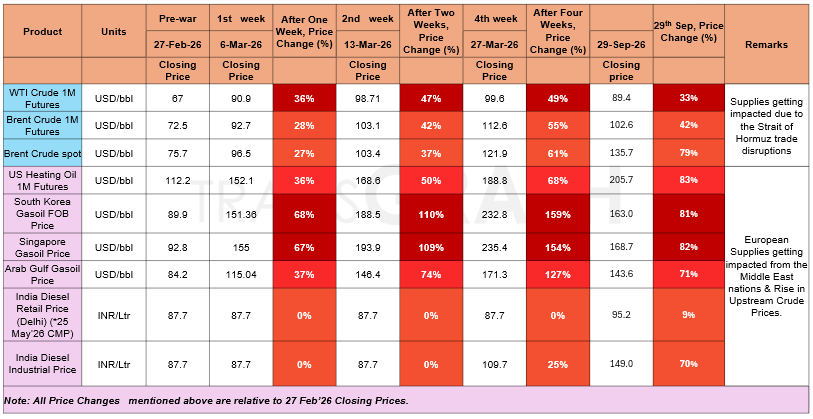
War Impact on Crude Oil & Gasoil/Diesel Prices
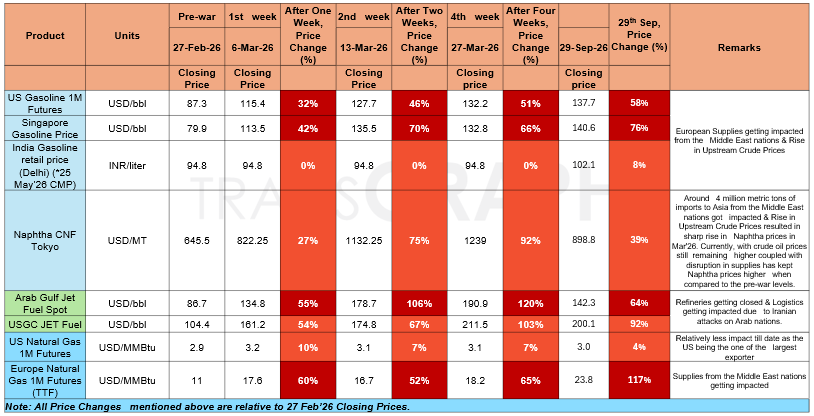
War Impact on Gasoline, ATF & Natural Gas Prices
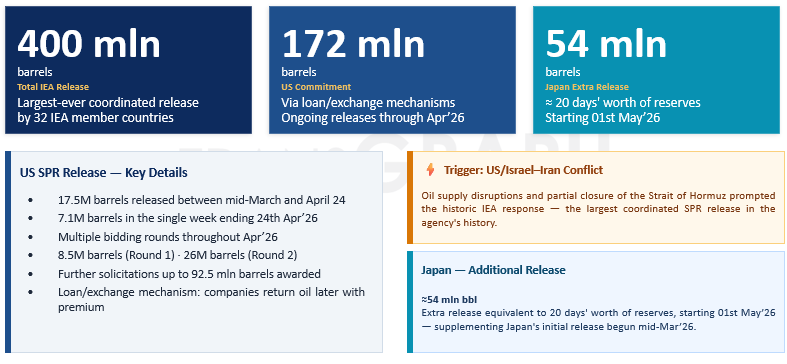
GCC Bypass Pipelines Running Near Capacity — But Shah Gas Field Ablaze and Fujairah Zone Struck
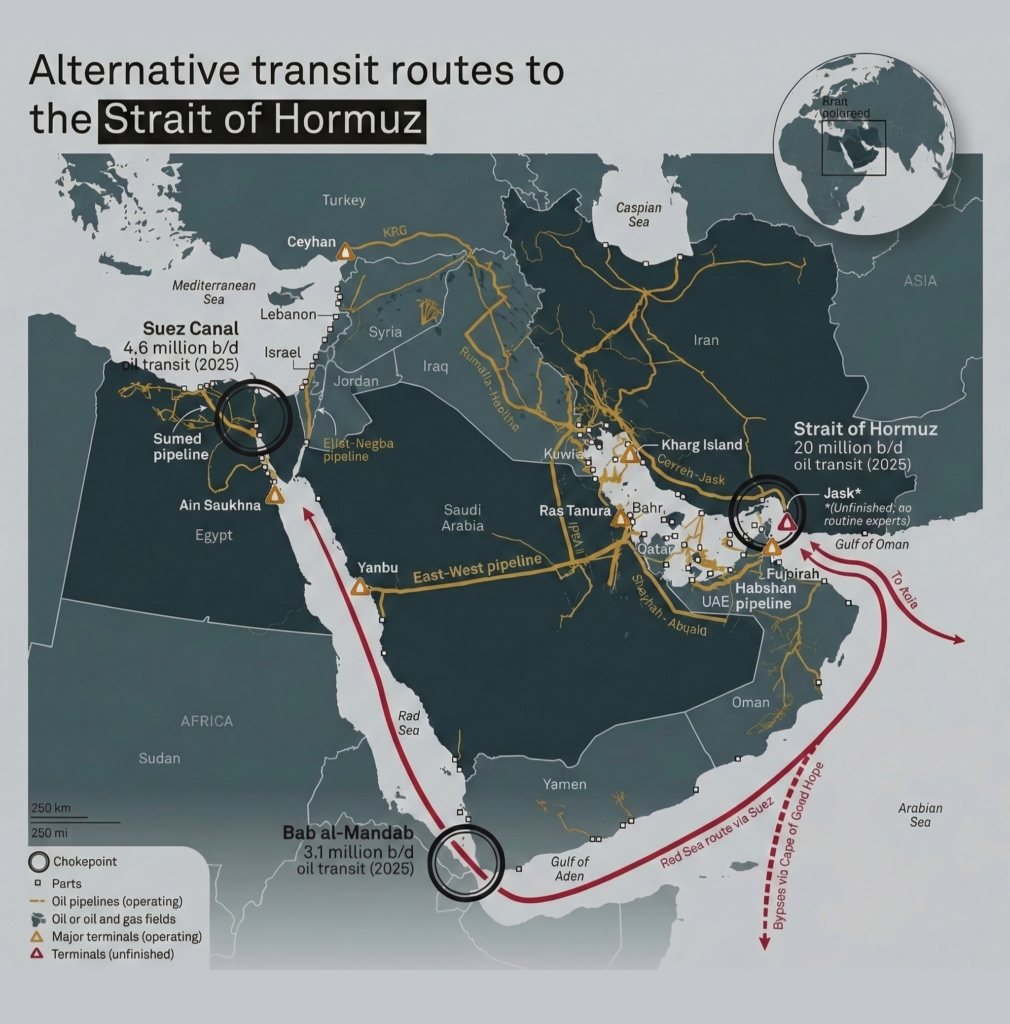
- Saudi Arabia's East-West pipeline is pumping oil at its full capacity of 7 MBpd, bypassing the Strait of Hormuz. Crude oil exports from Yanbu port have reached 5 MBpd, and the country is also exporting 0.70 to 0.90 MBpd of oil products.
- Of approximately 15 MBpd of crude transiting the Strait of Hormuz in OND'25, combined SPR releases and bypass pipeline capacity can offset roughly two-thirds — or slightly more — for the next 20 to 30 days, providing the Trump administration a window to assess strategic direction.
- New strikes directly threaten this buffer — Iranian drones struck the UAE's Shah gas field (currently ablaze) and the Fujairah Oil Industry Zone on Mar 17. A tanker was also hit near the Strait of Hormuz. Saudi Arabia intercepted over a dozen drones; Kuwait and Bahrain sustained additional attacks. These represent the first direct strikes on GCC energy export infrastructure since the conflict began.
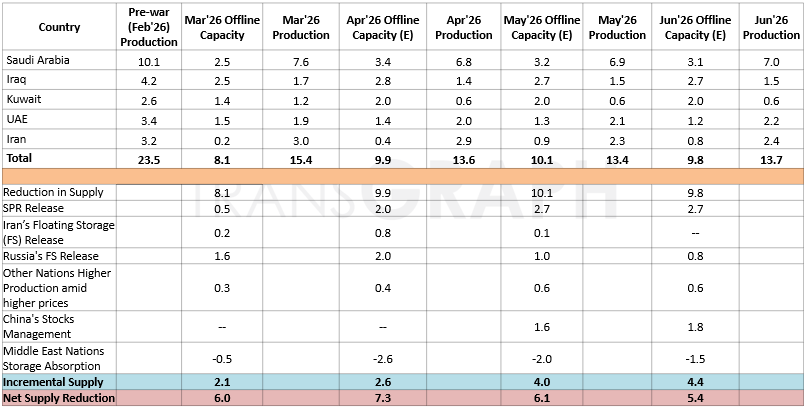
War Scenarios Point to Global Supply Deficit of 0.92–1.07 MBpd in 2026 and AMJ Quarter Most Severe with a deficit of 4.10 MBpd.
Pre-war, global supply and demand were near-balanced with a modest surplus of +0.55 MBpd projected for 2026. Both conflict scenarios introduce significant supply deficits driven by Strait of Hormuz disruptions and impacts on Iraq and Kuwait crude production.
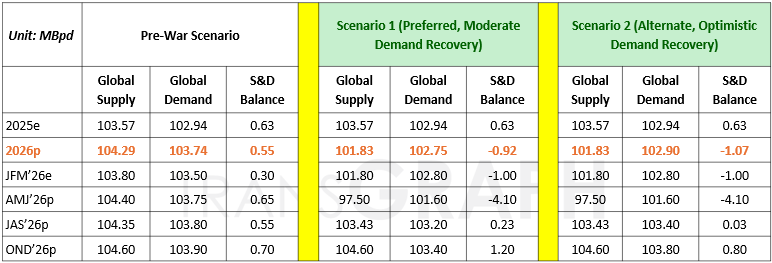
- Scenario 1 (Preferred): Ceasefire talks continue to progress positively, with tanker flows through the Strait of Hormuz gradually normalizing over the next 4–5 weeks. Supply recovers steadily, while demand improves at a slower pace and remains below pre-war expectations, resulting in a moderate market surplus.
- Scenario 2 (Alternate): The Strait of Hormuz normalizes over the next 4–5 weeks, supporting a gradual recovery in oil exports and supply. Demand rebounds more strongly than in Scenario 1, reducing the market surplus, although overall consumption remains below pre-war levels.
Geopolitical backdrop:

War Front: President Trump has indicated that US has rejected the latest peace deal. Fears of fresh attacks have risen amid breakdown in negotiations weighing on base metals. US President Donald Trump has rejected a news report claiming his administration offered Iran sanctions relief and access to frozen funds, calling the story a hoax on social media. Iranian Foreign Minister Abbas Araghchi says Tehran has held further indirect talks with the United States through Qatari mediators in New York, with Washington’s formal response expected by Tuesday.
The United States and China have agreed to reduce tariffs on $30 billion of goods and launch a dialogue on AI, both countries said following President Xi Jinping's visit to Washington. The tariff reductions would apply to US exports such as agricultural goods, wood and cosmetics, as well as US imports including small appliances, toys, decorations, a White House statement said on Friday.
Recently New York Fed President John Williams said there was “no urgency” to raise rates again. This reduced expectations of an immediate/October Fed hike: Saudi Arabia restarted flows through its East-West pipeline after repairs following drone attacks. September crude exports from Middle Eastern producers reached about 16.3 million barrels/day. The US offered to loan up to 40 million barrels from its Strategic Petroleum Reserve. This adds another potential source of crude supply and therefore put downward pressure on prices. These factors eased near-term supply concerns, reducing inflation pressure.
Steel:
- Steel supply chains remain largely insulated from the Middle East conflict.
- Moreover, HRC prices are up by 2.9% on a monthly basis due to raw material price surge and stronger demand from auto sector.
Base metals:
- LME 3M copper are down 2.2% on a weekly basis as mid autumn festival slowed China consumption. Further, rejection of peace deal by US and stronger dollar is weighing on metals. However, high premiums and supply disruptions will provide some support.
- Aluminum prices are down 1.1% due to gradual recovery from GCC and stronger dollar despite tensions in the middle east.
Precious metals:
- Stronger U.S. yields and weak industrial offtake are suppressing any upside momentum.
- Stronger US Dollar and geopolitical tensions are weighing on precious metal prices.
LPG Market Update
- For August 2026, Saudi Aramco Contract Prices (CPs) rebounded to USD 620/ton for propane and USD 640/ton for butane, compared with USD 580/ton and USD 600/ton, respectively, in July. This represents a 6.9% month-on-month increase in propane CPs and a 6.7% month-on-month increase in butane CPs.
- Sonatrach raised its August propane OSP by 4.2% m-o-m, from $518/ton to $540/ton, while the butane OSP was cut by 5.0%, from $600/ton to $570/ton.
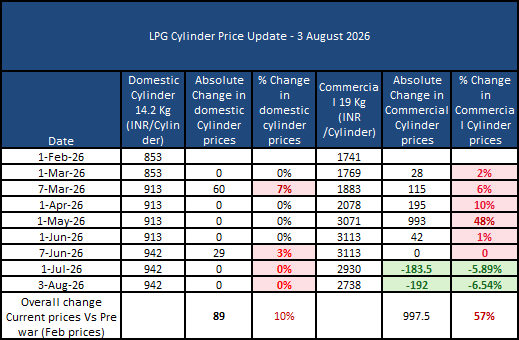
- India’s commercial LPG prices eased further in August, with the 19 kg cylinder price in New Delhi declining by ₹192, from ₹2,930 in July to ₹2,738 as of 3 August 2026. Despite the recent correction, commercial LPG remains substantially above its pre-war level of ₹1,741/cylinder. In contrast, the 14.2 kg domestic LPG cylinder remained unchanged at ₹942, reflecting continued price stability for household consumers.