
- On 26th Sep’26, Trump said he rejected Iran’s proposal to reopen the Strait of Hormuz and halt regional fighting within seven days, while leaving the door open for further negotiations.
- Market grapevine indicates that Saudi Aramco is considering discounts of around 9 USD/bbl on its official selling prices for crude loaded off Oman, where Asian buyers have recently paid 10–20 USD/bbl premiums, as it seeks to offset record freight costs and regain market share amid disruptions to Strait of Hormuz shipments, with Saudi exports through the strait projected at 7.4 MBpd this month.
- Market grapevine indicates that crude exports from major Middle Eastern producers rose to 12.8 MBpd in Sep’26, the highest level since February, supported by increased shipments from Saudi Arabia and the UAE.
- Indian refiners expect Russian crude supplies to tighten further in Oct’26–Nov’26 as Chinese demand outbids India, with Russian oil arrivals already falling 16.5% to 2.1 MBpd in Aug’26 and projected to decline to around 1.75 MBpd in Sep’26, prompting India to seek costlier alternatives such as UAE Murban, Iraqi Basrah and Angolan crude.
- Ship-to-ship transfers off Oman have reached capacity as Saudi Arabia redirected more crude through the Strait of Hormuz, with Saudi exports via Hormuz expected to rise to 3.6 MBpd in Sep’26 from 0.9 MBpd in Aug’26, increasing tanker demand and causing congestion.
- Crude oil flows through the Strait of Hormuz totaled 33.7 mln bbl in the week ending 25th Sep’26, with 19 tankers including, 17 VLCCs, keeping exports broadly in line with the previous week’s 49.2 mln bbl.
- On 24th Sep’26, commodity-vessel transits fell to 9 from 14 a day earlier and remained well below the 10-day average of 18, while the strait typically handled around 125 large commercial vessels daily before the Iran war.
- Libya’s National Oil Corporation said on Saturday that it had reopened Valve No. 7 on the main Sharara–Zawiya crude pipeline, allowing pumping operations to resume.
- Crude flows are gradually returning to normal after the pipeline was shut earlier last week, with the Sharara field’s output capacity of around 0.30 MBpd expected to progressively come back online.
- On 28th Sep’26 Russian President Putin signed a decree further restricting the disclosure of Russian energy and oil trade data, including information on prices, buyers, sellers, routes and destinations, to make Western sanctions harder to enforce.
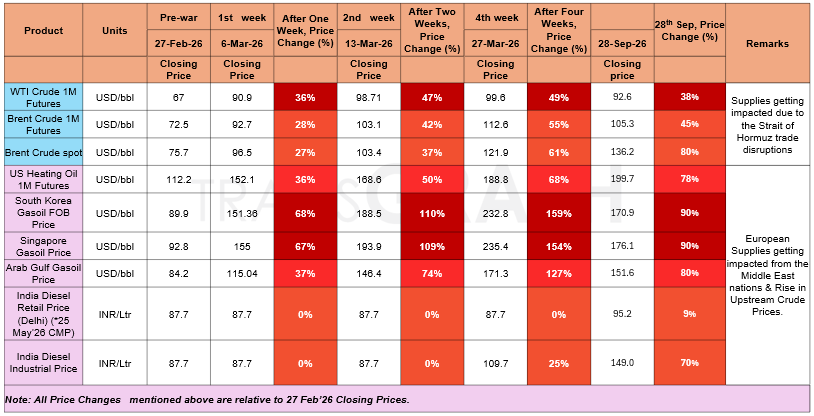
War Impact on Crude Oil & Gasoil/Diesel Prices
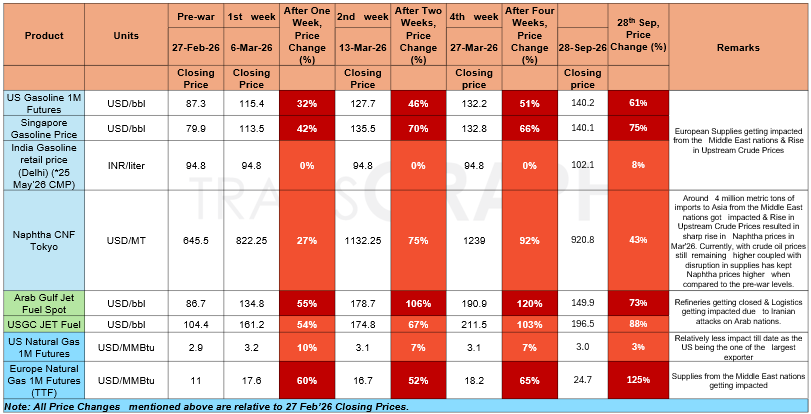
War Impact on Gasoline, ATF & Natural Gas Prices
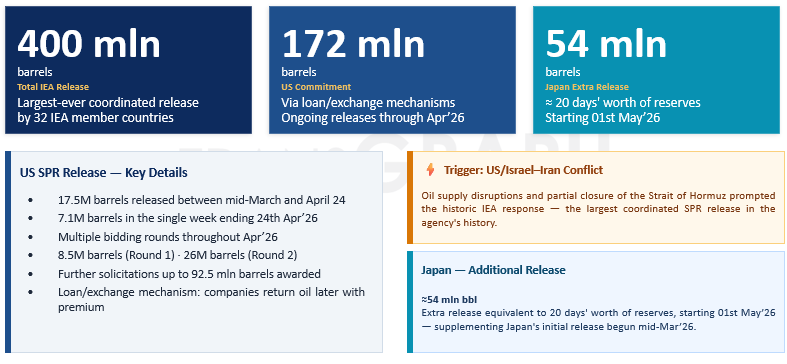
GCC Bypass Pipelines Running Near Capacity — But Shah Gas Field Ablaze and Fujairah Zone Struck
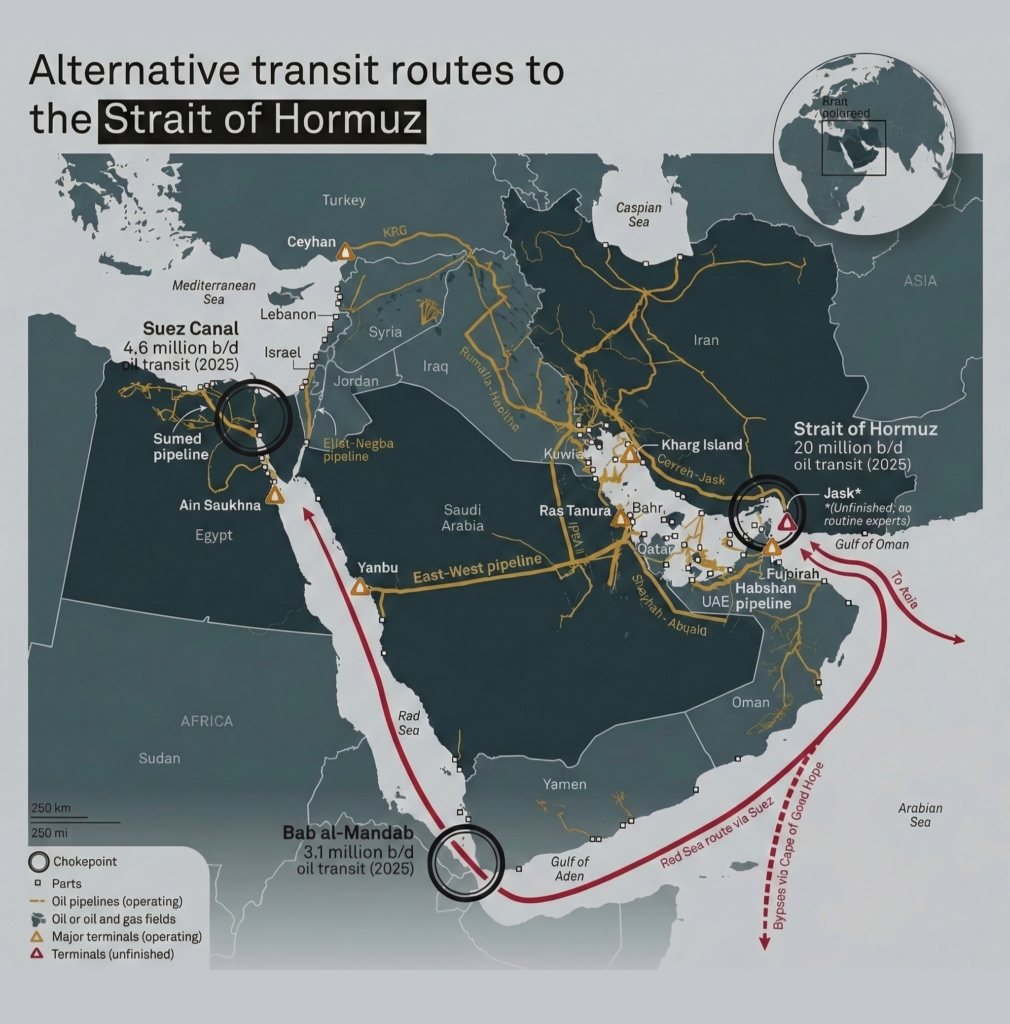
- Saudi Arabia's East-West pipeline is pumping oil at its full capacity of 7 MBpd, bypassing the Strait of Hormuz. Crude oil exports from Yanbu port have reached 5 MBpd, and the country is also exporting 0.70 to 0.90 MBpd of oil products.
- Of approximately 15 MBpd of crude transiting the Strait of Hormuz in OND'25, combined SPR releases and bypass pipeline capacity can offset roughly two-thirds — or slightly more — for the next 20 to 30 days, providing the Trump administration a window to assess strategic direction.
- New strikes directly threaten this buffer — Iranian drones struck the UAE's Shah gas field (currently ablaze) and the Fujairah Oil Industry Zone on Mar 17. A tanker was also hit near the Strait of Hormuz. Saudi Arabia intercepted over a dozen drones; Kuwait and Bahrain sustained additional attacks. These represent the first direct strikes on GCC energy export infrastructure since the conflict began.
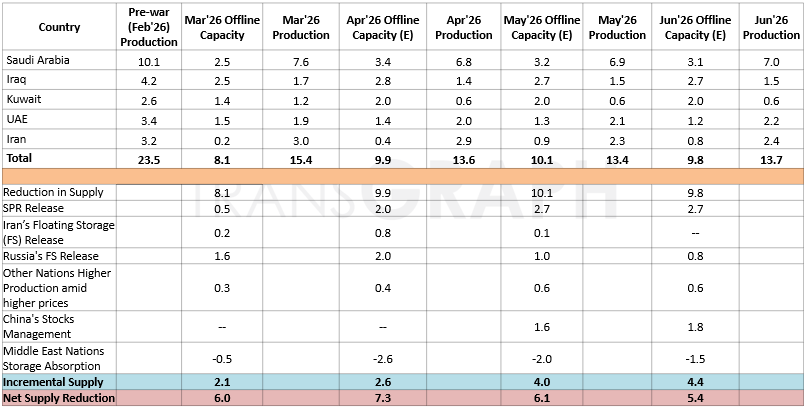
War Scenarios Point to Global Supply Deficit of 0.92–1.07 MBpd in 2026 and AMJ Quarter Most Severe with a deficit of 4.10 MBpd.
Pre-war, global supply and demand were near-balanced with a modest surplus of +0.55 MBpd projected for 2026. Both conflict scenarios introduce significant supply deficits driven by Strait of Hormuz disruptions and impacts on Iraq and Kuwait crude production.
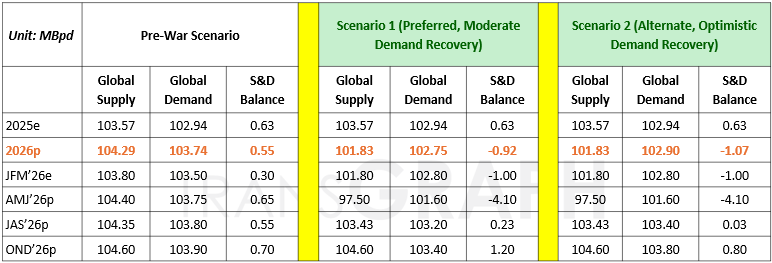
- Scenario 1 (Preferred): Ceasefire talks continue to progress positively, with tanker flows through the Strait of Hormuz gradually normalizing over the next 4–5 weeks. Supply recovers steadily, while demand improves at a slower pace and remains below pre-war expectations, resulting in a moderate market surplus.
- Scenario 2 (Alternate): The Strait of Hormuz normalizes over the next 4–5 weeks, supporting a gradual recovery in oil exports and supply. Demand rebounds more strongly than in Scenario 1, reducing the market surplus, although overall consumption remains below pre-war levels.
Geopolitical backdrop:

War Front: U.S.–Iran Talks Raise Hopes of De-escalation and Ease Oil Prices: U.S. and Iranian officials held around three hours of talks on the sidelines of the UN General Assembly in New York, with President Trump describing the discussions as “very good” and productive and indicating that another meeting could take place soon. The talks, mediated through regional officials, focused on conditions for ending the conflict and potentially reopening the Strait of Hormuz. The renewed diplomatic engagement, together with the restart of Saudi Arabia’s East-West oil pipeline and expectations of improving Gulf supply, has eased concerns over a prolonged disruption to energy flows, with Brent crude falling below USD 100/bbl and extending its recent decline.
The U.S Federal Reserve raised its benchmark interest rate by 25 bps to 3.75%-4.00%, marking its first rate hike since July 2023. The decision came amid persistent inflationary pressures, with the Fed stating that inflation remains elevated and that the latest rate increase would support a more timely return toward its 2% inflation target. The Fed’s updated projections indicate that 16 of 18 policymakers expect at least one more 25-bps rate hike by the end of 2026, taking the policy rate to 4.00%-4.25%. Policymakers also raised their 2026 inflation forecast, reflecting continued concerns over price pressures, particularly from higher energy costs. The Fed’s hawkish stance provides a positive backdrop for the USD and weigh on metal prices. This may keep the impact on INR relatively contained, with oil prices, capital flows and RBI intervention remaining key drivers.
Steel:
- Steel supply chains remain largely insulated from the Middle East conflict.
- Moreover, HRC prices are up by 6.8% on a monthly basis due to raw material price surge.
Base metals:
- LME 3M copper are up 2.5% on a weekly basis supported by high China premium, disruptions in Escondida mine, calls for strike at major Chile mining operations, and drawdown in SHFE inventory ahead of mid autumn festival. However upside remains capped by rate hike pressures, stronger dollar, and geopolitical tensions.
- Aluminum prices are down 2.3% due to gradual recovery from GCC and rate hike expectations despite tensions in the middle east.
Precious metals:
- Stronger U.S. yields and weak industrial offtake are suppressing any upside momentum.
- Stronger US Dollar and geopolitical tensions are weighing on precious metal prices.
LPG Market Update
- For August 2026, Saudi Aramco Contract Prices (CPs) rebounded to USD 620/ton for propane and USD 640/ton for butane, compared with USD 580/ton and USD 600/ton, respectively, in July. This represents a 6.9% month-on-month increase in propane CPs and a 6.7% month-on-month increase in butane CPs.
- Sonatrach raised its August propane OSP by 4.2% m-o-m, from $518/ton to $540/ton, while the butane OSP was cut by 5.0%, from $600/ton to $570/ton.
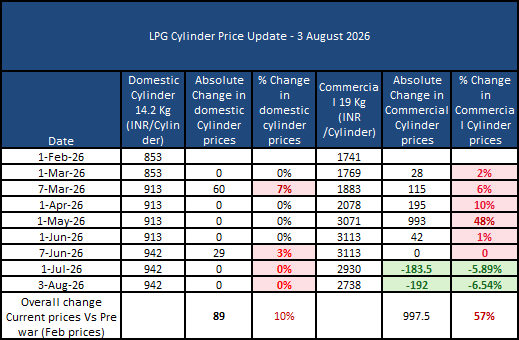
- India’s commercial LPG prices eased further in August, with the 19 kg cylinder price in New Delhi declining by ₹192, from ₹2,930 in July to ₹2,738 as of 3 August 2026. Despite the recent correction, commercial LPG remains substantially above its pre-war level of ₹1,741/cylinder. In contrast, the 14.2 kg domestic LPG cylinder remained unchanged at ₹942, reflecting continued price stability for household consumers.