
- Strait of Hormuz vessel traffic fell to just 4 transits on 15th Sep’26 from 7 a day earlier and well below the 10 day average of 18, with no VLCCs or LNG tankers transiting, while Bab el-Mandeb traffic remained relatively stable at 22 vessels on 15th Sep’26 versus 24 on 14th Sep’26, highlighting continued shipping and supply risks.
- Attacks on Saudi Arabia’s East-West Pipeline on Friday forced the country to shut the pipeline, raising concerns over sour crude supplies to Asia and contributing to a 3% rise in oil prices on Monday. Saudi’s Red Sea crude loadings from Yanbu had already plunged to 0.50 – 1.00 MBpd in Jul’26 from around 6.00 MBpd in Jun’26, intensifying supply concerns.
- To offset the disruption caused by the shutdown of Saudi Arabia’s East-West pipeline after drone attacks, crude loadings from Saudi Arabia’s Ras Tanura and Juaymah terminals have doubled to around 4MBpd, equivalent to roughly 2 VLCCs per day, with 4 VLCCs carrying up to 8mln barrels at Ras Tanura on 16th Sep’26.
- China’s refinery throughput increased by 11.2% MoM to 13.91MBpd in Aug’26, marking the second consecutive monthly rise, supported by stronger fuel exports after restrictions were eased in mid Jul’26.However, throughput remained 6.9% lower YoY, while domestic crude production rose by 0.8% YoY to 4.34 MBpd.
- China’s seaborne crude arrivals are expected to recover to around 8 MBpd in Sep’26–Oct’26, supported by ample onshore inventories, although an estimated 0.639 MBpd inventory draw in Aug’26 highlights tighter stock levels. Meanwhile, Jan’26–Aug’26 refinery throughput stood at 13.7 MBpd, down by 6.6% YoY, while crude production increased by 0.9% to 4.42 MBpd.
- Ukrainian drone strikes are disrupting Russian refining operations and tightening regional fuel supplies with 3 of Russia’s 6 largest diesel producing refineries accounting for around 50% of the country’s diesel output either halting or sharply reducing production in Sep’26 with Kirishi refinery shutting completely, while NORSI and Volgograd are operating at only around 25% of capacity.
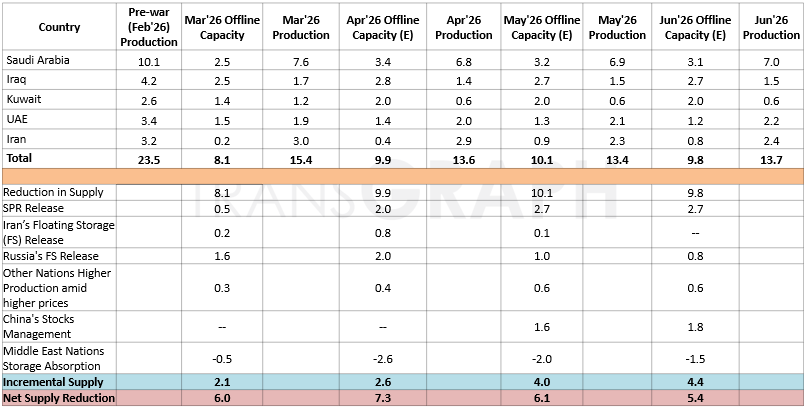
- The IEA expects global oil supply to decline by 5.7 MBpd (6.0%) in 2026, deeper than its earlier forecast of drop of around 4.0%, as Middle East conflict delays the recovery of Gulf flows into 2027. Global oil demand is also projected to fall by 2.5 MBpd, versus the previous estimate of a 1.6 MBpd decline, while inventories dropped by 3.1 MBpd in Aug’26 to their lowest level since 2023.
- Saudi Arabia’s crude supply fell by 2.30 MBpd MoM to 6.00 MBpd in Aug’26, the lowest in over 30 years, following attacks on key energy infrastructure and shipping routes. The IEA also cut its 2026 Saudi crude supply forecast by 0.88 MBpd to 7.60 MBpd, while crude loadings declined to 3.50 MBpd.
- Rosneft’s Ryazan refinery halted operations following a 06th Sep’26 drone attack, with its CDU-6 unit (160 kbpd production capacity) and CDU-4 unit (80 kbpd production capacity) taken offline, while CDU-3 remains under maintenance, potentially affecting around 240 kbpd of crude-processing capacity.
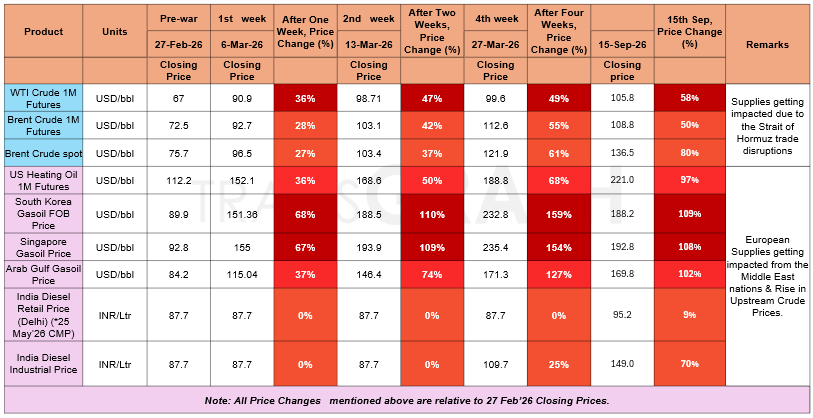
War Impact on Crude Oil & Gasoil/Diesel Prices
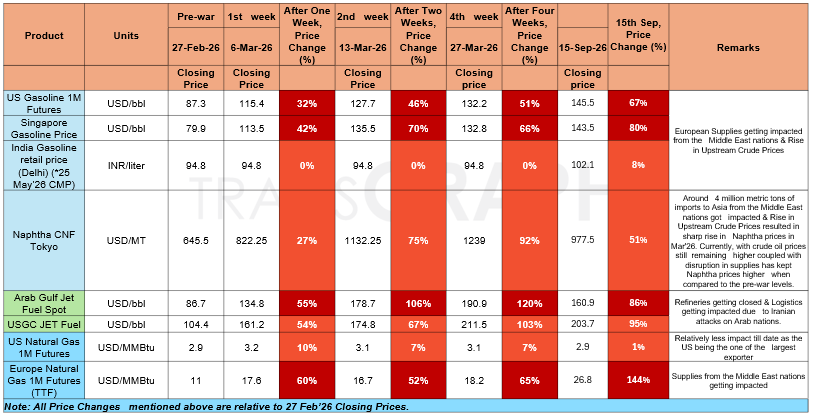
War Impact on Gasoline, ATF & Natural Gas Prices
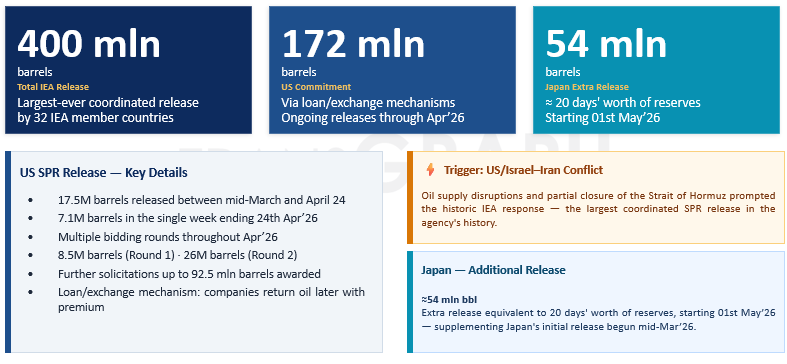
GCC Bypass Pipelines Running Near Capacity — But Shah Gas Field Ablaze and Fujairah Zone Struck
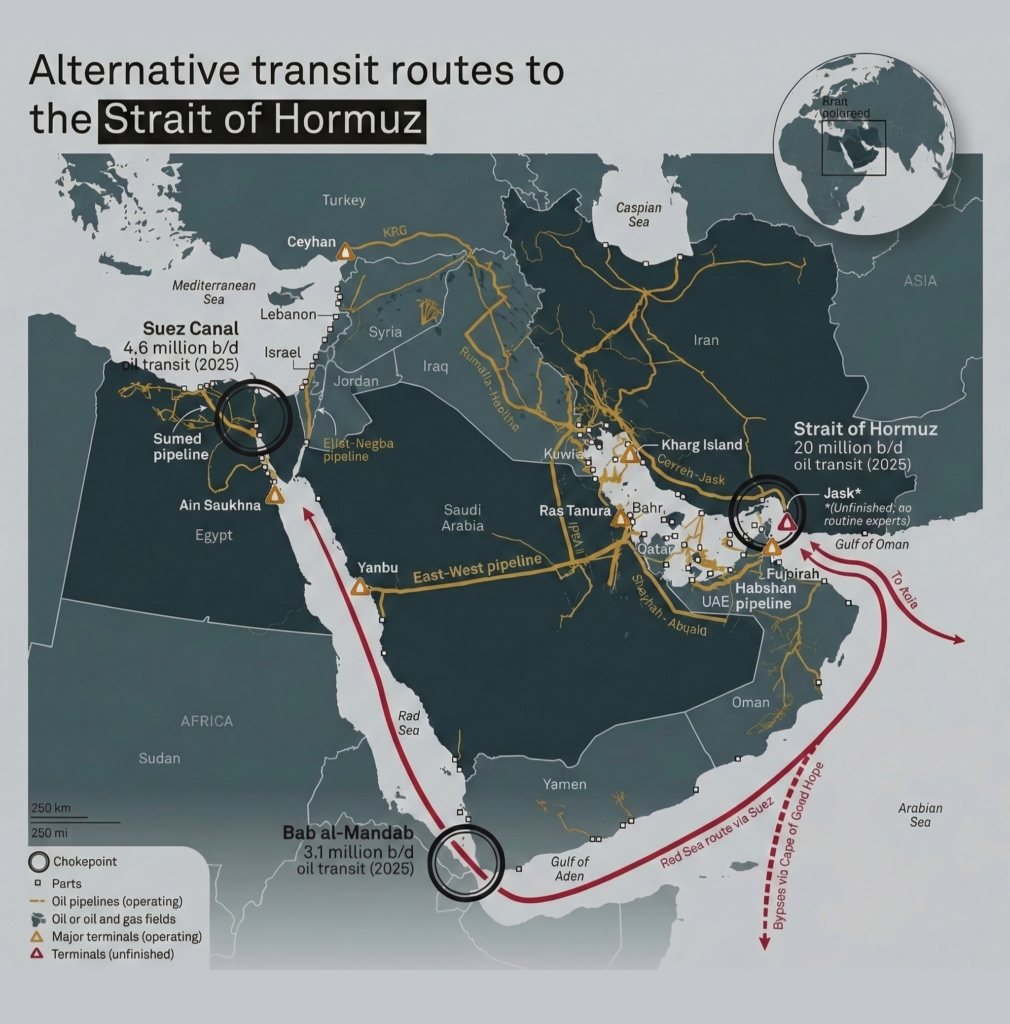
- Saudi Arabia's East-West pipeline is pumping oil at its full capacity of 7 MBpd, bypassing the Strait of Hormuz. Crude oil exports from Yanbu port have reached 5 MBpd, and the country is also exporting 0.70 to 0.90 MBpd of oil products.
- Of approximately 15 MBpd of crude transiting the Strait of Hormuz in OND'25, combined SPR releases and bypass pipeline capacity can offset roughly two-thirds — or slightly more — for the next 20 to 30 days, providing the Trump administration a window to assess strategic direction.
- New strikes directly threaten this buffer — Iranian drones struck the UAE's Shah gas field (currently ablaze) and the Fujairah Oil Industry Zone on Mar 17. A tanker was also hit near the Strait of Hormuz. Saudi Arabia intercepted over a dozen drones; Kuwait and Bahrain sustained additional attacks. These represent the first direct strikes on GCC energy export infrastructure since the conflict began.
War Scenarios Point to Global Supply Deficit of 0.92–1.07 MBpd in 2026 and AMJ Quarter Most Severe with a deficit of 4.10 MBpd.
Pre-war, global supply and demand were near-balanced with a modest surplus of +0.55 MBpd projected for 2026. Both conflict scenarios introduce significant supply deficits driven by Strait of Hormuz disruptions and impacts on Iraq and Kuwait crude production.
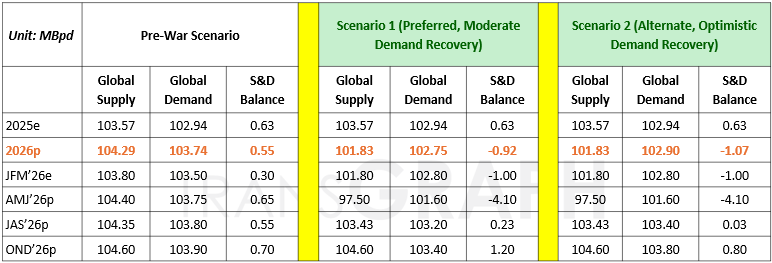
- Scenario 1 (Preferred): Ceasefire talks continue to progress positively, with tanker flows through the Strait of Hormuz gradually normalizing over the next 4–5 weeks. Supply recovers steadily, while demand improves at a slower pace and remains below pre-war expectations, resulting in a moderate market surplus.
- Scenario 2 (Alternate): The Strait of Hormuz normalizes over the next 4–5 weeks, supporting a gradual recovery in oil exports and supply. Demand rebounds more strongly than in Scenario 1, reducing the market surplus, although overall consumption remains below pre-war levels.
Geopolitical backdrop:

US-Iran Escalation Raises Risks to Hormuz Shipping and Gulf Energy Infrastructure: US-Iran tensions remain elevated, with Iran threatening further retaliation against U.S. military action and warning that Gulf energy infrastructure could be targeted. Tehran is also preparing to establish a restricted maritime zone around the Strait of Hormuz, increasing the risk of prolonged disruption to regional shipping. Shipping activity through the Strait of Hormuz has fallen sharply. Only 7 commodity vessels crossed the strait on Monday, down from 8 on Sunday, while traffic averaged around 10 vessels per day over the past 10 days, the lowest level since May. Qatar has warned that prolonged disruption could lead to an “industrial catastrophe.” The disruption continues to support energy prices, with Brent trading around USD 97/bbl.
Steel:
- Steel supply chains remain largely insulated from the Middle East conflict.
- Moreover, HRC prices are up by 8% on a monthly basis due to raw material price surge.
Base metals:
- LME 3M copper are down 3.4% on a weekly basis supported by stronger dollar and market moving back into contango structure. Copper prices fell sharply after the White House delayed a decision on tariffs on refined copper and copper concentrate, as policymakers weigh the benefits of supporting U.S. domestic mining against the risk of higher copper prices increasing manufacturing costs and hurting affordability ahead of the November midterm elections.
- Aluminum prices are broadly stable on a weekly basis due to support from renewed tensions in West Asia offsetting pressure from rate hike expectations.
Precious metals:
- Stronger U.S. yields and weak industrial offtake are suppressing any upside momentum.
- Stronger US Dollar and geopolitical tensions are weighing on precious metal prices.
LPG Market Update
- For August 2026, Saudi Aramco Contract Prices (CPs) rebounded to USD 620/ton for propane and USD 640/ton for butane, compared with USD 580/ton and USD 600/ton, respectively, in July. This represents a 6.9% month-on-month increase in propane CPs and a 6.7% month-on-month increase in butane CPs.
- Sonatrach raised its August propane OSP by 4.2% m-o-m, from $518/ton to $540/ton, while the butane OSP was cut by 5.0%, from $600/ton to $570/ton.
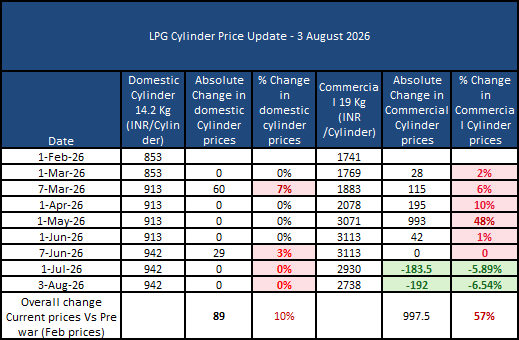
- India’s commercial LPG prices eased further in August, with the 19 kg cylinder price in New Delhi declining by ₹192, from ₹2,930 in July to ₹2,738 as of 3 August 2026. Despite the recent correction, commercial LPG remains substantially above its pre-war level of ₹1,741/cylinder. In contrast, the 14.2 kg domestic LPG cylinder remained unchanged at ₹942, reflecting continued price stability for household consumers.