
- The UN International Maritime Organization (IMO) paused its operation to escort ships through the Strait of Hormuz on Thursday after a vessel reported an attack, reigniting concerns about whether a preliminary deal to end the Iran war will hold.
- Iran's Revolutionary Guards said safe passage through the strait would only be possible through routes designated by Iran, adding that it would take action against vessels that failed to comply.
- Market grapevine indicates that storage tanks across the Gulf are around 50% to 60% full, so if tanker traffic through the strait does not pick up in the near term, producers will need to throttle back output, and the full recovery moves into next year.
- Saudi Aramco resumed oil loading at its Ras Tanura terminal on 26th Jun'26 after a near four-month halt, signaling Middle Eastern producers' efforts to boost exports despite a ship attack in the Strait of Hormuz.
- The terminal, the world's largest oil port, saw two Very Large Crude Carriers controlled by Saudi's shipping arm Bahri loading crude, each capable of loading 2 mln bbl of oil.
- QatarEnergy has issued a tender to sell crude for July-to-August loading, likely its first since the US-Iran conflict began, according to trade sources. The producer is offering its al-Shaheen, Marine Qatar and Marine Land crude, with buyers able to load or lift via ship-to-ship transfer between Fujairah and Sohar.
- China's state-owned refiners, including PetroChina and Sinopec, are considering resuming Iranian oil purchases, but their interest is tempered by competing alternative supplies and falling domestic fuel demand.
- The US Energy Department announced that energy firm Vitol took a loan of 0.50 mln bbl of crude oil from the Strategic Petroleum Reserve, representing about 1.25% of the quantities available in the latest allotment.
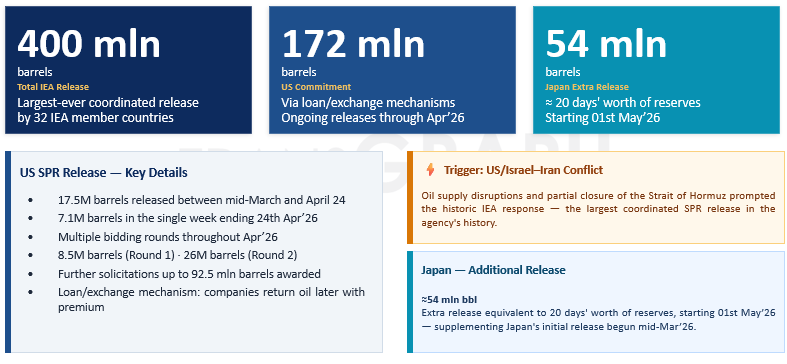
- The Trump administration agreed to release 172 mln bbl from the SPR in a coordinated effort with the International Energy Agency to control fuel prices. Companies borrowing the oil are required to return the original volumes with premiums of up to 24% in the form of extra oil, helping stabilize markets at no cost to US taxpayers.
- Oil tanker operators are earning record profits as they nearly double the hire cost of vessels going through the Strait of Hormuz and wider Gulf region due to rising demand and a shortage of available vessels.
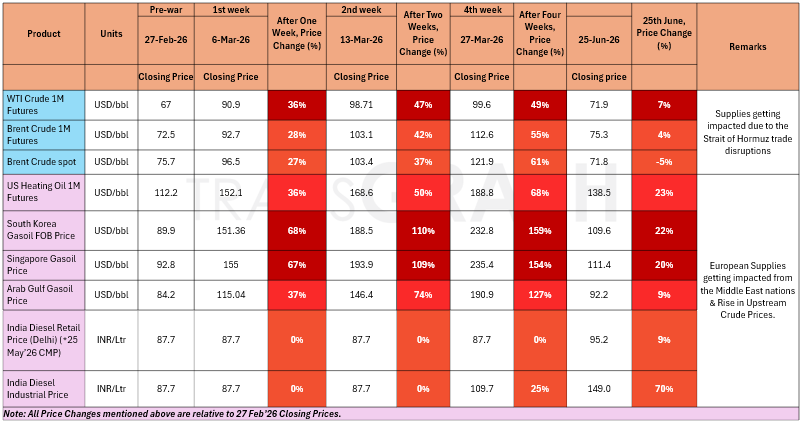
War Impact on Crude Oil & Gasoil/Diesel Prices
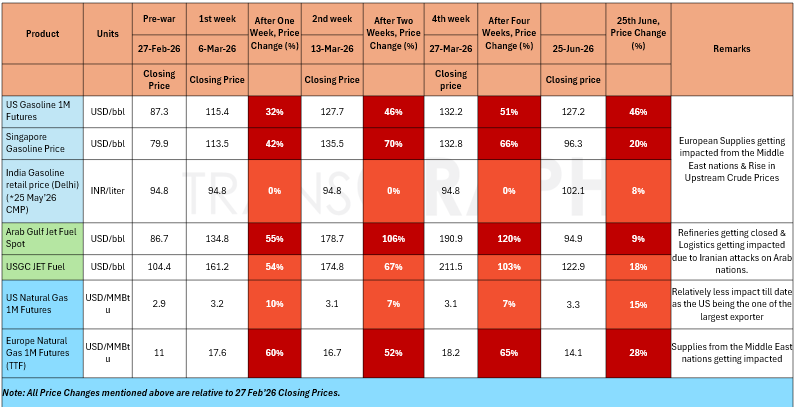
War Impact on Gasoline, ATF & Natural Gas Prices
GCC Bypass Pipelines Running Near Capacity — But Shah Gas Field Ablaze and Fujairah Zone Struck
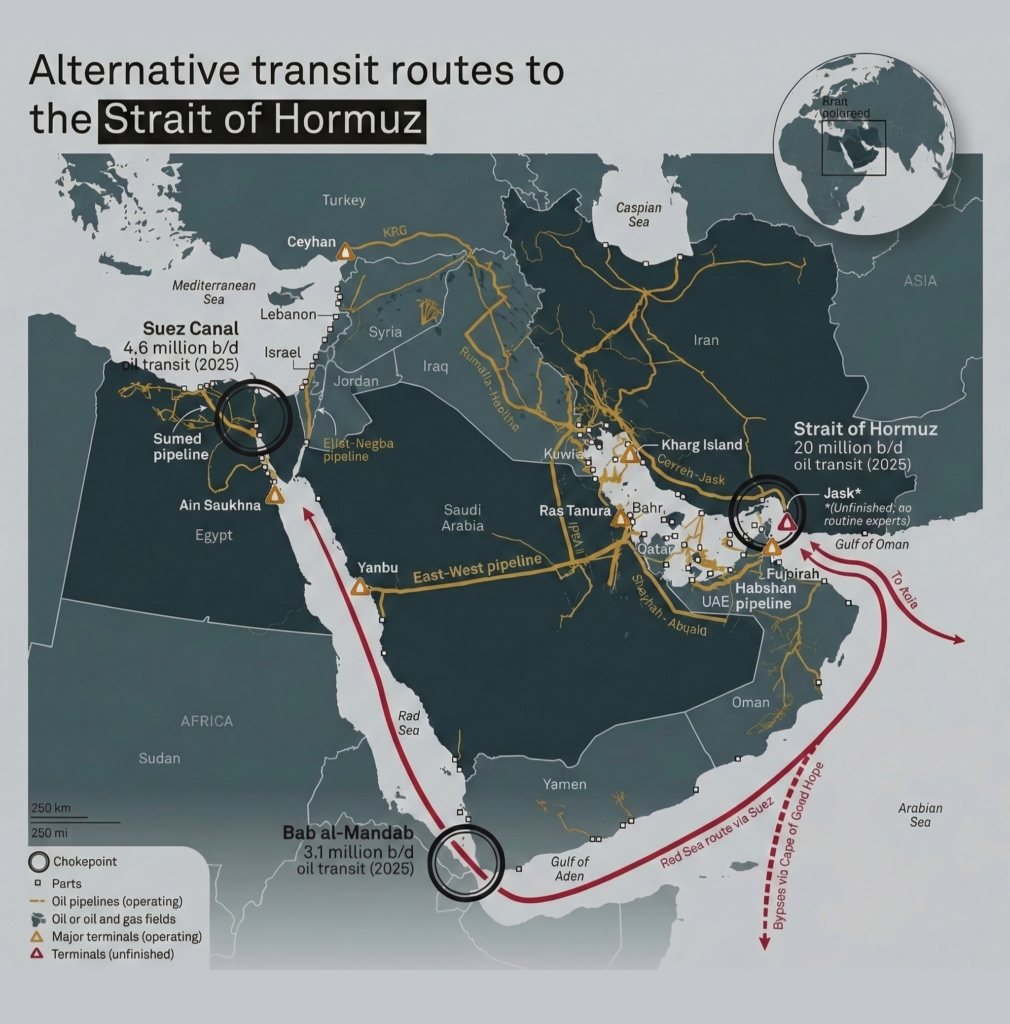
- Saudi Arabia's East-West pipeline is pumping oil at its full capacity of 7 MBpd, bypassing the Strait of Hormuz. Crude oil exports from Yanbu port have reached 5 MBpd, and the country is also exporting 0.70 to 0.90 MBpd of oil products.
- Of approximately 15 MBpd of crude transiting the Strait of Hormuz in OND'25, combined SPR releases and bypass pipeline capacity can offset roughly two-thirds — or slightly more — for the next 20 to 30 days, providing the Trump administration a window to assess strategic direction.
- New strikes directly threaten this buffer — Iranian drones struck the UAE's Shah gas field (currently ablaze) and the Fujairah Oil Industry Zone on Mar 17. A tanker was also hit near the Strait of Hormuz. Saudi Arabia intercepted over a dozen drones; Kuwait and Bahrain sustained additional attacks. These represent the first direct strikes on GCC energy export infrastructure since the conflict began.
Supply & Demand Analysis
War Scenarios Point to Global Supply Deficit of 1.35–1.90 MBpd in 2026 and AMJ Quarter Most Severe with a deficit of 3.00 - 4.50 MBpd.
Pre-war, global supply and demand were near-balanced with a modest surplus of +0.55 MBpd projected for 2026. Both conflict scenarios introduce significant supply deficits driven by Strait of Hormuz disruptions and impacts on Iraq and Kuwait crude production.
- Scenario 1 (Preferred): Ceasefire talks to remain on a progressive note and flows through the Strait of Hormuz improving over the coming weeks; however crude oil production losses will be there due to further non-availability of storage on on-shore in Iraq, Kuwait and other small Middle East nations.
- Scenario 2 (Alternate): No major deal being achieved from ceasefire talks and post completion of ceasefire talks, tensions continuing to remain in the Middle East and flows through the Strait of Hormuz continuing to remain restrained. Crude Oil Production Facilities & Refining Centers in the Middle East region getting affected and trade disruptions in Strait of Hormuz will be there for medium to long term (4 to 7 months).
Brent Crude 1M Futures are expected to trade in a range of 100 USD/bbl to 125 USD/bbl over the coming 1 to 2 weeks. The coordinated SPR release and GCC bypass capacity provide a meaningful supply cushion that limits sustained upside beyond these levels.
Metals & Energy Market Update – Geopolitical Context (Iran Conflict)
Geopolitical backdrop:

The United States and Iran concluded their first round of high-level talks in Switzerland, agreeing on a roadmap to reach a final deal within 60 days, while technical negotiations will continue this week. The discussions took place amid renewed tensions over Iran's closure of the Strait of Hormuz and U.S. warnings of potential military action. According to a joint statement released by Qatar and Pakistan, the parties also agreed to establish mechanisms aimed at ensuring safe commercial navigation through the Strait of Hormuz and advancing efforts to end hostilities in Lebanon. Iranian Foreign Minister Abbas Araqchi stated that the discussions resulted in waivers for certain Iranian oil and petrochemical exports, the release of a portion of the country's frozen assets, and the initiation of a reconstruction and development framework for Iran. Despite ongoing uncertainties, the diplomatic progress is likely to ease immediate concerns over global energy supply disruptions and geopolitical risks.
While the Fed has kept interest rates unchanged, updated projections indicated an increased likelihood of a rate hike later this year, with Chair Kevin Warsh reaffirming the central bank's commitment to containing inflation. Higher Treasury yields and firm U.S. economic data continue to support the dollar.
Steel:
- Domestic steel prices have moderated from recent highs.
- Steel supply chains remain largely insulated from the Middle East conflict.
- Since, the start of war steel HRC prices are up by 8.7%.
Base metals:
- Copper ended last week down by 0.5%, primarily due to FOMC outcome and expectations of rate cuts towards the end of the year.
- Aluminum rose by 7.7% since start of war linked to Gulf region supply disruptions. However, demand softness, possible peace deal, and macroeconomic sentiments are now driving price action.
Precious metals:
- Volatility has eased, but prices face upward pressure, due to improving market sentiment in peace talks.
- However, any esclation and halt in a resolution will pressure on Precious Metals.
- Stronger U.S. yields and weak industrial offtake—especially auto—are suppressing any upside momentum.
LPG Market Update
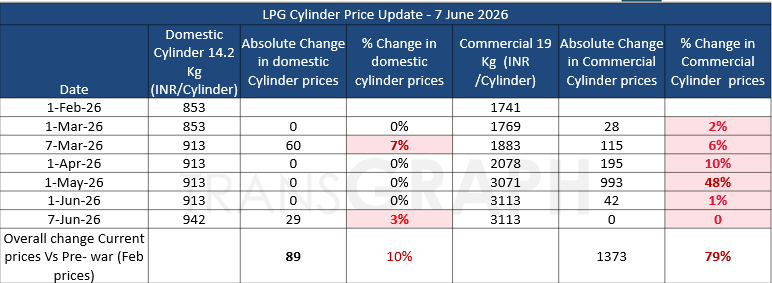
- India’s LPG market saw another upward revision on 1st June 2026 , with oil marketing companies increasing commercial cylinder prices. Commercial LPG prices were raised across major cities, with the 19 kg cylinder in Delhi increasing by Rs 42 to Rs 3,113.50. Similar hikes were reported nationwide, ranging from Rs 42 to Rs 53.50 per cylinder.
India’s domestic LPG market witnessed a price revision on 7 June 2026, with Oil Marketing Companies (OMCs) increasing the price of the 14.2 kg domestic LPG cylinder by ₹29 per cylinder across the country. - In addition to commercial cylinders, oil marketing companies also increased the price of 5 kg Free Trade LPG (FTL) cylinders by Rs 11. Following the revision, the retail price of a 5 kg FTL cylinder in Delhi now stands at Rs 821.50. FTL cylinders are sold outside the subsidized domestic LPG system and are commonly used by migrant workers, temporary households, street vendors, and consumers requiring smaller LPG packs.