
- The US crude oil output fell by 0.41 MBpd in Jan'26, the most in two years, due to a severe winter storm that disrupted production. Gasoline demand fell sharply during January's winter storms, while distillate fuel consumption surged as unusually low temperatures increased consumption for power generation and space heating.
- The US Gulf Coast refiners imported the most crude oil from Venezuela since Mar'25 in Jan'26, with imports rising to 6.2 MBpd from 3.8 MBpd in Dec'25.
- Market grapevine indicates that OPEC oil output plummeted in Mar'26 to its lowest level since Jun'20 due to the US/Israeli-Iran war, which effectively closed the Strait of Hormuz and forced export cuts.
- Crude output by OPEC members fell by 7.3 MBpd to 21.57 MBpd, led by cuts in Kuwait, Iraq, Saudi Arabia, and UAE.
- Ukrainian drones have targeted Russia's Baltic Sea port of Ust-Luga five times in the past 10 days, with industry sources telling Reuters that an oil loading terminal was hit.
- This follows a series of attacks on Russia's oil export infrastructure, with at least 40% of its export capacity halted due to drone strikes and other disruptions.
- Crude oil production resumed at Libya's Sharara and El Feel oilfields after completing maintenance on a crude export pipeline. The fields had been shut down due to pipeline damage and a suspension in operations.
- Sharara is one of Libya's largest production areas, with a capacity of between 0.30and 0.32 MBpd.
IEA member nations have agreed to a coordinated release of 400 mln bbl — the largest emergency SPR release since the IEA was founded after the 1973 Oil Crisis. The US, under the Trump administration, is contributing 172 mln bbl structured as loans to companies with repayment including a premium.
Deliveries are expected to begin reaching the market by the end of next week and will continue over approximately 120 days. The first batch of 86 mln bbl has already been opened for bidding. Japan will release 80 mln bbl beginning 16th Mar'26.
IEA Region-wise Release Breakdown — As of 15 Mar 2026
Key Supply Infrastructure
GCC Bypass Pipelines Running Near Capacity — But Shah Gas Field Ablaze and Fujairah Zone Struck
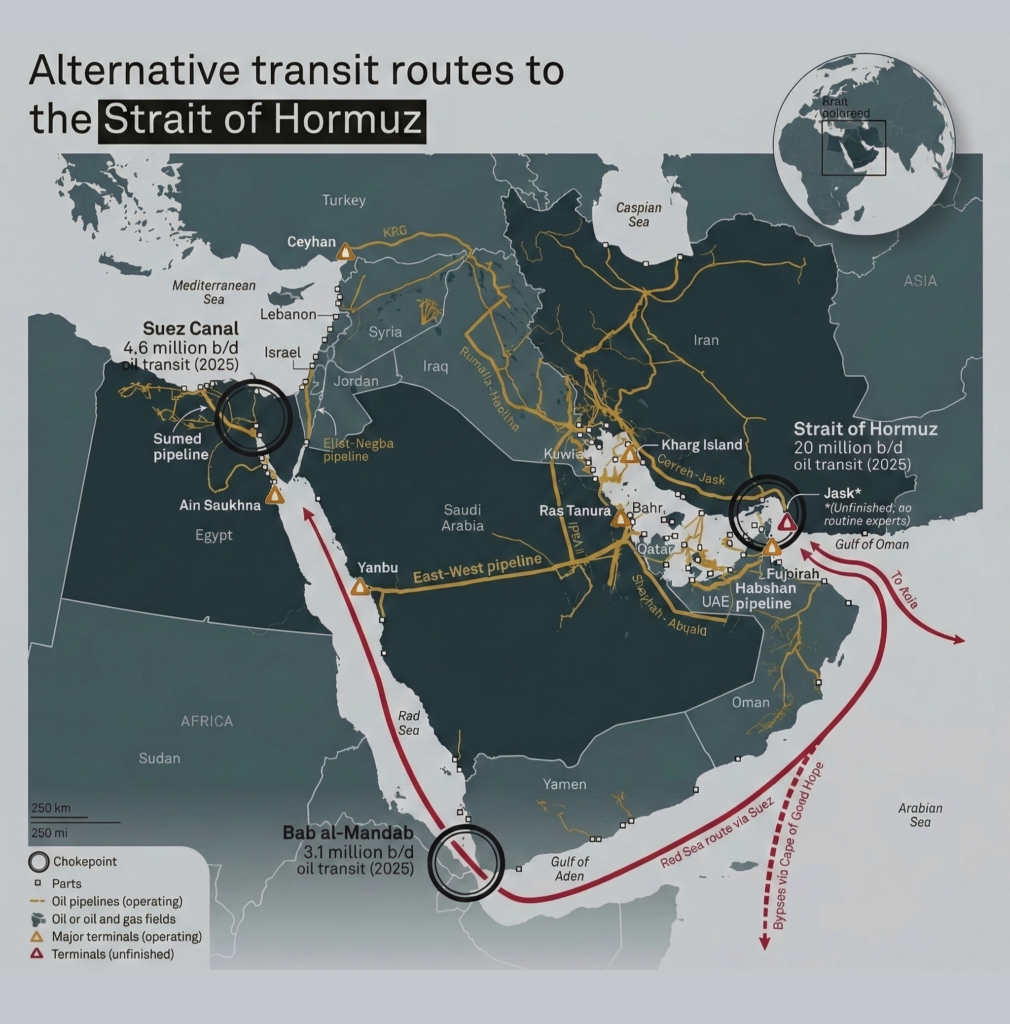
- Saudi Arabia's East-West pipeline is pumping oil at its full capacity of 7 MBpd, bypassing the Strait of Hormuz. Crude oil exports from Yanbu port have reached 5 MBpd, and the country is also exporting 0.70 to 0.90 MBpd of oil products.
- Of approximately 15 MBpd of crude transiting the Strait of Hormuz in OND'25, combined SPR releases and bypass pipeline capacity can offset roughly two-thirds — or slightly more — for the next 20 to 30 days, providing the Trump administration a window to assess strategic direction.
- New strikes directly threaten this buffer — Iranian drones struck the UAE's Shah gas field (currently ablaze) and the Fujairah Oil Industry Zone on Mar 17. A tanker was also hit near the Strait of Hormuz. Saudi Arabia intercepted over a dozen drones; Kuwait and Bahrain sustained additional attacks. These represent the first direct strikes on GCC energy export infrastructure since the conflict began.
War Scenarios Point to Global Supply Deficit of 1.35–1.90 MBpd in 2026; AMJ Quarter Most Severe
Pre-war, global supply and demand were near-balanced with a modest surplus of +0.55 MBpd projected for 2026. Both conflict scenarios introduce significant supply deficits driven by Strait of Hormuz disruptions and impacts on Iraq and Kuwait crude production.
- Scenario 1 (Preferred): Exchange of attacks between US/Israel and Iran continuing, leading to severe/significant/complete disruptions of crude oil and its products trade through the Strait of Hormuz, severely impacting Iraq's and Kuwait's crude oil production over the next 3 to 6 months. Full-year 2026 deficit: −1.90 MBpd. AMJ quarter most acute at −4.50 MBpd.
- Scenario 2 (Alternate): Partial disruptions of crude oil trade through the Strait of Hormuz, with Iran not targeting ships and oil tankers moving toward China, India, and select Asian nations outside the Western alliance. Full-year 2026 deficit: −1.35 MBpd. Balance returns to flat by OND '26.
- The US Dollar Index edged higher in yesterday's session, rising from 100.15 to 100.50 level, trading near a 10-month high. The index recorded a daily gain of 0.36% and advanced 1.58% on a weekly basis.
- The upward move was primarily supported by safe-haven demand amid escalating geopolitical tensions in the Middle East, particularly the ongoing Iran–Israel conflict, which weighed on global risk sentiment and drove capital flows toward the dollar.
- On the US front, US weekly jobless claims show a stable labor market with limited layoffs, despite macro risks from Middle East tensions and trade uncertainty. Initial claims rose modestly by 5K to 210K, in line with expectations, while continuing claims fell 32K to 1.819M, the lowest in nearly two years, indicating steady absorption of unemployed workers.
- The labor market remains in a “low-hire, low-fire” phase, though rising oil prices, tariff uncertainty, and tightening labor supply are starting to weigh on job growth, keeping the Fed cautious and supportive of a wait-and-watch approach amid inflation risks.
Brent Expected to Trade 90–120 USD/bbl
Brent Crude 1M Futures are expected to trade in a range of 90 USD/bbl to 120 USD/bbl over the coming 1 to 2 weeks. The coordinated SPR release and GCC bypass capacity provide a meaningful supply cushion that limits sustained upside beyond these levels.
LPG Market Update
India’s LPG import slump in March'26 signals Gulf disruption impact, triggers strategic shift toward US supply
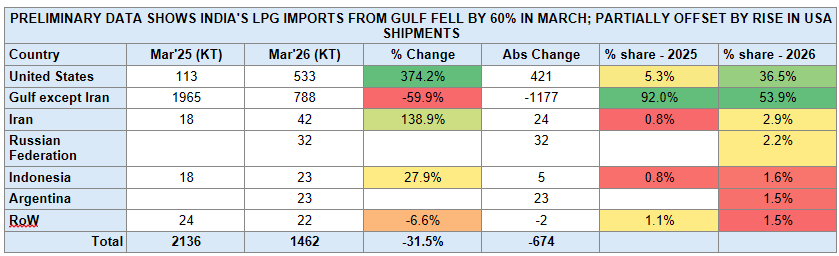
- India’s LPG import profile shifted sharply in March, with total volumes declining 31.5% MoM to 1,462 KT (down 674 KT), driven by a steep 59.9% drop in Gulf supplies (ex-Iran) to 788 KT (-1,177 KT), reducing their share from 92.0% to 53.9% amid disruptions around the Strait of Hormuz.
- This was partially offset by a surge in imports from the United States, which rose 374% MoM to 533 KT (+421 KT), lifting its share to 36.5%, alongside incremental volumes from Iran (42 KT, +139%), the Russian Federation (32 KT), Indonesia (23 KT, +27.9%), and Argentina (23 KT).
- Despite this rebalancing, the shift toward long-haul cargoes implies higher freight intensity and longer supply chains, reinforcing near-term tightness and upward pressure on delivered LPG costs.
India’s LPG balance under pressure as Hormuz disruptions persist, with vessel arrivals providing short-term supply relief
- India’s LPG supply–demand balance remains under near-term pressure amid geopolitical disruptions, with domestic demand estimated at 92.6–95.0 KT/day (~33 MMT annually), of which 55–60 KT/day (60–65%) is met through imports and ~35 KT/day from domestic production; notably, ~90% of imports transit through the Strait of Hormuz, creating significant exposure to ongoing disruptions.
- Recent vessel inflows have provided partial relief, with Hellas Gladiator (24 KT, Netherlands) and Gas Jupiter (24 KT, United States) having arrived on March 30 at Ennore Port and Visakhapatnam Port respectively, followed by BW TYR reaching Mumbai on March 31; BW ELM is expected to arrive at Mangaluru on April 1 after successfully transiting the Strait of Hormuz under Indian Navy escort as part of Operation Urja Suraksha.
- Earlier arrivals of Jag Vasant and Pine Gas (combined 92.6 KT; March 26–27) added roughly one day of national demand cover, along with the previously discharged Shivalik and Nanda Devi cargoes (92.5 KT; March 15–16) offering temporary relief despite persistent structural supply risks.