
- Iranian state media reported that seven oil tankers were damaged overnight on 22nd Oct’26, with four catching fire during oil transfers and three reportedly disabled by naval mines, raising concerns over tanker safety and crude shipments through the Strait of Hormuz and increasing the risk of further disruptions to global oil supplies.
- On 22nd Oct’26, Yemen’s Iran-aligned Houthi group claimed to have launched ballistic missiles and drones targeting Saudi Aramco’s oil facility in Yanbu, Abha International Airport, King Fahd International Airport in Dammam and the Saudi Defence Ministry headquarters in Riyadh.
- Amid escalating Houthi attacks on 22nd Oct’26, Saudi Aramco instructed employees to evacuate its Dhahran headquarters and work remotely, while Saudi air defences intercepted drones targeting key locations, including the Shaybah oilfield, raising concerns over the security of the country’s energy infrastructure.
- On 21st Oct’26, the Kuwait flagged oil product tanker MT Al Dasma, carrying 21 Indian seafarers, was struck by an unidentified projectile approximately 11 nautical miles west of Bukha, Oman, while transiting the Strait of Hormuz, triggering a fire that was subsequently extinguished.
- India’s crude oil imports increased 20% MoM to approximately 5.33 MBpd in Sep’26, as Middle Eastern supplies rebounded to 2.8 MBpd, the highest since Feb’26, accounting for 54% of total imports. Meanwhile, Russian crude imports declined 14% to around 1.8 MBpd amid stronger competition from China and improved price competitiveness of Middle Eastern grades, particularly Iraqi crude.
- On 21st Oct’26, Russian President Vladimir Putin agreed in principle to resume trilateral peace talks involving Russia, Ukraine and the US after 10th Nov’26, with discussions potentially taking place in Abu Dhabi to address a ceasefire and post war security arrangements.
- US commercial crude inventories fell by 3.06 mln bbl to approximately 412.5 mln bbl in the week ended 16th Oct 2026. Meanwhile, refinery crude inputs increased to around 16.6 MBpd, with refinery utilisation reaching 93.4%, indicating stronger refinery demand and providing support to crude consumption.
- Following the US decision to ease certain Russia related restrictions, India is expected to maintain Russian crude imports at approximately 1.8–1.9 MBpd in Oct’26, broadly in line with 1.82 MBpd in Sep’26. Meanwhile, China imported around 1.49 MBpd of Russian crude in Sep’26, highlighting continued demand from major Asian buyers.
- Russia scheduled its first diesel shipment of approximately 40,000 tons to the United States for 22nd Oct’26 under an agreement between Moscow and Washington. Deputy Prime Minister Alexander Novak said further shipments would follow as supplies permitted, with planned volumes of 0.3 mln tons initially, 0.5 mln tons in Nov’26 and 1 mln tons subsequently.
- Russia’s crude oil production increased by approximately 70,000 bpd to 8.43 MBpd in Sep’26, compared with 8.36 MBpd in Aug’26. However, output remained around 0.87 MBpd below the year-earlier level, reflecting continued pressure on the country’s oil industry.
- US President Donald Trump stated that Washington would not launch an attack on Iran before the 3rd Nov’26 midterm elections, citing ongoing productive discussions with Tehran aimed at resolving the conflict.
- Libya’s National Oil Corporation reported on 22nd Oct’26 that unauthorized individuals had closed an isolation valve on the Hamada–Zawiya crude pipeline, which transports crude from the Hamada and Al-Tahara oilfields. The corporation warned that a prolonged shutdown could force production stoppages and reduce crude availability in the near term.
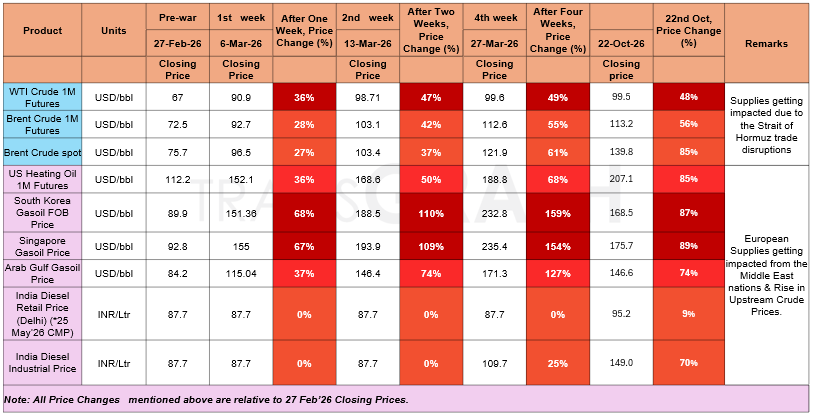
War Impact on Crude Oil & Gasoil/Diesel Prices
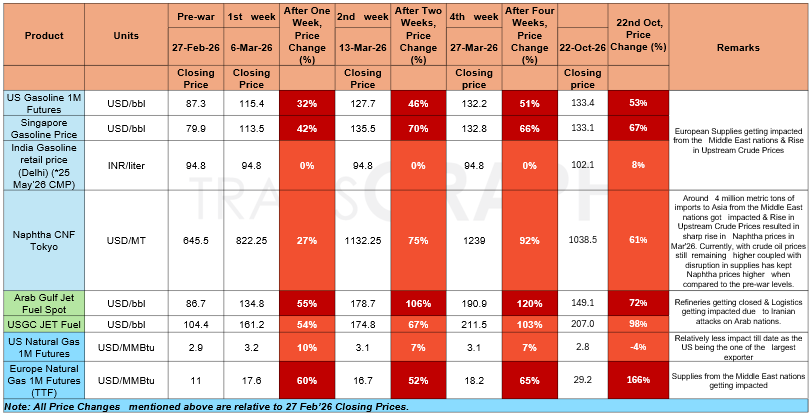
War Impact on Gasoline, ATF & Natural Gas Prices
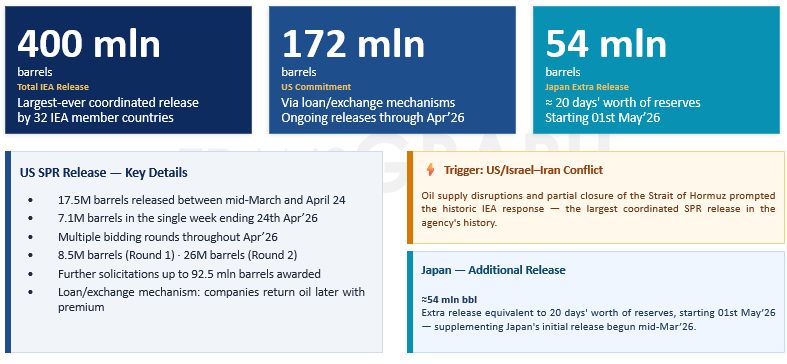
GCC Bypass Pipelines Running Near Capacity — But Shah Gas Field Ablaze and Fujairah Zone Struck
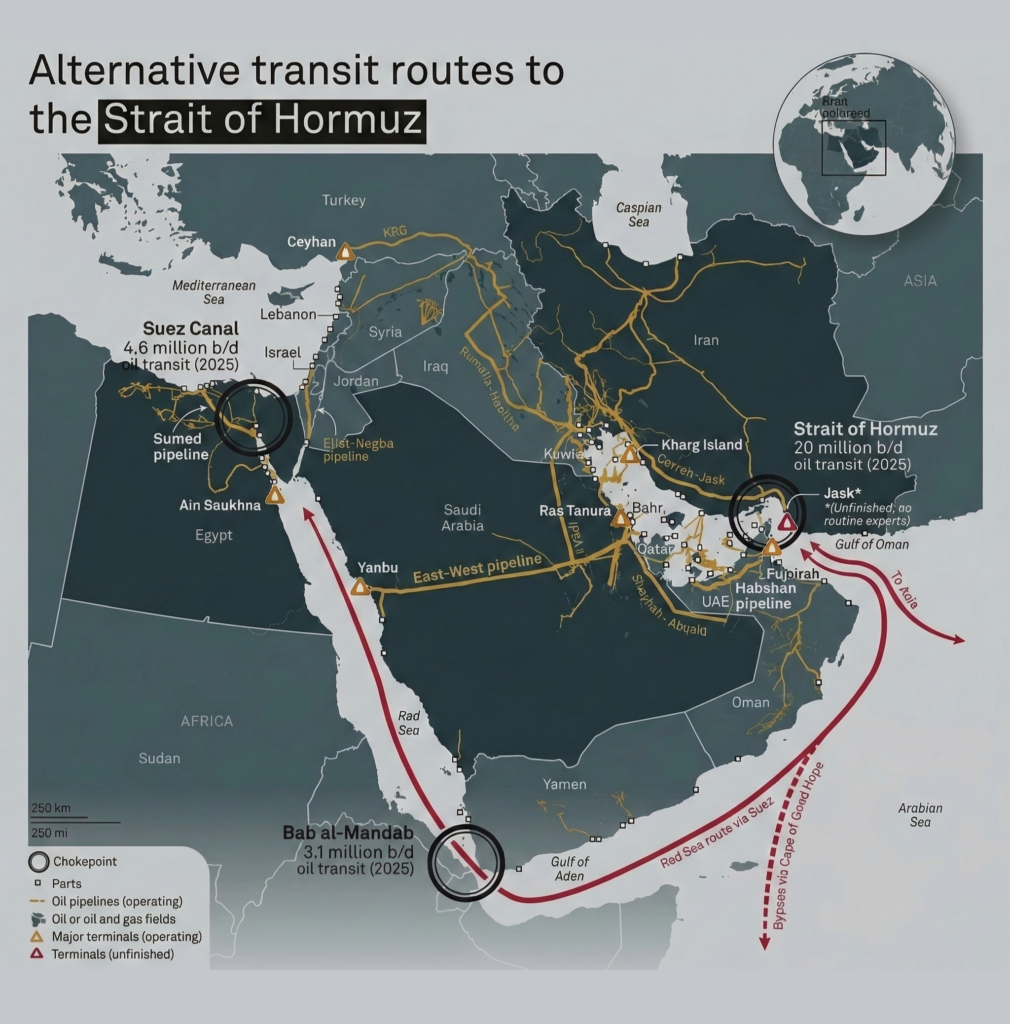
- Saudi Arabia's East-West pipeline is pumping oil at its full capacity of 7 MBpd, bypassing the Strait of Hormuz. Crude oil exports from Yanbu port have reached 5 MBpd, and the country is also exporting 0.70 to 0.90 MBpd of oil products.
- Of approximately 15 MBpd of crude transiting the Strait of Hormuz in OND'25, combined SPR releases and bypass pipeline capacity can offset roughly two-thirds — or slightly more — for the next 20 to 30 days, providing the Trump administration a window to assess strategic direction.
- New strikes directly threaten this buffer — Iranian drones struck the UAE's Shah gas field (currently ablaze) and the Fujairah Oil Industry Zone on Mar 17. A tanker was also hit near the Strait of Hormuz. Saudi Arabia intercepted over a dozen drones; Kuwait and Bahrain sustained additional attacks. These represent the first direct strikes on GCC energy export infrastructure since the conflict began.
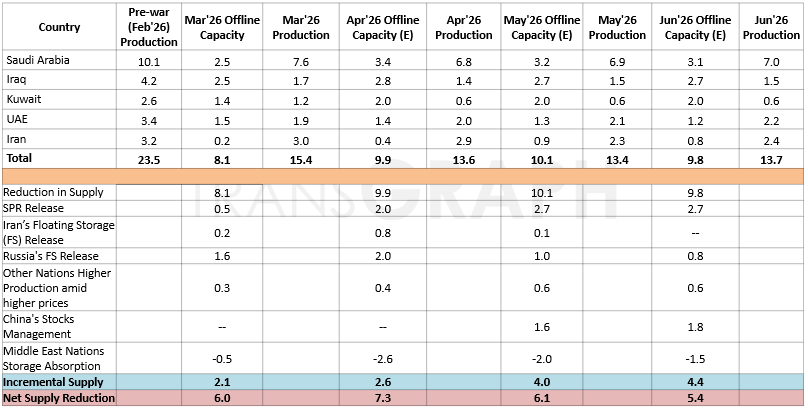
War Scenarios Point to Global Supply Deficit of 0.92–1.07 MBpd in 2026 and AMJ Quarter Most Severe with a deficit of 4.10 MBpd.
Pre-war, global supply and demand were near-balanced with a modest surplus of +0.55 MBpd projected for 2026. Both conflict scenarios introduce significant supply deficits driven by Strait of Hormuz disruptions and impacts on Iraq and Kuwait crude production.
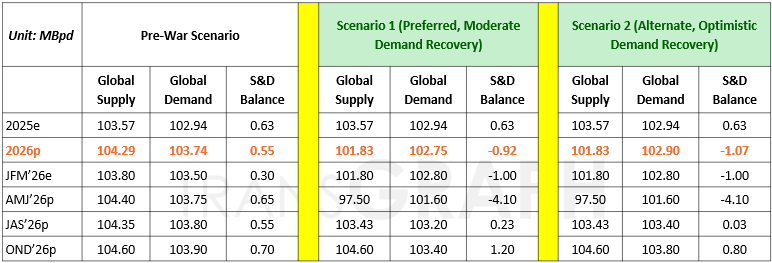
- Scenario 1 (Preferred): Ceasefire talks continue to progress positively, with tanker flows through the Strait of Hormuz gradually normalizing over the next 4–5 weeks. Supply recovers steadily, while demand improves at a slower pace and remains below pre-war expectations, resulting in a moderate market surplus.
- Scenario 2 (Alternate): The Strait of Hormuz normalizes over the next 4–5 weeks, supporting a gradual recovery in oil exports and supply. Demand rebounds more strongly than in Scenario 1, reducing the market surplus, although overall consumption remains below pre-war levels.
Geopolitical backdrop:

War Front: Hormuz Shipping Attacks Intensify as U.S.-Iran Peace Talks Stall
U.S.–Iran tensions escalated further on as Tehran threatened to target oil facilities, undersea cables, data centres and AI infrastructure across Gulf countries if the U.S. and Israel resume military strikes. Iran’s Revolutionary Guard also claimed that seven vessels had been struck in or around the Strait of Hormuz. Meanwhile, the U.S. ordered some diplomats and their families to leave Saudi Arabia amid intensifying Houthi attacks on Saudi airports and energy infrastructure. Reports suggest President Trump is considering fresh strikes on Iran, while the US is reinforcing its military presence in the region with the deployment of a second aircraft carrier. These developments have heightened concerns over a wider regional conflict, while diplomatic efforts to reach an agreement with Tehran remain stalled.
Steel:
- Steel supply chains remain largely insulated from the Middle East conflict.
- Moreover, HRC prices are up by 0.1% on a monthly basis as support from raw material price surge was capped by weaker trading activity during festive season.
Base metals:
- LME 3M copper are down by 2.2% on a weekly basis as higher CPI reading, resolving supply issues, geopolitical tensions, narrowing COMEX arbitrage, and inventory buildup in SHFE warehouses capped support from reduced rate hike expectations, high China premium, supply disruptions, and backwardation structure.
- Aluminum prices are down 6.4% on a weekly basis due to recovery in GCC production despite renewed tensions in the middle east.
Precious metals:
- Stronger U.S. yields and weak industrial offtake are suppressing any upside momentum.
- Stronger US Dollar and geopolitical tensions are weighing on precious metal prices.
LPG Market Update
- For October, Saudi Aramco CP was set at USD 680/ton for propane and USD 730/ton for butane, representing increases of USD 55/ton and USD 70/ton, respectively, from September levels. The propane-butane spread widened further to USD 50/ton, compared with USD 35/ton in September and USD 20/ton in August, indicating continued relative strength in butane pricing and tighter butane availability compared with propane. The larger month-on-month increase in butane also points to a stronger rise in butane market tightness entering October.
- Sonatrach increased its October propane OSP by USD 110/ton, from USD 560/ton in September to USD 670/ton. Meanwhile, the butane OSP increased by USD 140/ton, from USD 610/ton to USD 750/ton.
- US LPG prices strengthened across the board between 1 October and 8 October 2026, with propane rising by 8.6% to USD 466/ton from USD 429/ton. Butane increased by 7.6% to USD 738/ton from USD 686/ton, while the 50:50 LPG blend climbed by 8.0% to USD 601.77/ton from USD 557.28/ton. Notably, the Mont Belvieu 50:50 LPG blend crossed the USD 600/ton threshold for the first time since 2022, underscoring the strength of the current price rally. The simultaneous increase in propane and butane indicates broad-based upward pressure across the US LPG market rather than a rally driven by a single component.