
- Shipping through the Strait of Hormuz nearly ground to a halt, with only 5 commodity vessels transiting on 15th Aug'26 and none on 16th Aug'26, down from 31 the previous weekend and far below the 130+ vessels per day seen before the war, while Bab el-Mandeb traffic fell to 49 vessels from 55 and recorded no Saudi oil shipments.
- Saudi crude exports from the Red Sea are increasingly being shipped via "dark" voyages to evade Houthi attacks, with around 70% of west coast loadings operating without AIS tracking, Bab al-Mandeb vessel traffic falling to 32 ships/day from 50, and Sidi Kerir crude loadings reaching a record 2.17 Mbpd, up 50% WoW.
- Iran reportedly attacked an ADNOC vessel in the Strait of Hormuz, marking the third incident involving ADNOC vessels in less than a week, with no injuries reported, further threatening a waterway that handled around one-fifth of global oil and LNG shipments before the conflict.
- The IEA now expects global oil supply to decline by 4.3 MBpd in 2026 to 102.02 MBpd, creating a 1.27 MBpd supply deficit, as renewed Middle East disruptions and the Strait of Hormuz shutdown continue to constrain global flows.
- The agency also projects a 1.8 MBpd market deficit during Jul'26 – Sep'26, while lowering its 2026 oil demand outlook to a 1.6 MBpd contraction, with global refinery throughput falling 5 MBpd YoY in Jul'26.
- India has cut windfall taxes on fuel exports, reducing the diesel levy to ₹24/litre from ₹25.5, petrol duty to zero from ₹3.5, and aviation turbine fuel duty to ₹19.5/litre from ₹22, effective from 15th Aug'26.
- At least four Asian refiners bought US crude for later delivery as the Strait of Hormuz remained effectively closed, with South Korea's GS Caltex purchasing 2 mln bbl of Mars crude, Japan's Eneos buying 2 mln bbl of WTI, and Taiwan's CPC securing 2 mln bbl of WTI, while Asian US crude imports had already reached a record 2.35 MBpd in Jul'26.
- Russia suspended crude exports from the Sheskharis terminal at Novorossiysk following a drone attack, disrupting a facility handling around 0.70 MBpd, after crude loadings from the port averaged nearly 1.0 MBpd in Jul'26 and 0.80 MBpd in Jun'26.
- A drone attack damaged Novatek’s Ust-Luga gas condensate processing complex in Russia, which has three units with a combined capacity of 9.00 mln ton/year and produces significant volumes of light and heavy naphtha, while processing 3.80 mln ton of gas condensate in H1 2026. However, crude oil exports of around 0.70 MBpd from the terminal remained unaffected.
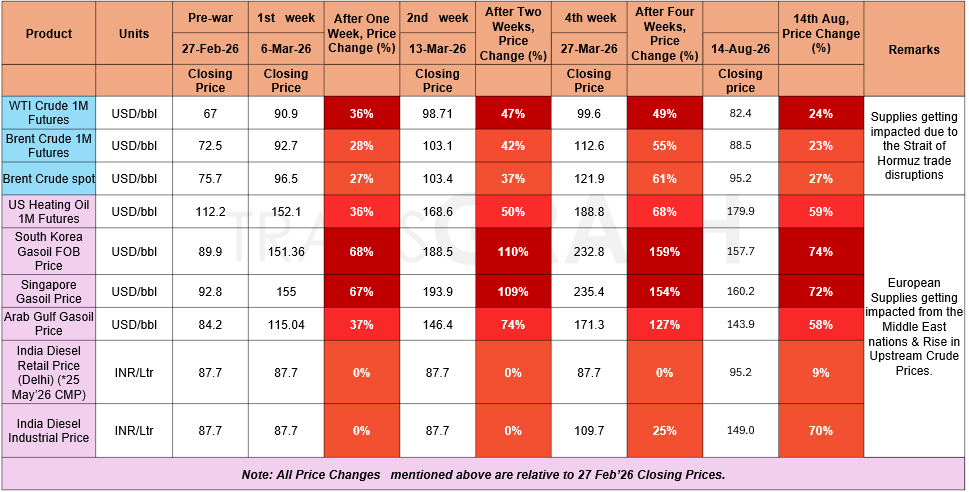
War Impact on Crude Oil & Gasoil/Diesel Prices
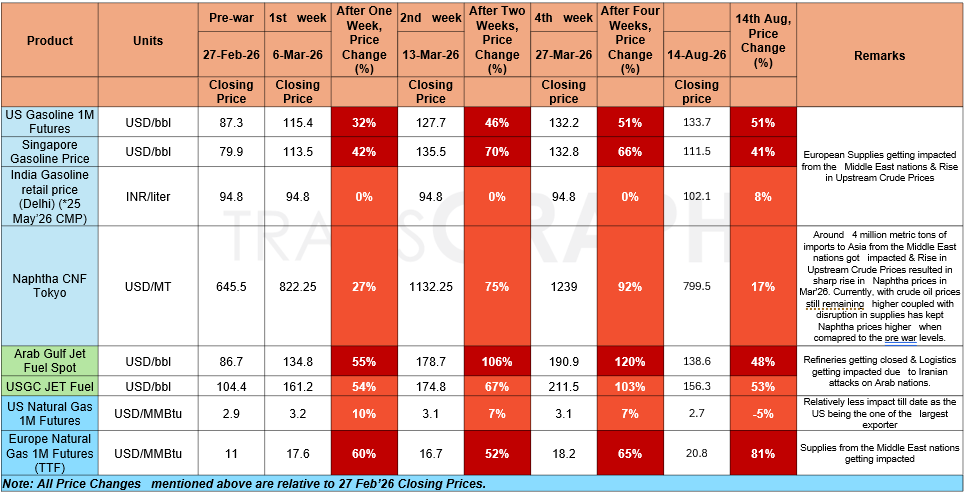
War Impact on Gasoline, ATF & Natural Gas Prices
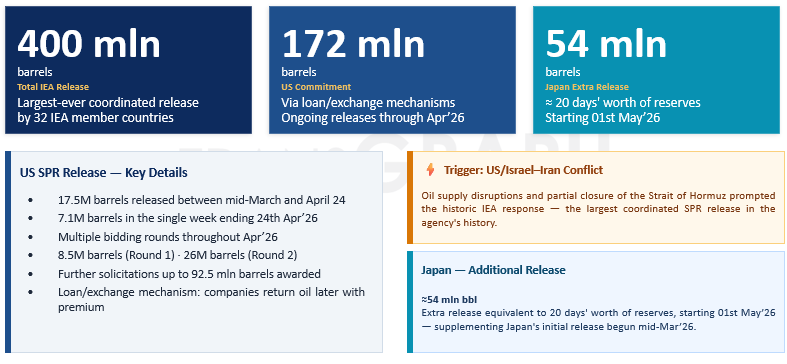
GCC Bypass Pipelines Running Near Capacity — But Shah Gas Field Ablaze and Fujairah Zone Struck
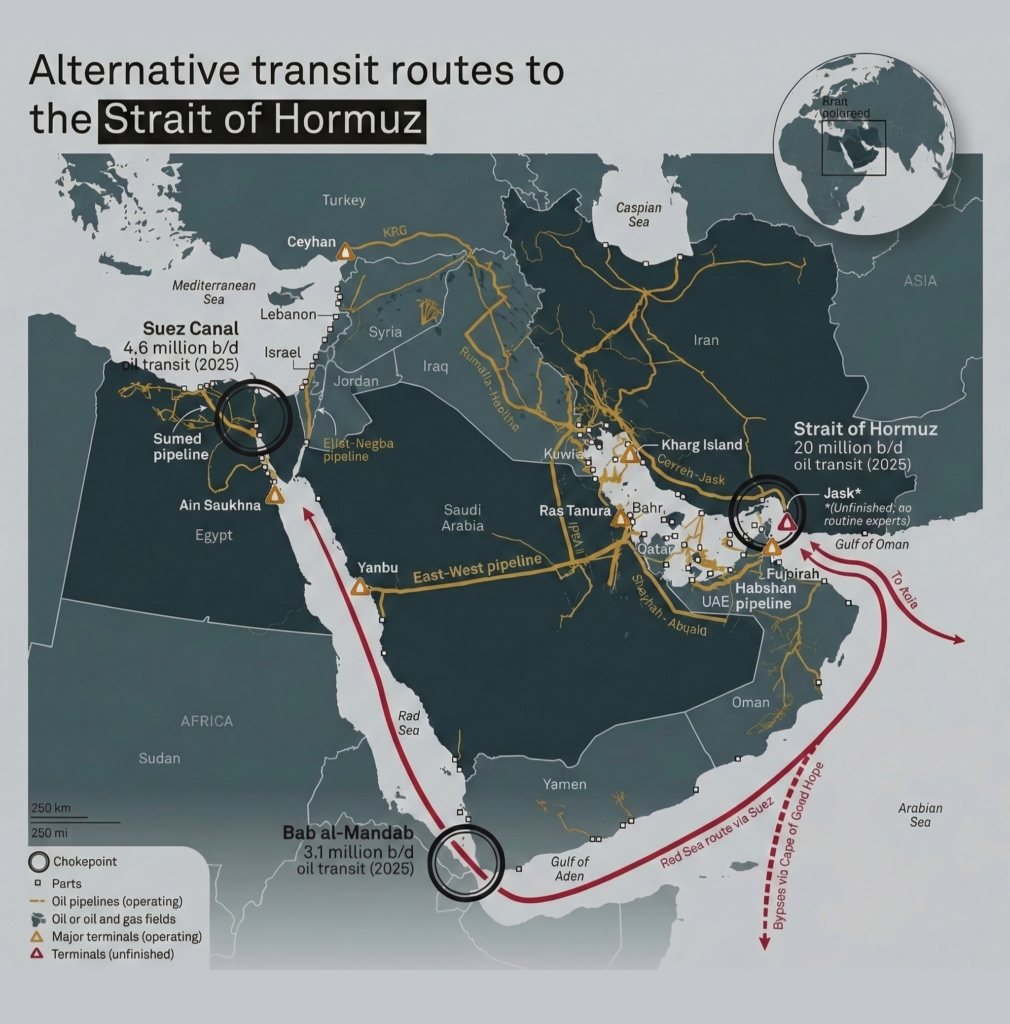
- Saudi Arabia's East-West pipeline is pumping oil at its full capacity of 7 MBpd, bypassing the Strait of Hormuz. Crude oil exports from Yanbu port have reached 5 MBpd, and the country is also exporting 0.70 to 0.90 MBpd of oil products.
- Of approximately 15 MBpd of crude transiting the Strait of Hormuz in OND'25, combined SPR releases and bypass pipeline capacity can offset roughly two-thirds — or slightly more — for the next 20 to 30 days, providing the Trump administration a window to assess strategic direction.
- New strikes directly threaten this buffer — Iranian drones struck the UAE's Shah gas field (currently ablaze) and the Fujairah Oil Industry Zone on Mar 17. A tanker was also hit near the Strait of Hormuz. Saudi Arabia intercepted over a dozen drones; Kuwait and Bahrain sustained additional attacks. These represent the first direct strikes on GCC energy export infrastructure since the conflict began.
War Scenarios Point to Global Supply Deficit of 0.92–1.07 MBpd in 2026 and AMJ Quarter Most Severe with a deficit of 4.10 MBpd.
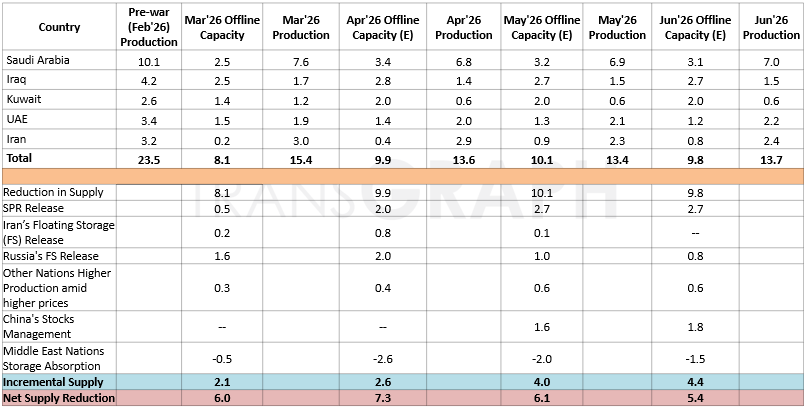
Pre-war, global supply and demand were near-balanced with a modest surplus of +0.55 MBpd projected for 2026. Both conflict scenarios introduce significant supply deficits driven by Strait of Hormuz disruptions and impacts on Iraq and Kuwait crude production.
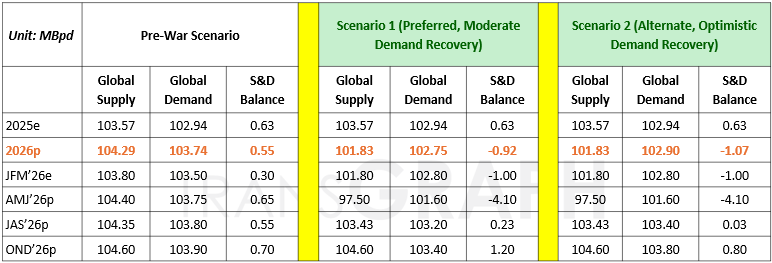
- Scenario 1 (Preferred): Ceasefire talks continue to progress positively, with tanker flows through the Strait of Hormuz gradually normalizing over the next 4–5 weeks. Supply recovers steadily, while demand improves at a slower pace and remains below pre-war expectations, resulting in a moderate market surplus.
- Scenario 2 (Alternate): The Strait of Hormuz normalizes over the next 4–5 weeks, supporting a gradual recovery in oil exports and supply. Demand rebounds more strongly than in Scenario 1, reducing the market surplus, although overall consumption remains below pre-war levels.
Geopolitical backdrop:

U.S-Iran tensions escalated as President Donald Trump reiterated that the U.S has “total control” over the Strait of Hormuz, However, Iran’s top security official said the waterway would remain closed unless Washington accepted Tehran’s conditions leading to U.S forces disabling a Panama-flagged cargo ship bound for an Iranian port. President Trump rejected Iran’s demands for sanctions relief and compensation, instead calling for Tehran to compensate those affected by wars, attacks and protests. The renewed standoff has complicated efforts to reopen the Strait of Hormuz, while attacks on regional energy infrastructure and shipping have kept concerns over oil supply disruptions elevated.
The proposed discussions aim to address the reopening of the Strait of Hormuz and Iran's nuclear program. The Strait, through which nearly 20% of global oil and LNG shipments pass, has remained largely disrupted during the conflict, contributing to elevated energy prices and broader inflationary pressures. Consequently, while the upcoming U.S–Iran talks have improved near-term market sentiment, the absence of a defined timeline and the fragile security environment suggest that geopolitical risk premiums are likely to remain elevated until tangible progress is achieved.
Steel:
- Domestic steel prices have moderated from recent highs.
- Steel supply chains remain largely insulated from the Middle East conflict.
- Since, the start of war steel HRC prices are up by 7.6%.
Base metals:
- Copper prices are up 1.5% on a weekly basis, as weaker job data and softer CPI shifts Fed hike expectations lower, market remains in backwardation structure, and inflation pressures ease amid ceasefire. Prices receive continued support from CME-LME arbitrage, exchange inventory outflows, and persistent mine supply constraints which offset pressure from geopolitical uncertainty and elevated global inventories.
- Aluminum prices are up 2.4% on a weekly basis due to geopolitical tensions and inventory drawdown despite subdued demand.
Precious metals:
- Stronger U.S. yields and weak industrial offtake are suppressing any upside momentum.
- Stronger US Dollar and geopolitical tensions are weighing on precious metal prices.
LPG Market Update
- For August 2026, Saudi Aramco Contract Prices (CPs) rebounded to USD 620/ton for propane and USD 640/ton for butane, compared with USD 580/ton and USD 600/ton, respectively, in July. This represents a 6.9% month-on-month increase in propane CPs and a 6.7% month-on-month increase in butane CPs.
- Sonatrach raised its August propane OSP by 4.2% m-o-m, from $518/ton to $540/ton, while the butane OSP was cut by 5.0%, from $600/ton to $570/ton.
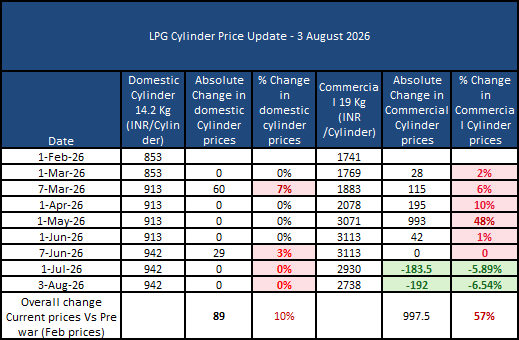
- India’s commercial LPG prices eased further in August, with the 19 kg cylinder price in New Delhi declining by ₹192, from ₹2,930 in July to ₹2,738 as of 3 August 2026. Despite the recent correction, commercial LPG remains substantially above its pre-war level of ₹1,741/cylinder. In contrast, the 14.2 kg domestic LPG cylinder remained unchanged at ₹942, reflecting continued price stability for household consumers.