
- The IEA has warned that the EU's methane emissions rules, set to take effect in 2027, could reduce the pool of legally importable crude by more than 50%, potentially increasing refining costs and weakening the bloc's energy security, prompting several member states to seek a delay in implementation.
- A bipartisan US Senate bill proposes tougher sanctions on Russia, including tariffs of up to 100% on major buyers of Russian oil and gas and sanctions on its shadow tanker fleet and key energy projects, while introducing exemptions for some countries and granting the President authority to waive the measures if deemed in the US national interest.
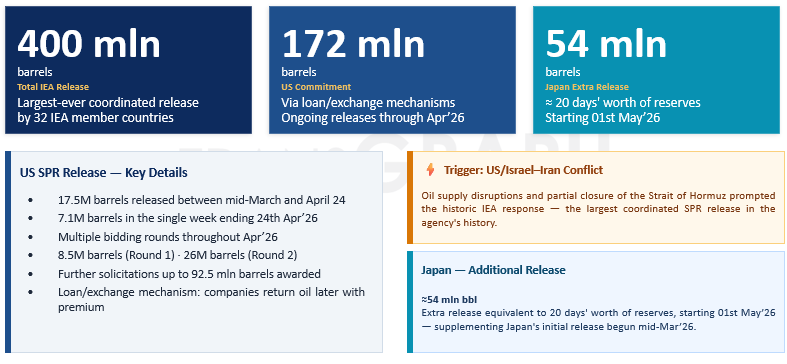
- The US Strategic Petroleum Reserve (SPR) crude oil stocks declined by 3.0 mln bbl last week to 316.5 mln bbl, the lowest since Apr'83, bringing total SPR draw downs since the onset of the US/Israel-Iran conflict to 98.9 mln bbl, while overall US crude inventories (commercial + SPR) fell to 730.8 mln bbl, the lowest level since 1984.
- Renewed US-Iran missile and drone exchanges have intensified tensions in the Gulf, with Iran targeting US facilities and reaffirming restrictions on the Strait of Hormuz, raising fresh concerns over regional energy security and global oil supplies.
- The escalating conflict has further undermined prospects for a lasting ceasefire, increasing geopolitical risk and supporting higher crude oil prices despite ongoing diplomatic efforts.
- China's crude oil imports fell 41.3% YoY to 7.12 MBpd in Jun'26 the lowest level since Oct'16 and were down a further 12% from May'26, with seaborne imports averaging around 6.0 MBpd, Middle East supplies at a 10-year low, and Iranian crude imports dropping 40% MoM to below 0.8 MBpd as refinery utilization declined to 57.72%.
- Weak domestic fuel demand and export restrictions on refined products kept refinery run rates near a 10-year low, while China's refined oil product exports stood at approximately 1.06 MBpd in Jun'26 and averaged about 0.95 MBpd during the first half of 2026, down 13.2% YoY.
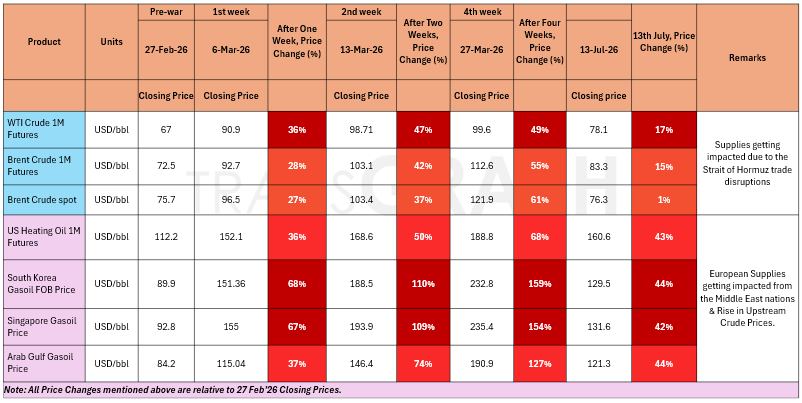
War Impact on Crude Oil & Gasoil/Diesel Prices
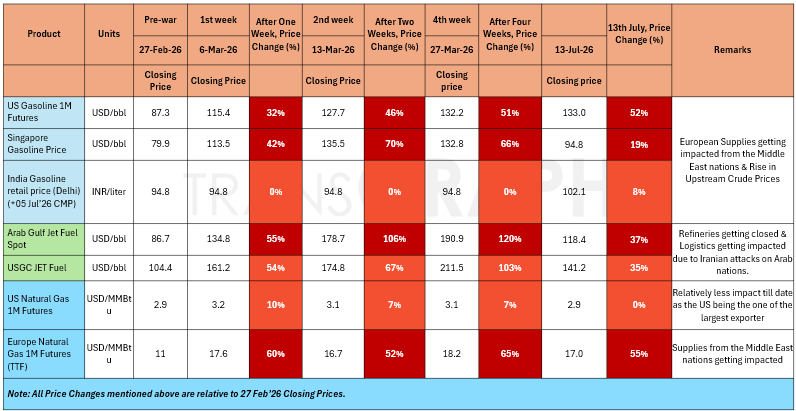
War Impact on Gasoline, ATF & Natural Gas Prices
GCC Bypass Pipelines Running Near Capacity — But Shah Gas Field Ablaze and Fujairah Zone Struck
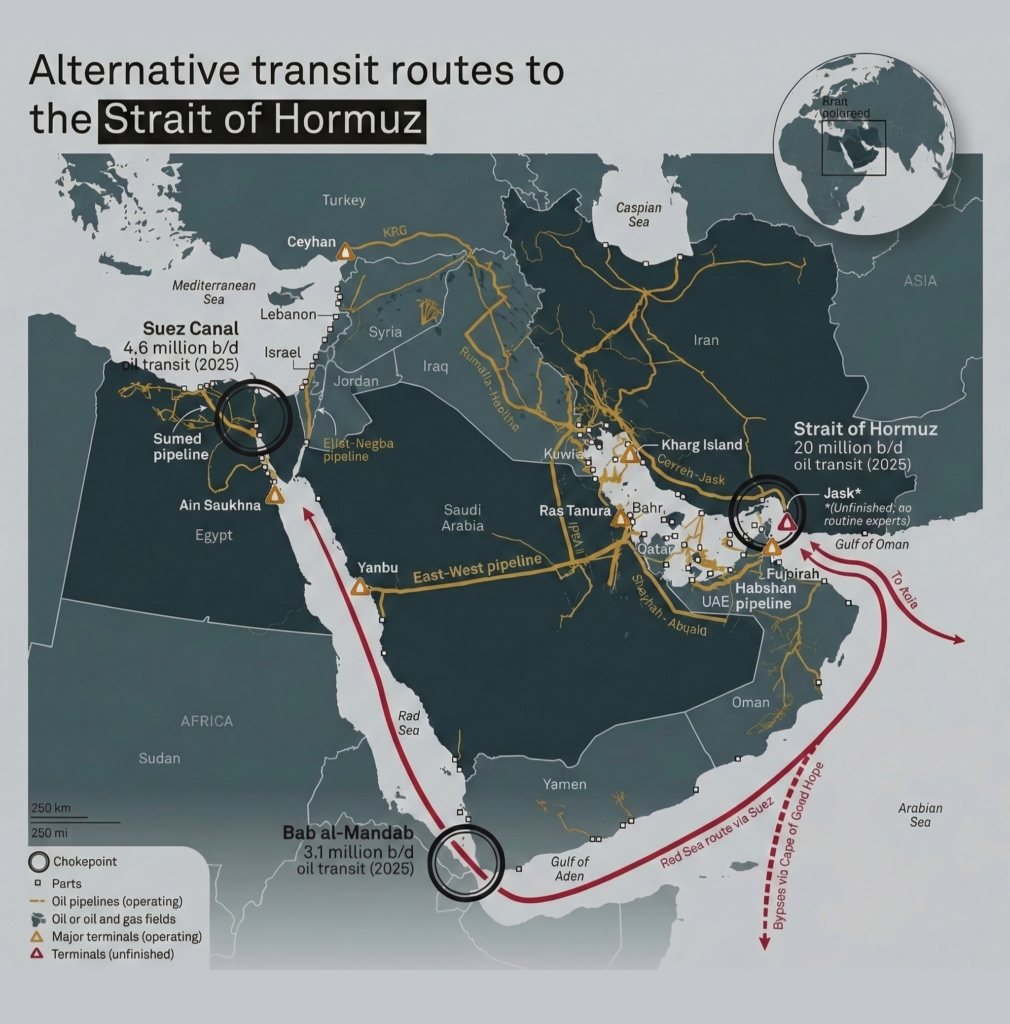
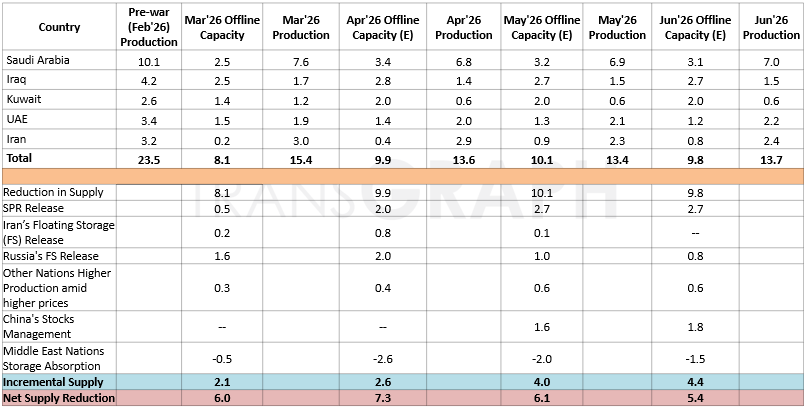
- Saudi Arabia's East-West pipeline is pumping oil at its full capacity of 7 MBpd, bypassing the Strait of Hormuz. Crude oil exports from Yanbu port have reached 5 MBpd, and the country is also exporting 0.70 to 0.90 MBpd of oil products.
- Of approximately 15 MBpd of crude transiting the Strait of Hormuz in OND'25, combined SPR releases and bypass pipeline capacity can offset roughly two-thirds — or slightly more — for the next 20 to 30 days, providing the Trump administration a window to assess strategic direction.
- New strikes directly threaten this buffer — Iranian drones struck the UAE's Shah gas field (currently ablaze) and the Fujairah Oil Industry Zone on Mar 17. A tanker was also hit near the Strait of Hormuz. Saudi Arabia intercepted over a dozen drones; Kuwait and Bahrain sustained additional attacks. These represent the first direct strikes on GCC energy export infrastructure since the conflict began.
War Scenarios Point to Global Supply Deficit of 0.92–1.07 MBpd in 2026 and AMJ Quarter Most Severe with a deficit of 4.10 MBpd.
Pre-war, global supply and demand were near-balanced with a modest surplus of +0.55 MBpd projected for 2026. Both conflict scenarios introduce significant supply deficits driven by Strait of Hormuz disruptions and impacts on Iraq and Kuwait crude production.
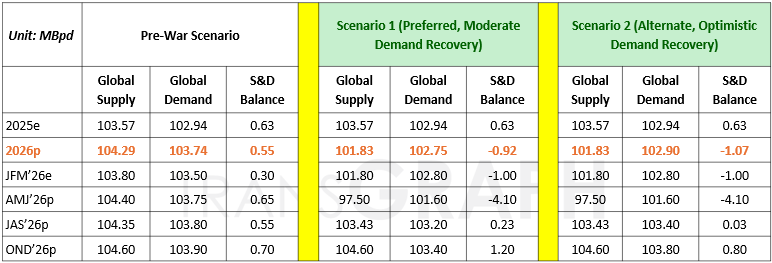
- Scenario 1 (Preferred): Ceasefire talks continue to progress positively, with tanker flows through the Strait of Hormuz gradually normalizing over the next 4–5 weeks. Supply recovers steadily, while demand improves at a slower pace and remains below pre-war expectations, resulting in a moderate market surplus.
- Scenario 2 (Alternate): The Strait of Hormuz normalizes over the next 4–5 weeks, supporting a gradual recovery in oil exports and supply. Demand rebounds more strongly than in Scenario 1, reducing the market surplus, although overall consumption remains below pre-war levels.
Geopolitical backdrop:

The conflict in the Middle East intensified further after Iran declared the June Memorandum of Understanding (MoU) with the United States effectively void. Tehran stated that the framework for de-escalation had collapsed, prompting a fresh round of military exchanges. In response, the United States launched another wave of strikes on Iranian military targets, while Iran retaliated by targeting US-linked military assets and commercial shipping in the Gulf. The conflict has now expanded beyond the US-Iran theatre. Yemen's Saudi-backed government carried out airstrikes on Sanaa International Airport, saying the strike was meant to prevent an Iranian aircraft from landing in violation of Yemeni sovereignty. The Houthis, who control Sanaa and are backed by Iran, blamed Saudi Arabia for the strikes and retaliated by launching missiles and drones at Saudi Arabia's Abha International Airport. No casualties were reported, but the attacks mark the first major escalation between the Houthis and Saudi Arabia since an informal truce took effect roughly four years ago, effectively ending that period of relative calm.
Meanwhile, Iran also intensified its operations around the Strait of Hormuz. The United States has reimposed a naval blockade on Iranian ports, raising concerns over disruptions to one of the world's most critical energy shipping routes. The renewed escalation has pushed Brent crude oil prices back to around USD 85 per barrel, as markets price in a higher geopolitical risk premium and the growing possibility of supply disruptions through the Strait of Hormuz, reinforcing expectations that interest rates could remain higher for longer.
Steel:
- Domestic steel prices have moderated from recent highs.
- Steel supply chains remain largely insulated from the Middle East conflict.
- Since, the start of war steel HRC prices are up by 8.1%.
Base metals:
- Copper prices are down by 1.3% on a monthly basis due to FOMC outcome, and expectations of rate hikes towards the end of the year.
- Renewed tensions and weaker US CPI release is supporting aluminum prices. Prices are up 1.7% on a weekly basis.
Precious metals:
- Stronger U.S. yields and weak industrial offtake, especially auto are suppressing any upside momentum.
- Stronger US Dollar due to anticipation of rate hike in US is weighing on precious metal prices.
LPG Market Update
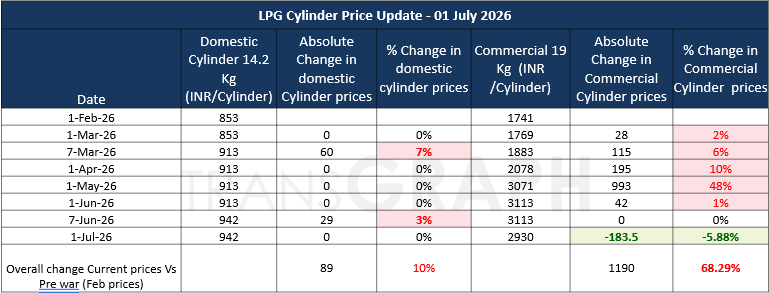
- As of 1 July 2026, India has reduced the price of the 19 kg commercial LPG cylinder by INR 183.5 per cylinder, lowering it from INR 3,113 to INR 2,930. The reduction reflects the recent easing in international LPG prices and freight rates following the de-escalation of geopolitical tensions in the Middle East, which has improved global supply conditions and reduced import costs.
- In response to the improving supply outlook, the Government has also begun rolling back several emergency measures implemented during the recent LPG supply disruption. Supplies of non-domestic packed LPG have been fully restored, while bulk LPG allocations to commercial and industrial consumers have been increased to 50% of pre-crisis consumption levels. These measures are expected to provide significant relief to LPG-dependent sectors, including manufacturing industries, hotels, restaurants, catering services, and other commercial establishments, while supporting a gradual normalization of the domestic LPG market.